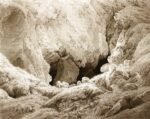
Albrýndaer hardly notices whenever the blockage is removed from the entrance to the alcove of stone. For he has ceased listening for it, ceased glancing over anxiously in its direction as if the looking would make time pass more quickly. Part of this is the natural consequence of the passage of time: for one can only wait fretfully on the surface so long before the natural atmosphere of timeless solitude beckons one deeper. The other, more significant, reality is the grace that touched him so beautifully and unexpectedly in this, the darkest of places. For now, having encountered in a depth and clarity far deeper than he ever expected or imagined the Love at the foundation of all things, he feels safer here in solitude than he does facing the cult members who are outside. For while this Love would never harm him, never forsake him or abandon him, those men who before his trial Albrýndaer had so readily—though so fearfully—joined are dangerous indeed.
It is a voice, in fact, which first stirs him from his thought and restfulness and causes him to turn his gaze to the doorway, “Young man, your time in preparation has passed. The time has now come for the crucial test.”
Albrýndaer rises to his feet and takes a slow and hesitant step toward the speaker, whose figure is nothing more than a silhouette in the dim light that shines behind it. He does not recognize the voice.
“What test is this?” he asks, knowing already that it is a test in which he does not wish to participate, and which he shall most likely fail. And why would he wish to pass such a test if its only boon is being granted access to this “power” that comes, not from the true Source of all power, but from creatures whom Albrýndaer does not know, and yet whom he can now affirm with a deep-seated confidence to be forces neither of goodness nor of benevolence?
“You shall see soon enough” is the reply. “Come, walk with me.” They begin moving forward out of the small cave of testing and into the wider cavern. “You have faced the abyss within. Now we shall see if you have learned the lesson that leads you to true power, the sole remedy by which man may surmount the absurdity that is around him and within him.”
“I have…I have learned that,” Albrýndaer says quietly, though he means something far different than the men around him would expect. His legs are now shaking beneath him in fear, though weeks with very little food have surely contributed to the weakness he now feels. “And that is why—and that is why,” he continues, trying to find his voice and to let it express the conviction buried in his heart, “I have decided not to go forward with the test. I desire to return to my home settlement.”
The man stops suddenly on hearing this and turns to look back at Albrýndaer. The latter now sees his face for the first time, and its expression sends a chill through his bones. “That is most unfortunate,” says the man. “We do not take kindly to those who learn the secret of our ways and then wish to depart. In fact, it is not allowed.”
This Albrýndaer had expected, and feared.
“What then shall happen to me?” he asks. “Please, you must let me go.”
“Must I?” the man’s voice drips with sarcasm. “Even if I wished to, I could not. That authority is not mine. Follow me. I shall bring you to our gôdi, and you can plead for your escape from him.”
Albrýndaer, seeing no other option, follows, hoping to find a means of escape whether through mercy or through flight. Wishing to do nothing that would betray or compromise the Love that has been revealed to him, he yet knows his weakness and his fear. If he let himself, he would simply run at this very moment, run in any direction as fast and as far as he can. But that would be merely to flee into the hands of those who would force him to remain here and would also likely punish him for seeking escape.
And so he allows himself to be led, though his heart refuses to follow, to the altar at the height of the encampment. And as he draws near he hears many voices chanting rhythmically a mantra growing with every repetition in both volume and intensity. All have gathered around the altar and are beginning to stir themselves into a frenzy of devotion, offering ablutions one moment and raising up their arms another, leaping up and then falling down to the ground. So distracted by this, Albrýndaer hardly notices that he has reached the altar now and stands in the midst of the company, and that words are being addressed to him.
“From the past we have learned many lessons, and toward the future we walk, unto the victory granted to us by the power we are given, a victory over all weakness and all petty seeking. We have come to believe that the anáridesire not the spilling of blood unto death, for such is an abomination when done neither in the heat of battle nor for the purposes of vengeance upon those who refuse to offer faith when they have already set out upon the way of enlightenment. But blood willingly offered in sacrifice, by a victim who in this gift seeks power from the ones who receive the shedding, is pleasing and good.” So speaks the man who had emerged from the darkness behind the altar upon Albrýndaer’s first arrival, whom he assumes is the gôdi. He stands now before him shrouded in black, extending a hand to receive him. Albrýndaer’s skin crawls when his cold and clammy hand wraps itself around his arm and draws him, with subtle force, to face the altar—as if saying to him without words, Come now, whatever happened in the time of solitude, you mustfollow this through to the end. But was not this time meant to be a personal test of one’s willingness, a preparation intended to awaken fidelity and the gift of oneself to these “gods?” Where then is the freedom to choose, to offer one’s assent or refusal?
“You have undergone the trial, and you have emerged. Speak now in the presence of these witnesses the fruits of your interior journey. Acclaim your conviction and give us strength and encouragement in your newfound resolve.” And as if noticing that Albrýndaer has no intention to do any such thing, the man, after only a brief pause, continues, “Or if you are too moved for speech, or if you have found yourself wanting and in need of purification, then let the silent spilling of your blood speak for itself.”
The hand around his arm tightens painfully, and even as Albrýndaer attempts to pull away the man, with surprisingly strength, draws him forward until he is pressed against the altar. And in a single swift motion a long and jagged blade is drawn from his cloak and run along the length of Albrýndaer’s exposed arm, from elbow to wrist. The blood pours out and splashes full upon the altar. Crying out, Albrýndaer tries to pull away, but the man’s strength is incredible, and two more men approach from behind him as if to offer support in completing the ritual, each laying a hand upon one of his shoulders. But as the blood hits the altar it hisses and steams as if poured upon a fire or a stone hot from the hearth.
At first Albrýndaer assumes that this must be normal, that this is the expected thing, a sign of the anáriaccepting the sacrifice, even if unwillingly offered. But the responses of the men all around him reveal otherwise. They begin to cry out as in anguish, and the man grasping his now wounded arm releases it without thinking and stumbles backward. “What abomination is this?” he cries. “Never before has this happened, that the stone rejects the blood and finds it displeasing! This offering is incapable of acceptance. Woe betide the one who makes such an offering! Woe betide the one who spills blood such as is unacceptable to the gods!”
“He must be punished!” comes a cry from the crowd.
In the frenzy and the fury of the company, Albrýndaer seizes his chance, more by intuition than by thought. He leaps away from the altar, startling those near to him, and, without a moment’s pause, weaves his way through the crowd and away from the place of sacrifice. At first everyone is too surprise or stunned, both by the steaming of the blood and by the sudden flight of the victim, to hinder him. And this is all that he needs, at least at present, to make his escape. He hears voices behind him and almost feels them rousing themselves to follow him and capture him, but he refuses to turn back. Despite the dizziness threatening to overwhelm him from the excitement and the fear, combined with the lack of food and the loss of blood, he runs forward as quickly as he can, through the main passage of the settlement and out into the darkness of the surrounding cavern.
When he is at last hidden in the depths of shadow, and not knowing what better to do, he removes his shirt and wraps it tightly around his injured arm in order to staunch the bleeding, though tying it satisfactorily in this manner is impossible. Voices continue to sound behind him, crying out in enthusiasm for his capture, but the massive space of the cavern and its almost complete darkness work in his favor. His first instinct is to make his way to his home, to return to his parents, and yet he realizes even as the thought crosses his mind that this is unwise. For the worshipers of the anáriknow his family abode and will surely search for him there. To return would be to endanger both himself and his parents.
What then can he do? He glances back over his shoulder and sees points of flickering light—torches—as some of the men spread out to canvass the cavern for the escapee. The cavern is large, but not large enough to give Albrýndaer the hope of going unnoticed from such a wide and well-organized search. The best thing to do now is to find a side passage, a narrow shaft or tunnel, in which to lose his pursuers. And so he directs his steps to the arching walls of the great cavern and, coming to them, follows along them with the hand of his uninjured arm lightly pressing against the stone as he walks, feeling for when it gives way. But after only a few minutes he feels weakness coming upon him with a vengeance, and he fears that he will give way long before does the wall. His legs quiver and shake beneath him and lightheadedness almost overtakes him, even as the sharp pain of the cut on his arm turns to a deep throbbing that seems to pulse with each beat of his rapidly pounding heart. Yet even as he is at the brink of letting himself sink to the ground and yield to unconsciousness, the wall gives way and he feels his hand grasping at empty air. There is nothing else to do now but follow this passage, wherever it might lead and whatever dangers await within it. At this point Albrýndaer is hard-pressed to imagine anything more frightful than the danger that currently pursues him.
The passage is hardly wide enough for him to pass through with his shoulders turned side-to-side, but after he has gone but a dozen or so yards it widens again to a comfortable width. Yet at this point he hardly notices, so disoriented is he becoming, stumbling forward as fast as he safely can even as his awareness is on the brink of slipping away. And as he does this, an event from his childhood comes to mind, his flight into the narrow tunnels following on another traumatic encounter. And yet even in the similarity of the two events, there is a significant difference, one that is by no means lost on Albrýndaer even in this state. How could he not be different after having been touched so deeply by ineffable Love in the place of his greatest poverty? Now, even in all the anguish and anxiety, he is held by a deeper and wider peace, a serenity and security born of the certainty that however dark his life may be, however dark indeed the state of the world, there is yet light beyond it and within it, holding and permeating all things: the One who is Three and the Three who are One.
† † †
Eventually Albrýndaer collapses in exhaustion and weakness and slips from consciousness, uncertain of whether, in this state, he shall wake—and if he does wake, whether it shall be in the hands of those from whom he flees. Yet when he does return to consciousness he is greeted not by his violent pursuers but by complete darkness and all-enveloping silence. And never before have darkness and silence been so consoling to him. He feels in this place, even with the loss of all other senses and bereft of every other security or consolation, the tender presence of infinite Love pressing upon him and enveloping him. And even though this Love is for all the world and envelops every person who is, was, or ever shall be, Albrýndaer experiences it as if it existed for him alone, as if its only care is to be present to him now in his place of need, upholding and cherishing him. How blessed this poverty that allows him to receive all things.
Pushing himself to his feet, he tries to get his bearings in the blackness, to find some sense of where he might be located in relation to the main cavern and the numerous encampments within it. And yet all he is able to surmise is the direction from which he has come. Is it even safe to return hence? Regardless of this question, there is something even more pressing that presents itself to his consciousness at this moment: the need for food and drink. Little extra energy does his body have to sustain him in the lack of food, and he feels his whole body descending into a state of weakness and fatigue that could soon cripple him entirely, drained as he is also by the blood he has lost and the adrenaline of his flight. But water above all does he need now, his lips cracked and his mouth so parched that his tongue nearly cleaves to his palate.
He decides, therefore, to continue along the tunnel that he followed before losing consciousness, knowing through experience that there are many underground pools of water in such tunnels and that he is not unlikely to happen upon one. And at the edges of these pools also grow edible mushrooms, bitter when uncooked but still edible in such a manner.
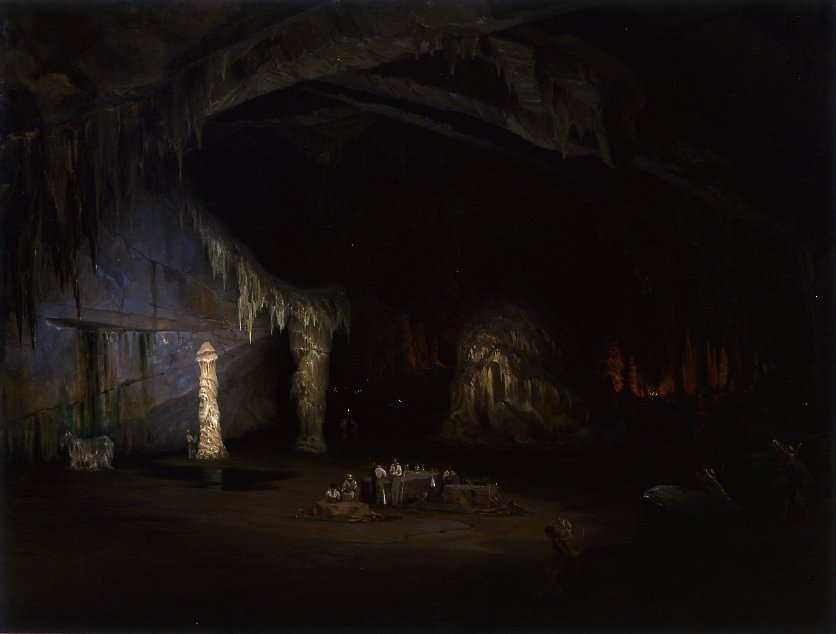
Within ten or fifteen minutes he finds exactly what he is looking for, but he also finds something else besides, something that is far beyond his hope or expectation. At first he encounters the pool, still and silent in the dim light cast upon it from the veins of ore weaving their way through the low ceiling above, even as the ceiling both recedes higher and opens out, as if the narrow tunnel is opening to yet another wide cavern. But Albrýndaer pays little attention to this latter fact for a long moment, as he drinks his fill of the water and eats what his stomach can reasonably handle of the raw mushrooms. Though at present he little feels any energy from either of these things, he is grateful to ease his parched thirst and to give some nourishment to his body. Only then does he turn his attention to the widening tunnel ahead of him.
As he proceeds down the tunnel the light gradually increases, and though at first he thinks he must be coming upon an especially rich vein of glowing ore, he soon realizes that the light has a different quality and texture than the light that until now in his life he has known. As the full breadth of the cavern becomes visible before him, he sees the source of the radiance: a narrow shaft of light splitting the cavern down the middle with a beam so intense that it appears almost solid, motes of dust glittering in its midst. Its source is a fissure in the stone of the ceiling of the chamber high above. It can be nothing else but sunlight.
Touched by the beauty of its radiance as it pierces the darkness that Albrýndaer for his entire life has known, it is a few minutes before he realizes that this fissure is not only a source by which light enters the underground cavern, but also a possible route out of the darkness and into the land above. And this changes everything. Stepping into the light and allowing it to shine full upon him, the realization dawns upon him that this is a chance for his people, perhaps the only chance, for them to escape from the death that awaits them at the hands of the ötûnr and to find hope for life anew.
As this realization sinks into his heart and spreads as though into his very bones, he feels reinvigorated, and he lingers little here before letting his enthusiasm to share the news with others spur him onward. But he does take every care that he can think of not to lose the path of return to this cavern of light. This makes his journey slow and difficult, as he drags a sharp rock against the wall of the tunnel while he makes his way forward in the direction he hopes will lead him back to the encampments, and as he makes a mental note of every turn and bend in the path that he follows, hoping this will be enough to help him find his way back again.
Unfortunately, all of this care seems to little benefit whenever he realizes that he is lost in the tunnels and wandering what seems to be aimlessly. He walks for half an hour, an hour, and then for more, and discouragement begins to tug on the fringes of his consciousness, born of the fear that he will lose his way, or at least lose it for so long that return is impossible. In response to this fear he cries out interiorly to the One in a plea for aid and guidance, that the path may not be lost. And though he receives no audible answer and no visible sign, eventually he does come to the exit from the tunnels and stands before the massive expanse of the cavern from which he had originally come. Unsure, however, of where he stands in relation to the encampments—and in relation to the members of the cult whom he desires to avoid at all costs—he walks cautiously and attentively straight ahead into the center of the open space. All the while he looks and listens for any signs either of human life or of landmarks that might stir his memory.
Eventually he comes upon an encampment that awakens in him no recollection, foreign in every respect except those traits that it bears in common with other encampments that he has seen. He enters it and casts his gaze about, ready to share the good news with the first person whom he sees. And her figure emerges from the shadows and into the torchlight in the same moment that her voice sounds, “Albrýndaer? What are you doing here?”