Over the next few days the three men prepare for their departure by gathering what provisions they might need and also by purchasing new clothing to replace those ruined or lost during the shipwreck. In addition, they simply think it wise to have more than a single outfit, which surely shall be soiled on the long road, with little chance of being adequately cleaned or mended in the wilderness. Hældáris decides to keep his gambeson despite the tears in the fabric where he was wounded by the serpent, for it is a garment that is not widely available, at least fitted so to his own body. Rather, he leaves it with a tailor for a day for a simple mending to close with stitching the tears which severed the fabric. He does, however, allow himself a couple pairs of new trousers and undershirts, as well as a long tunic of heavy dark fabric—its fibers of wool and flax that are naturally water and flame resistant—that reaches to his knees and is tied at the waist with a leather belt. Aeyósha’s clothing is still in good form so he accepts only a couple undergarments to replace those he lost in the sea along with a padded vest and matching pants designed for their hardiness. And finally Îsáric insists on giving to both of them heavy cloaks and matching cowls to ward off the cold, wool lined inside with fur, the only garment in their attire that can be called expensive, though in fact a heavy cloak is not an option but a necessity in the land of Vælíria, just as it is in the land of Telmérion. Îsáric himself is similarly outfitted, though his clothing is not newly acquired but old and weathered with many years. He also still has in his possession some simple armament which he intends to wear as part of his attire while they are on the road: a mail hauberk of tight and expertly crafted rings with a coif of the same quality and make, and hardened leather vambraces that reach from just below his elbows along the length of his forearms to his wrists, with gauntlet-like gloves of the same material, both plated with strategically-placed sheets of metal woven into the leather to protect the most exposed members during martial combat. For weaponry, Hældáris carries only the sword of his father, Aeyósha a studded mace that Îsáric had on hand from forgotten days, and the latter a sword and shield that are clearly of standard military-issuance and long since used.
As for acquiring horses or mules, it is simply an impossibility, considering that the shipwrecked men are destitute and Îsáric himself lives in poverty and expends what little he has on the above mentioned vittles and garments. They do however meet with some traders with whom Îsáric is acquainted, making inquiries until they find one who is sending a small caravan to the west—though only as far as Turholm and Fiándris—composed of two laden wains and a small guard of the same number of armed men. After receiving their word that they shall, for as long as they travel with the caravan, do what they can to see the goods safely to their destination and to aid the guards in their task, it is agreed that they may travel with the caravan along the length of its journey and ride upon it as they may to ease their way and speed their progress.
They also meet with both the reeve and the marshal of Ûlfaeng, informing them of what little knowledge they have concerning the plea of the haléndi and the danger described in their letter to the rulers of Telmérion. Îsáric, well known to both men, speaks to them in some detail of his hopes in traveling toward the heart of the nation and also repeats again his fear that the conflict that there exists threatens soon to spread even to these far-flung fringes of the nation. Though they are unable to confirm the truth or falsehood of this latter claim, they well know the word of bloodshed and battle spreading from Vælaróma and its surroundings, as do all but the most isolated on the continent. They therefore listen respectfully and take Îsáric’s words to heart, though it is evident that at least for the present they shall refrain from taking any action in response to these warnings. After all, this is not the first time that they have heard that dreaded word, war, and their understandable wish is to remain apart from it as long as possible, in the hopes that it shall pass them and their people by. Nonetheless, the word of Hældáris and Aeyósha lends credence to the word of Îsáric, though none of them has any proof of his claims beyond the strength of his own witness, and both reeve and marshal seem deeply affected by this threefold witness.
Having done what little they can to prepare, the three men take a final night’s rest in preparation for their departure shortly after the break of dawn on the morrow. When they rise all three of them feel a sense of anticipation that is both anxious and hopeful, even if simply through the fact of being a movement into the unknown and uncertain, which always bears within itself both danger and promise. They gather their few travel provisions and walk silently to the westernmost edge of town and up the slope of the surrounding hillside, where a well-paved road juts through cut stone and packed earth before it levels out at the crest of the rise and stretches into the distance, farm and pasture land hedging it on either side until, at the far limit of sight, it is lost in the trees of the woods. These woods, named Hûle Forest, cover a wide expanse of land along the easternmost reaches of the Vægo Moorlands, through which the company shall travel, until the moors themselves give way to the wide stretches of the Vollrænd, the “Region of Plains.”
They arrive before the tradesmen, though they have not long to wait, as these draw near within five minutes, leading the two wagons tethered each to a pair of shaggy mules with ruddy brown fur and wide, bleary eyes, looking out curious but uncomprehending at the landscape growing in clarity as it is gradually revealed under the light of the rising sun. The tradesmen, on the other hand, two brothers by the names of Édvin and Égill, focus upon their traveling companions and introduce the guards who shall be accompanying the caravan.
“This is Dágra and this is Astër. They are well-trained swordsmen and experienced mercenaries,” says Édvin, gesturing to the two men, both of whom wear expertly wrought mail under breastplates of iron or steel with pauldrons and gauntlets of similar kind and make. The former, however, is of a much larger build than the latter, and he looks to use this to his advantage, a disproportionately large greatsword, or two-handed sword, cradled in his left arm and leaning against the earth at his feet. The latter has at his waist a normal length longsword and, slung over his back with a leather baldric, a round shield of wood and hide. Édvin concludes the introduction by saying, “They shall be guarding the goods, and our persons, for the length of the journey, though your aid also, should it come to it, shall be appreciated.”
“And you shall have it as agreed,” replies Îsáric with a courteous bow of his head, and his two companions do likewise. They then make introductions of themselves to all.
The merchant brothers seem to all appearances to be twins, as they are of the same height and build and their faces bear a striking resemblance to one another, distinguishable at ease only because Édvin wears a long and bushy beard of graying black hair and Égill is clean shaven but for the hint of a mustache and goatee upon his lip and chin. The mercenaries, on the other hand, could hardly look more different. Dágra seems almost like a wild man who has spent his years living alone in the wilderness—not only because of the shaggy hair that surrounds his head and face like the mane of a lion but also because of the untamed ferocity that glimmers in his eyes. Astër, on the other hand, is small and unassuming in appearance, and even his wide, high brow and his close, intelligent eyes encourage thoughts not of warriors but of scholars or clerks.
“Hey ho!” shouts Égill, busying himself with the mules, patting each one as he checks its harness, “get ready for another trip, my boys.”
Looking at the others, Édvin says, “Do not mind him. It is just his way. He does this every time we prepare to depart.” There is no shame or embarrassment in his voice, nor in saying this does he aim to dismiss his brother or his particularities; at most they sense in his voice only a certain self-consciousness, or rather a certain protectiveness, over the mannerisms of his brother. But such is really not necessary, even when the latter begins to sing softly. For in witnessing his childlike unselfconsciousness the others experience nothing but wonder and delight.
“Listen, my darlings, littlest of creatures,
beasts of burden, one and all, we see you;
but in my eyes you are precious, good, and true,
so carry your burdens lightly, if you can,
though I have little idea how to rhyme.”
And with this, in a matter of moments, they are ready to depart. Placing their packs on the back of the carts, the five guards of the caravan walk alongside the mules while the two brothers ride in the carriage-seats behind them, spurring them on. As Ûlfaeng disappears behind the descending ridge at their backs the forest thickens and reaches out its arboreal arms to enfold them, enclosing them in an embrace which almost imperceptibly, instantaneously, hides them and makes them feel as though lost in the depths of the woods and not merely at their fringes. How much more hidden and concealed shall they feel when miles upon miles lay behind them on their journey and these selfsame woods remain to enfold them still.
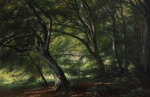
Regardless of the expanse that lies before them, their travel itself is as it always must be: moment by moment and step by step. The three tag-alongs and the two mercenaries take turns riding on the wains at intervals and, at other times, all walking, so as not to tire the mules. The forest is calm and cool, sheltering them from both sun and wind, though more sun in fact they would not mind in order to counteract the early spring chilliness that lingers in the air throughout the day. Its dappled rays reach them through the canopy of trees overhead, playing upon the undergrowth below and upon the narrow trail which has now passed from paved stone to simple packed earth, hardly wide enough for the carriages to pass single-file between the trees on either side. Because of this the sun falls full upon them only for short moments when through natural causes there is a widening or slight clearing of the trees. It is in one of these that they stop for a short midday rest and repast.
After eating a bit of food, Hældáris lays back against a soft bed of heather and closes his eyes, letting the momentary warmth ease and invigorate his tired and aching body. Even as he does this he begins to slip into sleep, only to be interrupted by a voice near to his side. Opening his eyes he sees Astër, the smaller of the two mercenaries, seating himself and looking intently and kindly upon him. “Where are the three of you headed?” he asks. “You are clearly not accompanying this small caravan at the request of the traders, I assume. Two swords should be enough for such a trip.”
“You are right in that,” replies Hældáris, turning his body slightly to face the man. “But we are glad to be of assistance in that way, though hopefully such assistance shall not prove necessary. It is just better to travel together rather than alone.”
“That is true,” says Astër. “The traders mentioned that you were foreigners, and now I know by your accent that you are, though you speak our language quite well. Better perhaps than many of our own people.” There is a question implicit in this observation, just as his earlier question remains unanswered, hanging in the air; and yet Astër does not seem particularly adamant in seeking answers. It appears that his mind is indeed simply inquisitive, and that his manner and his bearing reveal the dispositions of his heart, which is rare in one who works in a capacity such as his.
Seeing this candor in appearance if not in speech, Hældáris does not hesitate to give at least part of the answer, “We intend to travel a long way, hopefully to the capital of Vælaróma itself. Though the journey from Telmérion was even longer, in it we walked little, and while in leagues we have already traversed most of our way, it seems in thought and feeling that our journey has just begun.”
“A fine answer,” remarks Astër shortly. “So the caravan shall only accompany you part of the way. And for the rest?”
“We shall discern when it comes to that how best to proceed,” and then, as if to anticipate the gradual string of questions leading up to the mercenaries’ real query and curiosity, Hældáris says, “We travel to the capital because of the word of war that we have received. Know you anything about this conflict?”
“You come all the way from Telmérion, do you? It must be serious indeed, at least in your estimation,” says Astër. “Aye, I know a little. But it seems to me, to many of us in fact, to be a local affair and of no concern to us.”
“What makes you think that it is merely of local concern?”
“Because it is, as a fact, merely a regional matter. It is the squabble of a few new ‘lords’ vying for power over the right to sit on the tallest seat. And that is hardly something new or particularly concerning. In my opinion, indeed, the rebellion that overthrew the Empire did not put in its place something especially new, but rather the same thing wearing a more pleasing face. So what is happening now is not unlike what happened in the past, and little does it concern us ordinary people who, regardless of which man sits on the throne, shall go about our daily lives as if nothing has changed. For nothing has changed, or very little.”
“But what of the bloody battles occurring in the cities and settlements around the capital?” asks Hældáris, sitting up now and turning completely to face Astër.
“Such is merely the domain of power for the two vying lords. Vælíria, after all, has long wanted to see itself as the ruler over all the other states on this continent, but since the fall of the Empire it has lost its hold upon us. And the Republic explicitly encouraged us to assert our independence again—within the unity of the whole, though they said—as a return to the structure of our land before the rising of the Empire.”
“So you think that regardless of whoever wins this struggle for dominance over the city-state of Vælíria it shall impact you little?”
“Yes, I do think so,” replies Astër. “The days in which an Imperial rule is viable have long since passed. And the rulers who wish for more power than their own local governance shall be sorely disappointed to learn that we the people of this continent, we the members of the many clans, have found ourselves again and shall accept no encroaching upon our autonomy.”
“It seems more likely to me that this newfound autonomy shall result, not in the disappointment of those who seek power, but in warfare and bloodshed,” Hældáris remarks with a sigh. “For those who truly want to rule over others shall seek this at any cost, even be it the loss of innocent life. Surely you know this. Your people have a communal memory, rooted in generations upon generations of life, of this kind of oppression and this kind of violence.”
“Life under the Empire was not all that bad for us in material terms,” Astër retorts. “But who in their right mind would fail to recognize the lack of freedom and the quelling of our unique heritage as people? Nonetheless, I am tired of all the squabbling, and I wish things would simply settle down so we can enjoy our freedom.”
“It is true that you lost much because of the centuries-long reign of the Empire. But it is also true that however great your diversity might be, and might have been if left untouched by Imperial rule, all of you in fact share a common heritage and are more alike than you would warrant,” says Hældáris. “But I agree with the desire for independent governance and the fashioning of life according to your own unique regional and historical heritage, although that too could become revolutionary in expression and harm life rather than safeguard it. But it is also true that we all belong to one another, and are united, whether we wish it so or not.”
“I do not agree with you,” Astër says. “I believe that the severing of bonds that tied us in the past is the only way to asserting our own freedom and the true flourishing of our state. In anything other than this, it is the little people who are forgotten. We must insist on as few bonds as possible tying us to others outside of our own immediate domain. In the other direction lies the perpetual danger of a resurgence of centralized power and the curtailing of freedom that it brings.”
“As much as I empathize with your desire to affirm and defend the autonomy of your way of life as a state, it is also impossible to ignore your responsibility toward—and your deep rootedness in—the entire nation that has for long ages called itself Vælíria, and of which even now you remain a part. For this is not a mere political farce, but a matter of the roots of people’s stories intertwining together over many ages, and of their blood itself conjoining, blood of the flesh, but also of thought and life and aspiration.”
“You talk too much for one who does not know either our history or our experience of life,” says Astër, and it is apparent that his friendly tone has now reached its end. It seems that he was not looking for, nor expecting, anything other than friendly discourse and some bits of information on his mysterious travel companions, even though it was he who broached this difficult topic to begin with.
“Very well,” Hældáris concludes softly, startled by the abruptness with which Astër has sought to bring the conversation to a close. “Then I shall say no more.”
† † †
“Hældáris, we are moving out again,” sounds Aeyósha’s voice from where he sits.
“Very well. I will walk if you wish to ride,” he replies.
“Why do we not both walk? After a rest such as this, I say we give the mules a smaller burden for a while.”
“I agree.”
And so the caravan continues through the thickly-laden forest for the afternoon and into the evening until the sun dips low on the horizon and is hidden by the northern edge of the mountains hinted in the distance, at the limit of sight. Just as they are about the stop for the night and set up camp in the wilderness, Édvin calls out, “Look! I have found the sign.”
“It is about time,” remarks his brother. “I feel as though we should have come to it hours ago.”
“Odd how distances seems to shift and change depending on the dispositions of the heart.”
“True, true…”
While the two merchant brothers continue their converse, Hældáris, Aeyósha, and Îsáric draw near out of curiosity and inspect the sign that Édvin mentioned. Its wood is weathered and cracked after years exposed to the elements, but symbols etched into it are still easy to read:
Hinstad – One League
And so it is that at the end of their first day of travel they find refuge in a small inn-and-taberna in the hamlet of Hinstad, hardly more than a dozen houses nestled tightly in the densest part of the woods.
While the merchants stable the mules for the night, the mercenaries and the three travelers secure their goods in a locked stone room at the back of the inn (clearly traders passing through the hamlet is a common occurrence). They then take advantage of the warmth and comfort of the main room of the taberna to sit and rest from the long day’s journey and to give sustenance to their bodies. Since Hinstad is so small, there are only three other persons in the room, not counting the owner who himself sits by the fire with his legs propped up almost in the flames themselves, drawing slowly on a thin curved pipe. The acrid odor of the smoke causes Hældáris to cough, though he tries to hide this. Tobacco-smoke is not an invention that has come to exist in Telmérion, and this is his first encounter with it—and an unpleasant one.
The same is true of the strong ale that the two mercenaries begin consuming in copious quantities, until the sound of their boisterous voices and merriment echoes through the room. Seeing the looks on his companions’ faces, Îsáric says to Hældáris and Aeyósha, “The culture here is quite different than your homeland, is it not?”
“Aye, it is,” replies Aeyósha with a soft smile. “Inhaling smoke is not one of our past-times. What is it that he is burning?”
“It is called tángrin,” Îsáric explains. “It is a common herb used also in medicinal remedies, though as a topical analgesic and not in this form. When inhaled, however, it has a relaxing yet invigorating effect on the body. Unfortunately, one also comes then to crave it regularly, and to experience ill effects when it is not available.”
“And the drink?” Aeyósha asks. “I assume it is an alcoholic beverage.”
“You assume?” Îsáric asks, eyebrows raised in surprise. “What else would it be? Do you not have alcohol in your land?”
“We do have fermented liquids in Telmérion,” Hældáris observes, “and yet by long custom they are consumed only at sacred ceremonies. For us these have a liturgical, sacral significance such that they are a part of our culture only in cultic settings. In all of our taberna, on the other hand, we drink mostly tisane in countless forms. It has become something of an art for us.”
“Our cultures, it seems, are even more different than I had imagined,” says Îsáric. “I did not know it was possible for a culture to exist without the proliferation of smoking-pipes and pots of ale. To us in Vælíria, they are trademarks of the taberna. You would be hard pressed not to find a taberna filled with pipe-smoke and raucous with drink.”
“And what of yourself, Îsáric?”
“I had my ‘glory days’ long hence. In the army such things were customary. But I am an aged man now, almost sixty years of age, and I desire a simple and quiet existence.” Îsáric’s expression become distant for a moment as if he is caught up both in memory and in thought. “And I have come to love the beauty of ordinary life too much to either desire or appreciate such things.”
“Then it is all the more unfortunate that the events of the present stir you from this simplicity and set your feet upon a long and difficult journey,” remarks Hældáris.
“Unfortunate?” Îsáric asks with raised brows. “Aye, that it is. But it feels petty to be concerned for my loss of simplicity whenever the very well-being of our nation is at stake. And, after all, simplicity, quiet, and peace lie within a man more than they lie outside of him. If he does not have quiet within himself, he cannot find it anywhere else, but if he truly possesses it, or is possessed by it, then nothing can take it away from him.”
“Well spoken,” says Aeyósha with a smile. “But speaking of quiet, I am quite tired and shall now seek our chambers in order to sleep.” And looking to his friend, “Hældáris?”
“Yes?”
“You will be retiring soon?”
“I will. Even if I do not need much sleep, my body is fatigued, and I prefer the early morning hours for my sleeplessness to the lateness of night, though both are good.”
“Sleeplessness?” asks Îsáric. “Do you have trouble sleeping?”
“Oh no, it is not trouble,” responds Aeyósha on behalf of the king’s son. “He has ancient blood flowing in his veins, blood of a people of wakefulness and vigil. It seems he is meant to keep watch while the rest of us sleep. Though this was difficult for me at first, seeing myself as responsible for his protection, I have long since become accustomed to it.”
“Interesting. I would like to learn more of this,” Îsáric says.
“I shall leave you both to it,” Aeyósha says, and then he takes his leave.
The two men who linger in the common room of the taberna speak for another hour or so before they too retire for the night.
When Aeyósha rises in the morning and enters the common room, he finds Hældáris seated before the hearth, his face illumined by the flickering light of the fire while the rest of him is shadowed in darkness. The room is otherwise empty.
Seating himself by Hældáris, Aeyósha at first opens his mouth to speak but then instead resolves on silence, joining his friend in his own quietude during the early hours of the morning before the break of dawn. After a long time passes in this way, it is Hældáris who speaks. He asks quietly, “Aeyósha, do you think it was a mistake for us to come to Vælíria?”
“You ask this because of the loss that befell us and our dear companions?” replies his friend, turning to look at him with tenderness and understanding, though Hældáris, reciprocating his glance, cannot help seeing a deep and personal sadness in his eyes as well. Clearly this question has weighed upon him also, and grief has gripped his soul, even if he has borne it differently, and indeed if for him it has different contours.
“Why else?” answers Hældáris tersely. “If I had known beforehand what would befall us, I do not know if I would have had the strength to consent to the call I heard.”
“You asked if it was a mistake,” says Aeyósha, “and yet you still speak in the awareness of the call that you heard. It remains with you even in your questioning.”
“I…I suppose you are right. But perhaps I am just grasping to the last semblance of order and unity when all else seems to have crumbled into disorder and the thread of continuity seems to have been broken. How do I know that it was the voice of the One that I heard, and not the voice of my own desire or even a voice far more insidious?”
Aeyósha sighs deeply, saying, “You know as well as I that such a question can only be asked in the very act of living, and that such ‘what if’s,’ when juggled ceaselessly in the mind, bring not clarity but confusion, not peace but anxiety, not commitment but weakening of resolve. In order for light to be born in your heart once again, and surety in the path that you walk, the question itself and the very asking must be born of faith and trust. Do not take back, therefore, even in your mind, the gift you have once given. Do not return to Telmérion even in your thoughts, but ask rather now, from the depth of your own living, from the heart of your pain and from the reality of where you now stand, for the light and truth of the One who loves you. For here, too, into this very same heart, the answer shall come.”
“You believe light shall return if I continue to ask for it?”
“Light always comes when we seek for it. And yet whether or not you shall receive tangible confirmation of the path that you walk, I do not know. Perhaps your original assent must be enough, and going forward you are asked to walk in the darkness, clinging in faith without external consolation or easy clarity.”
“Why would that be asked of me?” asks Hældáris softly.
“Perhaps your journey through the darkness, precisely thus, is meant to bring light to others,” answers Aeyósha.
“I hear you,” responds Hældáris, and his voice is surprisingly hoarse. “But what of you? Certainly these events have shaken you profoundly as well. And yet you do not show it, or at least you do so very little.”
“Forgive me if I do not express my pain externally, and if I do not voice the lament of my heart,” says Aeyósha. “It is one of the tendencies that I have, and not necessarily a good one. You, on the other hand, have a gift of honesty and vulnerability with others that I find quite beautiful and remarkable. Like a child, almost, you share what is on your heart, and you rarely struggle to give it voice before others, or before the All-Giver himself. It simply lives there, viscerally with you, and you relate it outward without a second thought.” With an awkward smile and a shrug of his shoulders, he concludes, “I, on the other hand, tend either to ignore what is within me so that I can focus on the well-being of others, or I share it in such a way that I might not burden them in the sharing.”
“Then know that I want to receive from you too, Aeyósha, as you receive from me,” says Hældáris, “whatever might spontaneously arise within you. Shared pain is better than pain borne alone, even if the sharing makes things seem more messy. There is a time for silence and there is a time for speech. And I would rather be with you in the unfiltered journey and struggle of your heart—to walk together with you—than to bear my pain alone. Allow me to bear your pain with you, as I wish to allow you also to bear mine.” For a moment he lapses into silence before concluding, “And the words you have spoken are true; I know it. You understand my tendencies well, and I understand that I must journey forth from what has happened, from where we stand now, rather than taking refuge in lost possibilities. So let us lament together, and let us journey together. I do not think anything else is possible now, unless we are to collapse under the weight of what has been lost and before the mystery of the unknown that lies before us.”