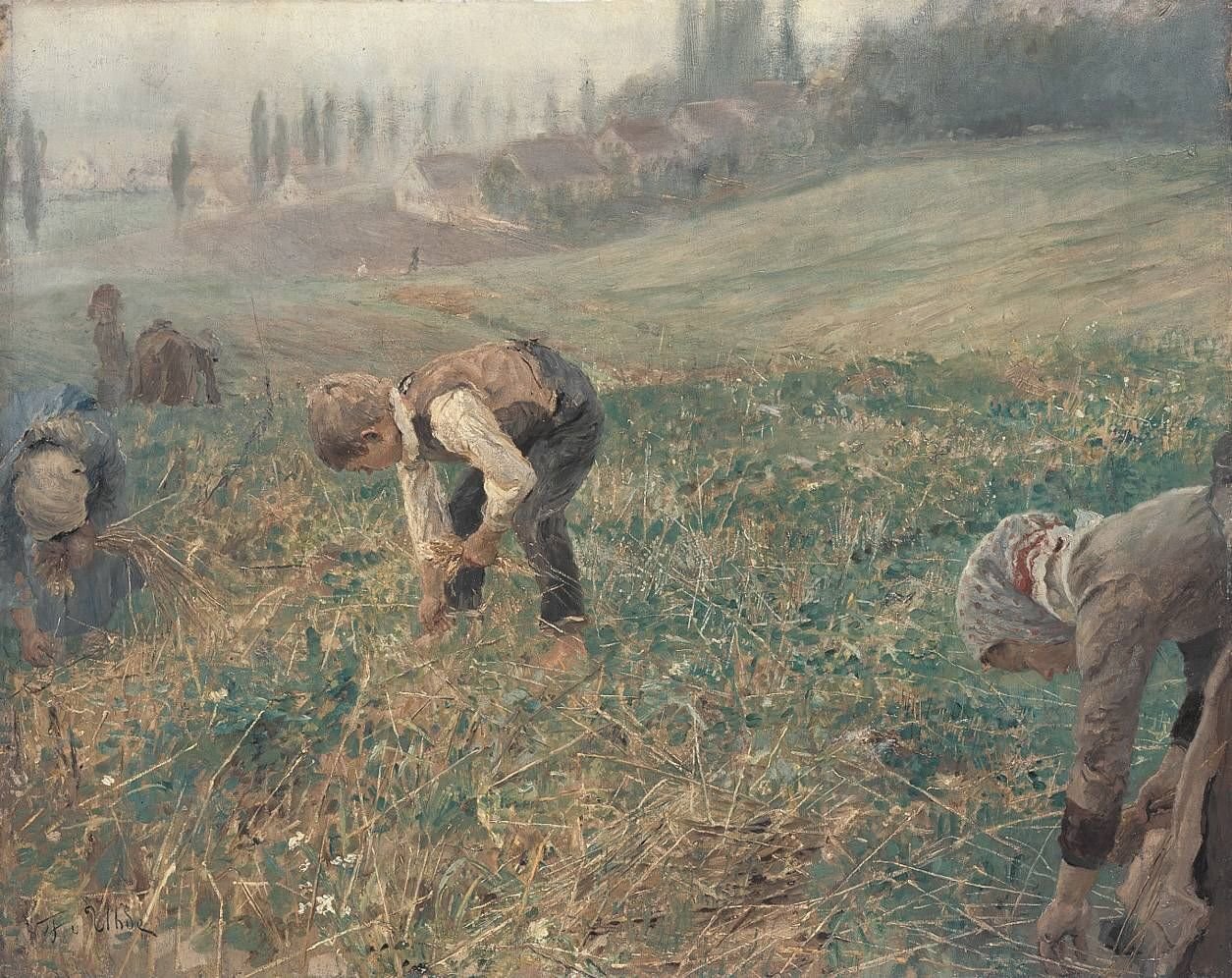
Hældáris’ sleep is tormented by nightmares, though upon waking they flee from consciousness into the dark recesses of his mind and all that remains is a dull, gnawing dread. When he sits up and looks around, he is surprised to see that Aeyósha is still asleep, curled almost in a fetal position beside the dying embers of the previous day’s fire. It looks, indeed, that he tended it to keep it burning through much of the night. The sky is beginning to turn from night’s blackness to the light of dawn, and the sun is already above the horizon in the east, though her light is cold and veiled by a thick layer of clouds. The air too is quite cold, though not bitter, particularly considering the fact that neither man has more than the clothes on his back. And though what they both wear, when dry, is adept at retaining heat and resisting the cold—Hældáris a gambeson of linen and Aeyósha a long tunic of the same fabric, with woolen garments underneath—it is little when compared with a cloak and hood and gloves.
Ignoring the pain in his body, which has lessened significantly from the previous night, though still very much present, Hældáris rises to his feet. As quietly as he can, he then gathers some fallen logs and other small pieces of wood and arranges them on the still-red embers, squatting near to them and blowing lightly until the fire reawakens and begins to spread onto the fresh wood. Then, not finding the fire enough to warm and relax his stiff body, he rises again to his feet and, crossing his arms over his chest and cradling his hands in the pits of his arms, he walks to the water’s edge and looks out over the ocean, which is now as calm as an ocean can be. The waves whisper as they rhythmically wash up on the shore, leaving trails of white foam as they again recede, only to be replaced a few seconds later with the mark of another wave, in a cycle that shall not cease for as long as the seas remain.
But he does not stand for long, as both external chill and internal restlessness urge him on, and he walks along the beach toward the south, the rocky sand crunching beneath his boots with every step. The shore is mostly shapeless and uniform, a grayish color stretching as far as the eye can see, though it appears to curve further inland in the distance. Thirty to fifty yards away from the ocean, however, the land rises in rocky promontories or grassy bluffs littered with stones, whose vegetation is austere in the extreme—grasses almost devoid of color and trees bereft of leaf and berry except for a few scattered conifers. This sight draws Hældáris’ to recall the date, and—after reminding himself that he missed almost an entire day in unconsciousness—he settles on the fourteenth of Téras, the third month, in the year 29 of the third age of Telmérion, and year 1174 of the Vælírian calendar. The ages of his homeland are counted in millennia, in periods of a thousand years, and he was born almost exactly at the conclusion of one age and the dawning of another—and this is true not only numerically, but existentially, for the world in which he was born and raised is far different than the one known even by his immediate progenitors. And it was their love and sacrifice that paved the way for the peace and serenity, the faith and goodness, which have bathed his youth and his adulthood in their light.
The count of Vælírian Years, however, is not divided into millennia or “ages,” but counted simply from the colonization of their land 1174 years ago—in the year 844 of the first age of Telmérion. Thinking of this simple difference in calendar reckoning is enough to remind Hældáris quite vividly that he is now in a foreign land, one that has been developing largely independently from his own for almost twelve-hundred years. And not only that, but he does not know where upon this land he is, nor does he have any supplies other than the clothes on his back and the sword of his father—and most grievously of all, though he resists thinking of it, he is bereft of all those who traveled with him toward this land but one, the man who saved his life. The thought is still utterly inconceivable to him that his wife, to whom only recently he had been joined in marriage and with whom he had yet to bring forth children, is dead. How could things end so suddenly and unexpectedly? And indeed so unfairly? Death is a cruel reaper indeed, cutting down men and women without regard or discernment, almost at a whim and with malicious pleasure.
The anger and resentment boil up within Hældáris before he is aware of it, and only as these emotions spill over does he become conscious of his thoughts—that he is replaying again and again in his mind the horrific scenes of the serpent’s attack. And he is as it were grasping the evil of the event by the hand—the sheer stupidity and absurdity of it—not to confront and conquer it, but to use it as a bludgeon to batter away the sparks of faith and of hope that remain in his heart trying to stir into flame. And this seems the most natural course of action, the most humane and understandable response to such senseless suffering and loss. In accord with these thoughts the already gray landscape takes on an even more monotone hue, and Hældáris realizes that even were he to look upon the woods of his home in the full blossom of spring, they would appear hardly more than a half-tone trapped between light and dark, and devoid of real color.
And he recognizes that deep underneath this numbness lies an unspeakable pain too intense for him to bear, the grief of loss and the gaping hole in his heart and his life where Relmaríndë should be. But he recognizes this almost as he would if it were in another person rather than in the inner recesses of his own being. And this is a startling realization, an expression of the rupture that has happened in his heart, as if now the life he lives is not his own, but merely a fragment, a dream, or a nightmare of loss. Even so, thinking of the loss of his wife, tears spring to his eyes, and he cannot withhold them from giving voice to his anguish. But they are bitter tears, bringing no relief or ease to his suffering, no sense of meaning to his loss, and no awareness of reconciliation either with his fate or with his own ruptured self. But what does it matter? For the cruelty of the world has stolen her so swiftly and so easily, and she is gone.
If there is any hope or relief for Hældáris, it lies beyond the grasp of his conscious feeling and thought, in the hope that even if she is lost to him in this world he may yet see her again when he too passes beyond the portal of death, and in the trust that beyond the darkness of senseless loss there is yet a greater light that, even if it cannot be seen, continues to hold together threads that to all appearances seem torn asunder.
When he returns to the camp close to an hour later he finds Aeyósha awake and sitting by the now blazing fire, though he has pulled some hot embers to the side and is cooking a small bit of breakfast for the two of them. “A chilly morning,” remarks Aeyósha when he looks up and sees his friend drawing near. “But winter is in its last moments and spring shall soon be coming.”
“Aye,” says Hældáris. “At least we shall not be wandering through a foreign land in the freezing cold.” He sits down and extends his hands over the flames.
“How do you feel today?” asks Aeyósha. “I am surprised you rose so early and walked about with the wounds to your back.”
“The pain is not great. I took care not to cause any stress to the wounds.”
“Good. We would not want them to reopen now. I shall take a look at them later, if you let me.”
“Certainly.”
After a moment’s silence, Aeyósha says, “Do you have any idea where we might be? You have studied the landscape of Vælíria more than I, as well as its language and customs.”
“All three of the ships that set sail from Telmérion were bound toward the port city of Aelthiryn. However, Captain Olándir spoke with me a few days past and said that he intended to stop for a few hours in the town of Ûlfaeng in order to resupply, since there had been some miscalculations regarding stock before our departure. We were in fact drawing near to that town when the serpent struck, and so, unless we were blown far off course during the storm, it must not be far from here.”
“As threatening as the storm appeared,” Aeyósha adds, “it was not so violent after all. It was the serpent that…never mind.” Seeing Hældáris’ expression he does not finish giving voice to his train of thought. Instead he says, “The wind was inclining toward the north, so perhaps if we were to travel southward we would come upon the port. Know you how large or small the settlement is?”
“It is a well-established town and a center of trade, so we shall have no trouble finding services there, though how we shall pay for them, I do not know.”
“We shall take thought for that if and when we find it, I suppose. Did you walk far? What have you to say about the landscape?”
“All that I saw looks much the same as it does here, though the shoreline does recede inland to the south,” explains Hældáris.
“I saw whilst fishing and hunting for shellfish yesterday that it recedes also to the north. Perhaps we are on some kind of peninsula or outcropping of land.”
“Perhaps so.”
They then begin to eat, while Aeyósha turns to Hældáris and, with his usual intense look, says, “I could have done little to help you if the cuts on your back were deeper. But as it is you were spared much, and they were shallow—little more than wounds of the flesh—and should heal rapidly. I wonder if traveling soon would risk harm to you.”
“It is you who have seen the wounds, but I feel that, with your care and the bandaging you have given, walking disturbs them little. Did we not already agree to proceed without delay?”
“We did speak of it. I only wished to make sure. At least allow me to take care of any the manual activities for the present. In the meantime, I shall rely upon you for the knowledge I lack. As we walk along, I shall pester you with questions about the landscape, peoples, and customs of Vælíria to make up for my lack of education.”
“Very well then, I accept,” says Hældáris, “but on one condition.”
“What is that?”
“We do so in the Vælírian tongue.”
“Oy, that is a lot to ask!” Aeyósha exclaims. “But no—you are in the right. Though in years past I would have been more confident in my knowledge of the Vælírian tongue, it has been long since I have given it the attention of either study or practice. I will need much speaking before I feel entirely comfortable with the ins and outs of the language.”
“You may have plenty before we finally come to the city of Vælaróma,” says Hældáris, “if nothing hinders us from making our way that far.”
† † †
Within a half hour the two men set out along the coastline to the south. The morning clouds gradually pass away and the sun shines full in the sky; the air is warm and pleasant, with a hint of a breeze. Aeyósha carries the illoándirover his shoulder in order to give Hældáris’ wounds the rest needed in order to heal, but otherwise they are entirely devoid of any supplies. Whatever weapon Aeyósha once had was forfeit during the serpent’s attack, and neither of them had on their person either armor or goods, food or maps or tools of any kind, and so they walk hoping that the town is nearby, though even this does not promise to solve all of their problems in this regard. Thankfully they both are well acquainted with the tongue of Vælíria, though Hældáris has had more practice in its speech; and it is a tongue which is a derivative of that of Telmérion and so is not too difficult to learn, even though in the course of its history it has doubtlessly developed many words, rules, and nuances of its own.
A few more trees begin to cloak the inland landscape as they follow the curve of the shore until they find the sea stretching to the south rather than merely to the east. And even as the day progresses and the shadows cast by the sun lengthen again from midday’s height to evening’s length, they are surprised to find that the shore continues in its curve, and devoid of any signature of man. By nightfall, realizing that no hope of finding human habitation remains this day, they take shelter in a close-knit copse of trees and littered stone and build a campfire around which they settle to rest.
Not until the end of the next day do they realize without a shadow of a doubt that they are not upon the mainland of Vælíria, but rather ashore an island off its coast. The day is cloaked in a dense fog that lingers even with the full height of the sun, and a light rain falls on and off from a dense roof of clouds, covering the earth with a heavy perspiration and dancing upon the face of the sea in innumerable droplets of water. Only as the fog pulls back in the evening and the clouds break do they glimpse land across the water to the south and to the west, a land looming large at a remove of perhaps three or four miles. Before this they had come to suspect as much, walking round the opposite end of the place of their washing ashore and finding themselves looking out upon water to the west as they had to the east. But only with the sighting of land are they able to situate themselves and, thankfully, Hældáris’ memory serves him well in recalling the contours of the map of Vælíria which he had brought with him on the voyage and which is now lost in the depths of the ocean.
And so there is nothing for it: before they retire for the night they begin gathering wood to build a raft and, for much of the following morning, they continue the work. Using fallen logs and branches for the body of the raft and small saplings twisted tight and stripped of bark to fasten them together, they are able to construct something safe enough to brave the waters of the ocean between here and the main shores of Vælíria, though further than that would be folly.
Unfortunately, even while they sit down for a midday rest, the completed raft resting in the sand and rocks beside them, a heavy wind begins to blow in off the ocean and the waves rise high to white crests. The two men have no choice, therefore, but to drag the raft inland and to situate it tightly among some boulders so as to keep it from the danger of being swept away in the high tide. And then they themselves seek what little shelter they can amid the trunks and boughs of the spruce and cypress trees that stand twenty or so yards from the beach.
In but a few minutes wind turns to storm and a heavy downpour of rain is loosed from the clouds above, low-hanging and quick-moving toward the northwest, accompanied by flashes of lightning and peals of thunder. Unprepared as the two men are, all they can do is nestle close to the trees and receive what little dryness they can provide against the rain and what little protection against the wind. And long into the night does the storm last with no signs of lessening or relief, and the travelers grow both hungry and tired, and cannot sleep for discomfort and cold. But as suddenly as the storm came, so too does it depart, and with a final gust of wind like a last gasp the wind eases and the rain gives way to hardly more than a soft and intermittent drizzle. Relieved that the storm has passed without causing any greater harm than this, both men breathe sighs of relief and, since it is too dark to hunter or gather with any measure of success, and too wet to have any hopes of starting a fire, they dry their clothes as they may and try to sleep. But the first light of dawn greets them before either has slept anything more than fitfully; and yet this light is not unwelcome, for with it comes both warmth and luminosity, and the ability to sail toward a place that shall provide even more than that.
And this they do after a frugal breakfast of raw shellfish (all the wood is still too wet to build a fire), pushing the raft into the water and directing it out against the waves until the shore falls away beneath their feet. Then they use makeshift oars to direct it still further, setting their course to the south. The sky is now clear and blue overhead and the wind is no more than a gentle breeze from the east. Thus, though the rowing is difficult work, it is not nearly so much as it would have been were the weather different. And yet in Hældáris’ heart there rages a storm of another kind, one which has been in a tempest the entirety of the night. He cannot cease re-living again and again the moments of the loss of his wife and companions, and in his imagination her voice resounds, calling out to him, and her form appears, a murky shape flailing about underwater and reaching out for him to save her. And he cannot do so.
It takes six tiresome hours for the two men to guide the boat to the opposite shore, whose contours rise ever larger and more defined before them as they draw near. In the distance, quite a ways inland, they can see the silhouettes of mountains in a massive range that stretches from the east to the west, growing more imposing as it does so. Nearer at hand they discern rocky undulating hills and heather rippling out from the mountains almost to meet the waves of the sea, clothed in more trees and vegetation than were present on the island. When they have washed ashore they pull the raft a safe distance from the water in case of need, though seeing no reason for it. And they set their sights to the east and the south, along the shore, and hopefully thus toward the town of Ûlfaeng. And yet the light of day is failing fast, the rich hues of twilight painting the sky in the west. Before darkness comes upon them completely, therefore, they hasten to make camp as best they can. However, little dry wood can be found on this shore either, as here the rain must have fallen likewise, and so they settle simply for a sheltered place in the midst of a dense brush watched over by a circle of old pines. But soon they regret this, as the wind shifts and begins to blow from the north and the temperature begins to drop rapidly. It is dark now, however, with only the moon and stars above them to give light. In this dim half-light they search under rocky overhangs or among the branches of trees for something dry enough to accept flame. And though it takes some time, they bring to their shelter enough wood and kindling to keep a fire through much of the night—granted that they are able to get it to burn in the first place. And this takes a good half hour, as they must block the wind with their bodies even to get a single flame to hold for long enough to light grass or wood kindling, and it takes even longer for the larger pieces of wood to yield to the flame. But at last they find themselves before a moderately burning fire, and they settle their bodies as close to it as possible, the cold air clinging to them as the moon rises higher in the sky and shows her face, half-full, with a panoply of countless stars all about her. And here they sleep, taking turns tending the fire and keeping it alight.
Morning dawns cold and bright, the trees and grasses clothed in a heavy white frost that shimmers in the light of the early sun before it begins to melt with the increasing warmth of day. Hældáris and Aeyósha depart quickly, not only in their haste to find Ûlfaeng or another settlement but in order to warm their chilled bodies with movement. By midday the temperature is more or less comfortable again, though a slight bitterness lingers in the air from the northern wind of the night before, taking refuge as it were in the shadows or in places where the cool air still blows unobstructed from the high places of the earth. But they walk mostly in a sheltered path cradled between rocks and trees, to their right a woodland of various arboreal beauties, from conifers of all kinds to elms and alders, and to their left rocky cliffs that descend to the shores of the ocean below. The path is not well marked or trodden by human feet, but rather by the animals of the wood in their hunting and traversing; for they make out in the soil the hoof-prints of deer and elk, as well as the soft paw-prints of wolves and even rabbits.
The walk, with the warm sun upon his skin and the beauty of nature about him, helps to raise Hældáris’ spirits slightly, though against such anguish, doubt, and loss no merely external beauty is enough. Aeyósha remains always nearby, as the natural paces of the two men match each other well, both spontaneously and deliberately. And his presence and his compassion is evident even when they do not speak; and in fact even as Hældáris helps to familiarize his friend again with the language and lore of Vælíria, it is the teacher here who is helped. The very speaking and sharing, the very exercise of the mind in communion with a beloved person, helps to loosen somewhat, even if not completely, the stranglehold of despair upon Hældáris’ heart.
On the third day, in the late afternoon, they draw near to the town. First, however, they are greeted by sprawling fields stretching over miles of land cleared of forest and tilled to rich brown earth, though lying now fallow, with no crop yet in sight. But even as they walk they see in many of the fields men and women and even children at work, sowing seed in the soil, speaking or singing as they do so. And so Hældáris and Aeyósha hear the language of Vælíria spoken from the mouths of Vælírians for the first time. And they find it beautiful. It is not unlike their own language, of course, coming from the same root and ultimately born of the same ancestral culture, and yet the foreignness of it is enough to open their eyes to the beauty of its sound, and indeed to awaken them to the beauty of their own language as well. One of the songs which they hear, upon the lips of a woman, a mother, who works with four children at her side, is this, with its translation:
Köra mena, siri, sudángë,
átë oïla laíka tara fen,
anfa myka, aftir é uïntas lígengë:
duja gráfas, mæna, et dragas vestën,
anfa hilas, en penna é ena átë lænd,
anúsa nos ilá, átho anadraë kána,
et seyyas, en hænda, vestën ûvæla tuara
illi aupta faleng en átë aslaë.
Little seed, humble, life-giving,
the soil warms to welcome you,
soft now, after winter’s resting:
dig deep, little one, and drink true,
hide now, in the one earth’s embrace,
while we trust, though cannot reckon,
and then show, in time, your true face
as a plant dancing in the sun.
Ûlfaeng appears before them unexpectedly as they crest the rise of a hillock. It occupies the larger part of an inlet of land cradling a placid bay and rising in gradual slopes on almost every side, creating, therefore, a sheltered haven which must be greatly appreciated when the bitter winds of winter blow. The houses are well constructed, mostly of timber though some are also of stone, with wood-beamed or shingled roofs except for a few stables or workshops which are thatched. There are more trees here, as well, now that the farmlands have ceased, both along the slopes of the hills round about the town as well as nestled among the buildings themselves and providing them shade and at least some protection from the elements.
As they descend the hillock again their feet fall almost spontaneously onto a cobbled road that curls out from the town and winds its way toward the coast to their left. This road they take into Ûlfaeng and soon enter into the bustle of town life in what appears to be one of the main streets or squares of the settlement. Shopfronts open onto the street and many people stand either conversing with those within or standing in line waiting for their turn to order food; hucksters too push their carts along the center of the street plying their trade, calling out to draw in any interested persons, “Meat pies! Get your meat pies here! Only three manés!” or “Fresh vegetables straight from the garden!” or some such words. Considering the narrowness of the street it is full beyond expectation, and yet it feels not cramped but abundant in life, a welcome change after the anguished loss and sense of isolation that has gripped both Hældáris and Aeyósha since they washed ashore upon this land.
One of the most notable things about Ûlfaeng, at least in the estimation of these two Telmérins, is that nearly inexpressible reality called “culture,” multifaceted and difficult even to summarize or explain without great empathy of heart and openness of mind. They feel it in the atmosphere and see it upon the face of every man, woman, and child whom they encounter; they recognize it written all over the architecture and layout of the town just as they hear it in the voices of those who buy and sell. In the simplest and most immediate estimation it is obvious that, if Ûlfaeng is any measure, the nation of Vælíria possesses a more technically developed and also comfortable standard of living than its ancestral Telmérion. The latter, while having achieved great feats of beauty and ingenuity in craftsmanship and creativity, from temples and public monuments of wood and stone intricately carved, to glasswork and smithing and the smaller arts of painting, crafting, and music, and especially a life of rich thought and piety, expressed both in the lore of the scribes and in the tales of the common folk, it nonetheless remains mostly pastoral in the appearance and the substance of its vital life. In other words, Telmérion has never strayed very far from its origins in the seven clans which flourished almost exclusively as communities of small agrarian settlements of simple but sufficient means, with huts and later cabins of mostly felled timber and thatch, with roads of packed earth trod by man and animal alike, cradled round about with woodland or prairie often cloaked in fields of grain. There has always existed a certain frugality to the people and the culture of Telmérion, a certain hardiness and simplicity that has moderated the pursuits of technological development in culture while in no way denigrating them, since the interests of the people have simply been directed to things that they see as more important.
In Vælíria, however, it is evident that a much more deliberate focus on technical culture has occurred, and this can be seen both in the buildings of the town and in the clothing of its people, which are Hældáris’ and Aeyósha’s first introduction to a strong class distinction based on wealth and status and what can only be termed “fashion.” But along with these immediately visible differences, there is a reality even more profound, if more subtle, that they cannot help noticing, though they are uncertain of whether it is something they actually see with their waking eyes or is rather an intuition of a general atmosphere that then plays itself out in their perception. For as they glance into the faces of the townspeople they recognize a trait that is common to nearly all of them. And this trait is sadness, though it seems to be less the lament of loss than the apathy of having forgotten, the emptiness that follows upon the cooling of desire and the hardening of hope.
Having no money or other items to trade, the two men ignore the shops, as hungry as they are, and pass through the street without stopping except for once when a huckster stands in their way and tries to convince them to buy some fresh-caught fish. With courteous apologies they say that they are unable, and extricate themselves from the encounter. They do, however, keep their eyes open for an inn in the hopes that, by some small kindness, they may be allowed to sleep even in the barn or near to the communal fire. This they find, quite hard to miss, soon after they turn onto a second street, narrower than the first and filled with far less people. A sign hangs out into the road with a crude painting of a black horse with a white rider upon it, the paint chipping after many years in the elements. Nodding to one another, they enter this building and step into an almost uncomfortably warm room; it is wide and with a low ceiling, and seems to be divided into two sections. On the right side they see tables arranged close together and all abustle with people eating, drinking, and talking; and on the left they blazing see a wide and deep hearth with a few chairs, mostly empty, facing it, and, a little closer to the entrance of the room, the counter from which the barkeeper (who, it seems by universal custom, is also the innkeeper) takes his name. Without further ado Hældáris and Aeyósha approach the counter and hail the man who stands there, an individual with skin creased with countless wrinkles too deep to judge and with hair and beard of hoary white, who nonetheless seems both full of energy and attention, washing dishes even while his eyes continually scan the room and vigilantly take in its customers.
Seeing the two men approach, he directs his gaze to them and says, “Welcome to The White Rider. What will you be having? Room and board for the night—or for longer? You have the appearance of travelers.”
“We are travelers, yes,” says Hældáris, “and from afar.”
“Aye. Your accent is rather unusual. Are you from one of those far northern settlements? I hear that the accent and dialect is quite different up there.”
“We are actually from the east. We hail from Telmérion and have come here by boat.”
Hearing this, the man cocks an eyebrow and looks at the two of them suspiciously. “No other way to come than by boat—leastwise not that I know of. But all things being said, we don’t get many visitors from Telmérion. Or rather, we don’t get any visitors at all, at least not but on the rarest occasions. What’s your business?”
“You may not believe us if we tell you,” says Aeyósha.
“Try me.”
“Very well,” begins Hældáris, well aware of how his words will likely be received. “My name is Hældáris Illómiel. I am the son of the high king of Telmérion. My companion and I are the sole survivors of a shipwreck to the north of here.”
“The son of the king, eh?” asks the innkeeper, and then, raising his voice and gesturing with his hand, he speaks to all persons in the room, “Hoy, everyone, we have the prince of Telmérion here with us, the heir to the throne! Do you believe that?” Clearly the innkeeper does not. Though Hældáris and Aeyósha can almost feel the looks directed toward the from behind, and the shift in the surrounding conversations is evident, they suspect that few others believe it either, and understand it simply as an ill-placed joke. But whether the innkeeper’s words are taken seriously or as mere mockery or jest, either way it shall likely become a topic of rumor and conversation in coming days. Lowering his voice again and looking back to his interlocutors, the man now continues, “And fancy that: you were even shipwrecked like your old man! If you want to spin a yarn to garner the beneficence of innkeeps, barmaids, and merchants, then let me give you a little advice: settle for something at least a smidgen more believable. You hear me?”
“You know of my father’s shipwreck?” Hældáris asks, surprised by this piece of information and also not knowing what else he could possibly say.
“Aye,” says the innkeeper, “we know of it. That man is well known now even in these parts, though half or more than half of what we hear is probably nothing but legends.”
“Perhaps so,” observes Aeyósha, growing a trifle impatient at this point, “but we speak nothing but the truth. Clearly you can see that we are from Telmérion, if not but from our appearance and our accent, can you not? And you yourself said that you rarely see visitors from Telmérion. Why not then give some credence to our story?”
“Because it is a yarn if ever I heard one.”
“That it is not, though I know not how to convince you of it.”
“Perhaps some coin would not be amiss, and I’ll let it slide and give you what you’ve come here for,” the man says flatly.
“But that is precisely the issue,” Hældáris says, “we have nothing but what you see before you. All else was lost to the ocean.”
“It is as I expected, then,” the man replies. “Your story was given in place of payment. What else could possibly have been the motive?” He pauses then, and, after a moment’s thought, he adds, “I see you have a nice sword there. How about that? If you need a room and some food so badly, how about we make a trade for it?”
“No, I am afraid not,” answers Hældáris without hesitation.
Hearing the tone in his voice, the innkeeper pauses for a moment and looks at Hældáris intently, and then at Aeyósha, and at the hilt of the sword over his shoulder. “That wouldn’t happen to be that ‘magical sword’ about which we hear tales? The one that can shoot light from the blade like arrows?”
Neither Hældáris nor Aeyósha can refrain from chuckling at this remark, and they look at one another with a knowing smile. “I am afraid it cannot do that, exactly,” says Hældáris. And, unwilling to pursue the conversation any further or to attempt an exhibition of the sword for pragmatic purposes, he says, “Well, we thank you for your time. We shall seek accommodations elsewhere,” and he turns away. The eyes of many follow them as they go.
Once in the street again, Aeyósha turns to his friend and says, “Well, that was more or less what I expected. So what do you propose we do now? I fear it shall be little different in most of the inns in this town, if not in all of them.”
“We have slept outside until now,” replies Hældáris, “so I suppose we can do so again. I do not mind, though fish-meats are not proving to be enough to satisfy my appetite and I crave something more.”
“Without money, I don’t know—,” Aeyósha begins, but he is interrupted by the emergence of someone from the door directly behind them, a person who has followed them into the street as they exited the inn.