A presence of unutterable evil and strength of will presses itself into her consciousness, invading her, and even all of her resources are not enough to keep it out. The feeling of oppression far surpasses any sense of evil that she has felt in years past at the proximity of the eötenga, and even of the Draíon themselves, for now she feels it not at a distance but in direct contact, indeed in a battle of minds and wills locked in mortal combat. But even as this presence floods her being and her consciousness she does not yield in despair or defeat; rather, she calls out to the only One great enough to protect her in such a situation, and whose immense love is so wide and deep as to swallow up such evil as a drop of water in a boundless ocean. And so Relmaríndë finds herself caught in the conflict of two oceans—two very different kinds of oceans—the one of death and the other of life.
The one engulfs her spirit and her body with malice uncounted, and she feels the hatred and malintent, feels it so deeply that it seems to press through every fiber of her being and to become in some way her own, insinuating itself into her thoughts and feelings and attempting to unseat her very identity, her identity as a child of the Father of all, and to replace it with alienation and loss. And one of the paradoxical things about this force is that, even as it seeks to depersonalize her, to invade her very sense of self and to suffocate it, it does so as something itself impersonal. In this sense it seeks to make her as it is, to force her and mold her into its own image, the image of a being that was once a person, once even beautiful and good, and yet which has long since forfeit the seat of its own identity, the center of its own belovedness, and become alienation, become a lie in setting itself in opposition to its Maker and Sustainer.
Even so, this invasion would not threaten her or enter into her to such an extent, except that the latter ocean, that of world-cradling love, withdraws from her consciousness and leaves her to bear the pain of the former evil in its direct ferocity, to feel it in herself, tearing at her heart and flesh, surging into her body to suffocate her even unto death. And why this must be so, why she must suffer the brunt of the attack without the shelter and shield that could, did Eldáru will, so easily defend her, she does not know, except in the deep sense she has within her that she must bear and suffer this evil in its full measure, for only thus can it be confronted at the root, and overcome. And perhaps it is simply part of the limitation of human consciousness in this world that one cannot experience to the full and simultaneously both the utter darkness and the utter light, and that even when one is called to bridge the distance between the two in reconciling and atoning love, the mystery that one lives surpasses consciousness and lives fully only in faith and in trust.
And so she stares the darkness in the face, even while her eyes never cease to look beyond it, to look beyond it toward the imperceptible light for which her heart yearns, even while this selfsame light sustains her from behind and from within even without being felt or seen, the luminosity in which all things, even darkness and evil, are seen as they truly are, while the light itself remains unseen, too pure and undiluted to be grasped in such a way, while all things are grasped in it.
And she feels the pain of countless individuals, fallen men and Draíon alike, ringing in the ears of her spirit like a deafening cacophony, and she experiences herself to be one of them, to be one of the lost and the damned destined for an eternity of isolation and despair. She feels the collapse into the narrow confines of a self that has betrayed its very impetus outward into love and relationship, and through grasping selfishness has become instead imprisoned in its own self-made security, which now reveals itself to be nothing but a facade cloaking over the nakedness and vulnerability of a heart that was made for more. In this pain she feels two threads distinct but interwoven. The first is the apathy of human hearts who have clung to this self-made security so firmly, and with such rebellious insistence, that they have ceased to see their prison as a prison, ceased to have even the slightest openness to the saving light that would set them free, and thus have become incapable of salvation. They have care now only for themselves, and yet this care itself has degenerated into an apathy in which the vestiges of self fade away into obscurity and the very impetus of longing, of desire, and of action that impel every living heart forward descend rather into inertia, a state of motionlessness which is not repose, but its very opposite, the nihilism of death, which is not the rich fullness of silence echoing with meaning and purpose, but the silence of absurdity in which nothing is heard since the heart has long since forgotten how to listen.
One the other hand, she feels an evil and a lack of a different kind and tenor, which can only be that of the Draíon themselves and of the minions whom they fashion and control with the shadowy substance of their own malice, insubstantial as it is, a mere mockery of the creation of the One, and yet filled with all the hatred and evil and desire to destroy which the Draíon bear within. Yes, what she feels above all else in such loss is the arrogant pride that fuels itself with envy and hate, and which makes itself an enemy of all that is good, light, and true, as if somehow its own wretched darkness, its own destructive power, were necessary to balance out in the universe the harmony between darkness and light, good and evil. But this in fact is not its intent, and has never been, even if such lies has it used continually to seduce and betray the hearts of feeble men and women; for this pride desires only to rule, to spread its own darkness until every last vestige of light has been snuffed out, and every savor of goodness and beauty has been swallowed up in its own dominion, and it alone reigns as lord supreme and unquestioned.
And the depth with which she bears both of these forms of evil is so intense and so complete that she is unable, in herself, to even pronounce an explicit “no” against them, or to turn her attention to the light for which her heart yearns, to take refuge in the arms of the Father who is her refuge and her strength. At these far reaches of the mystery of bearing, in which she carries within herself the darkness and evil of the world, such conscious prayer is impossible—at least for a mortal heart in all its limitation—and only the faith that is within her while also being beyond her sustains her through this darkness. And so all she can do is endure, in trust beyond trust and hope beyond hope, letting the voice of her heart sound in opposition to the darkness and in consent to the light even beyond her own feeling and awareness. And here she abides in the loss of all things, naked and poor, bereft of all goodness and descending from lament in the loss of the One whom her heart loves—and of all that is beautiful, good, and true as, in the loss of him, all else descends too into nothingness—she tastes the despair that lies beyond lament, the despair that can hardly even remember what it has lost. And yet even here a movement grips her heart, a movement from beyond her even as it works within her. This is a movement that takes this poverty and this loss, that enfolds this utter nakedness and vulnerability of heart, and carries it forward, carries it beyond its own loss, and yet in it, to the place where lament is reborn as longing and despair is transmuted into a hope deeper than all reckoning and surer than all understanding.
And thus the light enfolds the darkness, the light holding her heart enfolds through her, as she herself carries it, all the pain, evil, and loss that she has welcomed into herself. Pouring into every pore of her being, subtle but true, the uncreated light of eternal love confronts the darkness and shines through it like the dawn’s rays dispelling the blackness of night; and thus she knows and feels that even the deepest bearing of darkness, that even the holding of the most violent rebellion against the light, need not eclipse the light that holds her and that shines within her, pouring through every fiber of her being into the world to heal it and make it whole, to touch the lost hearts furthest from salvation and to mediate to them the hope and the gift of new life. After all, it is this light alone, the eternal light of the One who alone has fashioned the universe from nothingness and who gives it being according to his own Being, whose everlasting Love is the Origin, Sustenance, and Consummation of all things—it is this light alone that conquers the darkness. It is this light alone than saves the fallen heart and opens up for it anew the path to salvation and light, to the love and intimacy, the play and the wonder, the abundance and joy and overflowing delight for which it was created and yet which in the darkness it had lost.
And thus her own voice now emerges anew from the muteness into which she had descended, and Relmaríndë cries out in song in the depths of her heart, letting her song mingle with the song of the Anaíon, with the song of the All-Giver, the Father of all. Or rather she allows this eternal song to reverberate within her and to awaken her own deepest and most intimate voice, her own most authentically personal song, joined together with the song of the One who in love created her and in the same love forever sustains her in existence. She sings forth in him and through him by the very love that he sings forth into her, and this joint song together spreads out through the surrounding ocean of darkness, loss, and hate, permeating it and changing it. And even as this process occurs, Relmaríndë becomes aware of her body again, of her surroundings, and she knows that she is in the ocean off the coast of Vælíria, the body of the mykkëvéngr coiled about her and dragging her into the depths of a watery grave. But even as she becomes aware of this she also knows that the same serpentine body is dissolving into nothingness, that the mykkëvéngr is no more.
Kicking with her legs as consciousness returns to her, she tries to swim upward toward the surface of the ocean, to bring her body above the crashing waves and to breathe again the air that her body so desperately needs. And even in this effort at swimming, at safeguarding her earthly life just as she faced the great battle for spiritual life, she feels a mysterious presence, an intimate personal presence, enfolding her and buoying her up, and in this instant she knows that she is not to die this day, and that more yet lies before her in this world before her life’s journey is complete.
† † †
She awakens to the touch of something scratching upon her cheek and, brushing her hand over the spot, she feels a hard object move and shift and then move away. Opening her eyes she sees drop back onto the sand and scurry away a small crab with an ornate shell encompassing its body. It seems it was drawn to her in curiosity only to discover to its surprise and fear that she was a living thing. Relmaríndë lies upon her side, her shoulder and her head resting against the sand while the rest of her body still lies at least partially in the water, though the waves are calm and quiet. With a groan of pain and exhaustion she pushes herself up into a sitting position and drags herself out of the water and higher onto the beach.
Before she moves any further she simply sits, drawing her knees to her chest, shivering in the cool air and looking out over the waves of the sea and trying to remember what happened to her people, to her husband and the delegation of men sent from Telmérion. But she remembers nothing. From the moment that the mykkëvéngr—or rather the force that inhabited it—entered into her mind she had lost consciousness of all things outside of herself. She does not know even how much time has passed; it is clearly different than she would expect, for it is not night time after the setting of the sun, but mid-morning with the sun shining high above the ocean and sending silver sparkles across the face of the waves. How long has it been since the mykkëvéngr approached the ship? And what happened to it? But even as these questions and many others flurry through Relmaríndë’s mind, she feels the dreadful fear that she was too late to save them and that the ship floundered in the ocean, and all of them—even the one she loves most in the world—have perished in the waters. How else, after all, did she end up herself in the ocean to wash ashore in this manner?
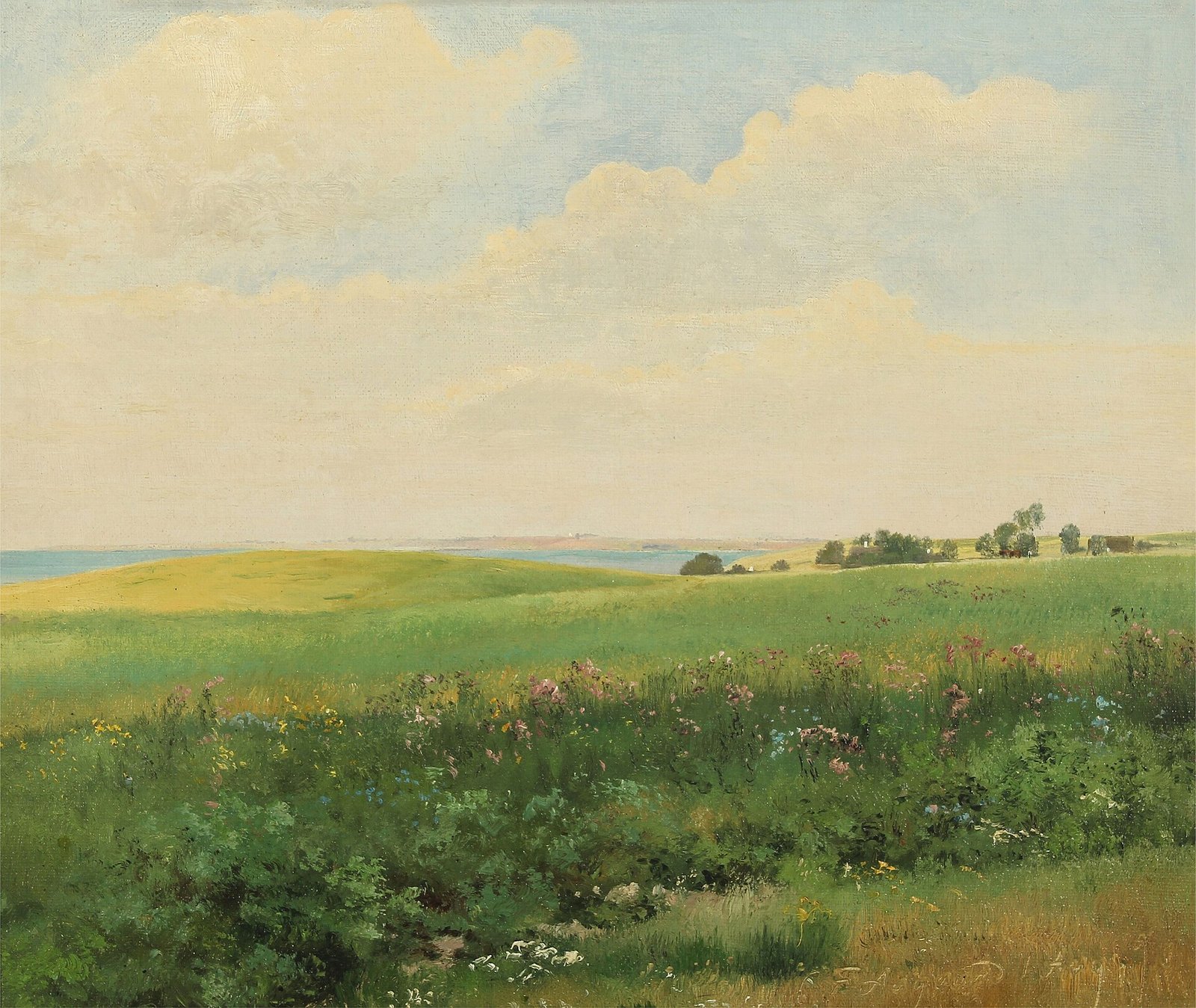
But this she does not know for sure, and stirred by the hope that she may yet find the ship safely brought to dock or anchor, she rises shakily to her feet. Uncertain either of where she is or of where she might find her companions, she looks around to study her surroundings for some hint of either; but she finds only indeterminate shoreline stretching in both directions, to the northwest and the southeast, and open sea opposite it. The landscape inland appears rugged and difficult to access, with stony cliffs undulating up to higher ground cloaked thick with tawny heather and grasses and trees of spruce and pine and birch growing even over the edge of the cliffs as if leaning to get a glimpse of the shoreline below. As for the beach, its rocky gray sands stretch for about ten yards from wave to cliff, almost entirely devoid of vegetation, though it is teeming with life. Tiny crustacean creatures crawl or dig through the sand, and, in places where the sand has created something of an alcove from the ceaseless undulation of the waves, and the water stands still and placid, fishes swim.
Relmaríndë sees all of this and acknowledges it, but her mind is preoccupied with the question of which direction may hold the greater hope of finding those whom she has lost. She settles on southeast, since the waves of the night before—or whatever night it had been—were turned northwards, and thus likely carried her in that direction. The ship, on the other hand, would have sought land as quickly as possible to escape from the threat of the mykkëvéngr, and thus have landed further south. She doubts the decision even as she makes it, however. And it is only upon experiencing this stirring of doubt and fear that she feels for the first time the depth and seriousness of her plight. She fully realizes now the uncertainty and anxiety of the fact that she is stranded with little knowledge of her location and with little hope or means of finding anything to guide her to civilization except good fortune itself. And her heart reaches out to Hældáris, wondering with a piercing pain born of doubt and fear whether or not he still lives. This fear of his loss weighs upon her heart far more than the insecurity of her situation or the concern for her own safety, and she casts about with her mind and spirit seeking to feel the reverberations of her husband’s presence, the echoes of his being making contact with her own. And yet she feels nothing.
What is she to do whenever she does not even know the direction in which to walk? Reflecting on this, she decides to cease walking for the moment and instead to set up whatever kind of makeshift camp she can to give herself time to rest and to listen. She clambers up the slope into the trees and grasses overlooking the shoreline, and searches for a sheltered place. She finds an ancient willow tree with its leaves hanging down low like arms to embrace and gathers together underneath it whatever fallen or broken branches she can find from the surrounding area, weaving them together to make a protection from the wind and the elements. It is not particularly cold at the moment, though the chill in the air is very noticeable to her without any possibility of changing her garments or throwing a heavy cloak about her shoulders. When she has done what she can, she curls up in this shelter and tries to rest both her body and her heart, allowing her spirit to repose in the All-Giver and there to find in him both safety and refreshment, as well as light for her path.
The hours pass and then she is stirred back into awareness of her surroundings and her plight by a distant sound coming to her through the trees. Pushing herself into a sitting position, she inclines her head to listen, and then she rises to her feet and steps out from the enclosure under the tree. The sun now hangs low in the sky to the west, soon to dip below the horizon and to bid farewell for the day, and the air is already becoming uncomfortable with the cold of early spring. Taking a few steps, Relmaríndë listens intently to the sound that had drawn her attention, and she hears it growing both nearer and more audible: voices, voices carried on the breeze. She attempts to close the distance between the sound and herself in order to make out their tenor and their words, and she notices a break in the trees ahead—yes, a section of road overgrown now but still in use if the wheel tracks rutted deep in the earth are any indication. At the same moment that she comes to the edge of the road and looks about, a large wooden carriage rounds a bend from the southeast, followed by a number of others of the same kind, and with them the voices too echo across the space between them and become fully comprehensible.
“Aye, up to Bornstad next, and then on to Aelthýrin after that,” says a husky male voice. “Our contact there expressed great interest, and at this rate we will have no cargo left to carry to Vælaróma, which, to be honest, is fine by me. I despise that city. They always seem to complain about the quality of our selection, both before and after purchase.”
“We do everything we can to find suitable stock,” replies another man’s voice, higher pitched and more youthful in sound, though the pitch does not give impression of tenderness but of snobbery and haughtiness, “and yet it seems they always prove inadequate in some way. How difficult can it be to find good specimens? You would think that there would be more hearty ones around.”
“You would indeed,” says the first voice. “Perhaps the problem is that the weak are easier to attain than the strong, even though the strong are ideal in every respect.”
“Almost every.”
“Aye, you are right. There is that.” And then after a pause, “Wait! Look over there! Hey you, what are you doing out in the wilderness like this?”
Relmaríndë takes a step back into the shelter of the trees, sensing that these men are neither welcoming nor safe, but in the same moment she knows that it is too late to withdraw or to flee. She attempts it nonetheless, though within a few seconds she is overtaken by men who have leapt from a carriage and rushed to her side. And now faces give flesh to the voices. Looking past the two men, she sees a few people, both men and women, emerging from the carriages, some stretching their arms and legs and others pacing about, evidently taking this opportunity to ease the burdens of the road. Many of them wear armor and weapons.
“She’s a beauty, ain’t she?” asks the husky voiced man, a crooked smile showing yellow teeth on his pock-marked face.
“What do you want?” Relmaríndë asks the men. “What kind of traders are you?”
“Traders? What makes you think we are traders?” asks the other man, his long and youthful face hardly made more mature in appearance by a scraggly beard. The childishness of his demeanor seems incapable of matching his age in years, and creates a bizarre impression of discordance.
“I heard you speaking as you drew near,” says Relmaríndë, taking another step back. “I only wish to be on my way to the nearest town, thank you. I wish you all the best on your journey.”
“Ah, but we haven’t even answered your first questions, lady,” says the same man.
“Forget I asked them.”
“No, I think not.”
“She’s a good pick, right Trygvë?” asks the other man.
“Good indeed.”
She turns again to flee but only makes it a few strides before she is caught, the larger of the two men tackling her to the ground and with his superior strength subduing her with ease. There is little she can do to resist him.
“Come on, Stagrímur,” says Trygvë. “Bring her. Let’s get back on the road without wasting any more time.”
And so it is. With hardly more ado than if she were an abandoned sack found on the roadside, Relmaríndë is taken into captivity, made another’s property for no other reason than that she was encountered alone in the wilderness by the wrong persons and does not have the physical strength to resist them. After grappling in mortal conflict with the seemingly unbounded strength and evil of the mykkëvéngr and surviving, the apparent absurdity of this situation is not lost upon her. But little time or attention does she have now for thoughts of this kind, or, indeed, for any other. Forced in the back of one of the carriages that has followed behind the first, she finds herself thrust into a barred cage concealed beneath a heavy canvas tarp. The metal door clangs shut behind her and keys jangle while the lock is fastened.
Looking about in the dim half-light that filters through the canvas, Relmaríndë sees that she is not alone. Two other women sit crouched in the back of the carriage, one hardly more than an indistinct figure in the corner, head buried between knees, and the other looking up at the newcomer with eyes that seem to gleam with both life and sorrow even in the darkness. After sharing a reciprocal gaze with the woman, Relmaríndë sinks down to her knees and tries to still the anxious trembling of her body. And to her surprise a hand is placed upon her shoulder.
“I wish I had something to say in this moment that might be of encouragement to you,” comes the woman’s voice, touched with a tenderness that Relmaríndë has only heard in those whom she trusts most in the world. “All I can say is that you shall find no help from man in the path that now opens before you, yet you need not for that reason lose all hope.”
Relmaríndë exhales slowly and places her hand upon the hand that rests on her shoulder, though she cannot keep it from shaking. “No man in this world has any power except what is allowed him from beyond this world. Long have my people faced hopelessness and loss and found hope still. Shall I, however, when I am tested, stand up to the task?”
So she speaks, but her heart trembles and questions. Ta, is this the answer to my prayers? Is this truly the path that you have opened before me? If so, why? How could this in any way serve your purposes or the purposes for which we set out to this land?