Hældáris. 3rd T.A. 29 (V.Y. 1174)
He finds himself engulfed in darkness and deafening silence, and he is at first aware of nothing but pain: a deep ache across almost his entire body and a sharper throbbing from the area of his left shoulder to his lower back. Even before he fully realizes that he is awake, a groan escapes from his lips, and, immediately following it, the sounds of the world come rushing in with the light of awareness. He hears the constant, low rumble of surf and, softer but nearer at hand, the crackling of a fire. And though it takes a moment for his mind to focus, he also makes out words spoken above him, and their meaning gradually forms in his mind. “Try not to move much just yet. I have bound your wounds but they need a little longer to heal before you can move about freely.”
Hældáris attempts to speak, but his voice fades away even as he tries to form words in his throat. And he realizes now that he lies prostrate, face down upon sand, though his head is propped by what feels like cloth so as to grant him space to breathe and to keep his face from pushing against the ground. And he recognizes now the voice that has spoken to him. It is the voice of Aeyósha. “You…” Haeldaris groans, at last able to form his thoughts into speech, “ah, my friend, you are here.”
“Yes, it is I,” the man replies, and Hældáris feels a gentle hand placed upon his right shoulder, as if in understanding and consolation.
“What ha—”
“What happened? I was able to save you from the sea, and to carry you up here among the rocks. For a moment, though, I thought it was too late. You had in you neither consciousness nor breath. But after coughing up a great deal of water you began to breathe again, thank the All-Giver.”
“But what about the others?” Hældáris exclaims, forgetting the prohibition on movement suggested to him and turning over onto his back in order to look up at Aeyósha. He immediately cries out in pain, although does not allow his friend to force him back around again; he must see in order to speak properly. And there are questions that need to be answered. “What happened to the others? What is the fate of Relmaríndë? What of the men with whom we traveled? Have they also survived?”
Aeyósha lowers his gaze in sorrow, and says, knowing that there is no benefit to hiding the truth, “I was able to save only you. The water and the sea serpent consumed the rest in death…”
“What? Not a single other person survived?” Hældáris asks, his heart sinking in sorrow and in disbelief.
“Not that I have found. I am sorry. I dragged you through the water as I myself swam, clinging to a timber, toward the shore. I was able to save no one else.” Hældáris sees the conflicted sadness etched deeply into his friend’s face. Even though he did what many would have thought impossible—he saved the king’s son from the attack of a great sea serpent—he was able to do no more than this.
But Hældáris is overcome with his own grief at this moment and he fails to emphathize vocally with Aeyósha, instead lamenting, “Even Relmaríndë! My wife…I cannot, I cannot believe that it is true. What happened to her? You saw her, did you not—how she was as though enraptured? She could not defend herself. What was happening to her?”
“I know not,” Aeyósha responds tersely.
“And I had her in my arms. I was holding her,” Hældáris continues, not attempting to restrain his sorrow and grief that seeks expression in tears. “But I was struck—struck by something—I know not what. And I lost her. I could not find her. She was gone. And now…” He does not continue but rather allows his voice to subside into sobs. Aeyósha, witnessing this, simply extends a hand and places it gently upon Hældáris’ forehead as if in blessing, allowing it to rest there until the sobbing has ceased.
After a number of minutes Hældáris speaks again of something else, as if resolved to hold the pain and grief of his wife’s passing, and of the loss of the men entrusted to his care, in the silence of his heart, as the pain is too fresh for words. “How long have we been ashore?”
“You have been unconscious for close to a day,” replies Aeyósha. “We washed ashore deep in the night. Oh, the relief I felt when my knees finally struck sand and rock! By then I could hardly make out anything in the nocturnal darkness, so I had to trust to my previous sense of direction to continue swimming toward land. I hauled you up onto the shore and out of the water, and revived you as best I could. The night was cold, and more bitterly so for the fact that we were soaked to the bone. As much as I felt I was soon to collapse with exhaustion, I carried you into this alcove of stone a ways from the shore and gathered fallen wood and twigs to start a fire. At last, as much as I wanted to stay alert to watch you and insure your well-being, I too slept.”
“I am glad you rested,” Hældáris says. “It is clear now that you needed it more than I needed watching.” And then, after a heavy moment of silence, “Thank you, Aeyósha, for saving my life. You did for me more than anyone could have expected of you.”
“Except perhaps myself. I realize that my expectations may be unrealistic, and that I demand of myself things too great, which others would not expect of me. But so it is. Would that I could have saved them all.”
“I understand your grief, and share it,” says Haeldaris, turning his body slightly and directing his gaze into the sky above them, which is awash with clouds full of moisture and threatening rain. Still feeling both pain and exhaustion, he then asks, “What time is it?”
“Nearly evening,” says Aeyósha. “I suspect there is an hour or two of daylight remaining before night falls.”
“We have been here but one day?”
“Aye. Not even a full day yet.”
“What about my wounds, Aeyósha? What have you to say of them?”
“How do they feel?”
“There is pain, but it is not too severe,” replies Hældáris. “Is there any serious injury?”
“I think not. Insofar as I can tell, the wounds are superficial. Nonetheless, we must take great care against infection. I have treated and dressed them as well as I can. There are two cuts—or rather gashes—one upon the back of your left shoulder and one on your lower back on the same side. Do you recall what caused them?”
“I was struck, though whether by a stray piece of the shattered ship or by the mykkëvéngr itself, I do not know.”
“Mykkëvéngr? That is the name of the creature?”
“Yes. It is a creature of the same order as those that once threatened our people with destruction.”
“I see,” says Aeyósha pensively. “You mentioned sensing something before the attack. Was this what you expected? Did you know of its nature beforehand?”
Hældáris opens his mouth to speak, but the thought of his wife for a moment silences him as a pang of grief pierces his heart. Only when he has collected himself is he able to continue, “Relmaríndë is the one who brought its possible appearance to my attention. She felt many things that I have only begun to sense and to feel, like echoes on the edge of my consciousness. She lived at the center whereas I know hardly more than the periphery. And thus her loss is grievous for more than just myself. It is a loss for our entire people.”
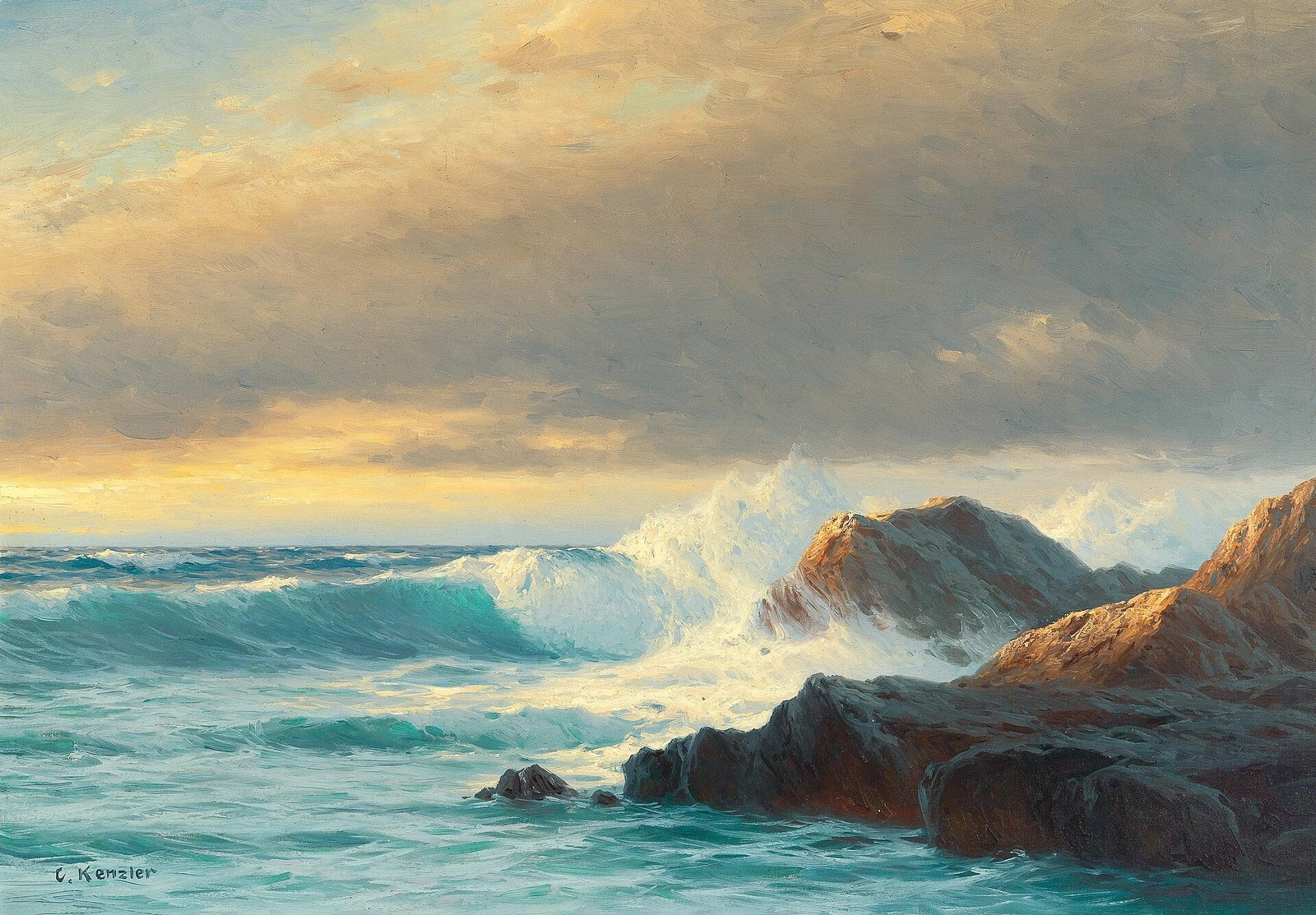
The conversation lulls for a moment into silence and both of the men listen without speaking to the crashing of the waves against the shore, to the whisper of the light breeze between the rocks, and to the intermittent sound of seagulls calling overhead. Finally Aeyósha interrupts the silence with a question, “Do you feel well enough to eat?”
“Eat?” Hældáris thinks about this for a moment, as in the midst of everything else the thought of food never entered his mind. “My body and my heart are overcome. Food means nothing to me at present, and I would wish for many days to yield myself to grief in silence.”
“And I wish that I could give you the time and space to do so. I am sorry that I asked.”
“No, please do not apologize.”
“Then let me leave you alone for a while,” says Aeyósha. “I earlier found some shellfish along the shore. While there is still light, allow me to find some more for the both of us. I may also be able to gather a bit of seaweed and perhaps even some fish.”
Haeldaris, at the thought of at last having solitude to give voice to his pain, is able to muster no more than a nod in response. As soon as his friend has gone from his sight, Hældáris closes his eyes and immediately fatigue, grief, and confusion overtake him again. His head throbs and spins from the pain of his injury and his brush with death, but even more from the grief that eats away at his mind and his heart. And the pain is too fresh, too raw, to allow space even for discursive thought, and his mind drifts in and out of blank spaces uncounted in time and memory, until sleep again gradually overtakes him. He is awakened by the smell of food cooking over the embers of the fire. Opening his eyes and rolling gently onto his right side (his left side pulses in pain from the weight that had been pressed upon it as he slept), he looks at the fire and sees above it a couple fish and some seaweed, all suspended upon sticks. On the other side of the fire sits Aeyósha, watching him, his face silhouetted against the warm glow, as twilight engulfs their surroundings.
“I was successful in the search, as you can see,” he says with a kindly smile, laced both with sorrow and compassion. “Shall I help you sit up? It might be good, as well, to get you up from the ground and to see if your stitches and bandages hold, or if blood flows again.”
“Aye, let us do that,” answers Hældáris. And as Aeyósha helps him he asks, “You gave me stitches?”
“That I did, though I had little to work with. Hopefully they shall last until your flesh heals sufficiently to hold itself of its own accord.”
“Were my father in the habit of giving titles and honors, you would be doubly worthy of one already,” Hældáris remarks, glancing at his friend and attempting to return his smile.
“And I am thus doubly glad that he does not,” Aeyósha says. “He came into his kingship not by any plan or desire of his own, and he knows that every man is to be judged not on titles that he has inherited but on the merits of his own actions. In fact, he knows that even these actions are never accomplished by force of will alone.”
“That is true. Nonetheless he has inherited a title and has done his best to step into it with humility and with responsibility. Would not receiving some such title allow you to pass on to your children a legacy that would invite them to walk in like manner?”
Hearing this, Aeyósha tilts his head to one side as if reflecting, and he says, “I shall need time to think about this, young prince.”
“You may call me prince if you must, but only in jest, and as long as I may in similar humor call you ‘the prince’s knight.’”
“If that is how you shall have it, then you shall not hear another ‘prince’ out of me for as long as I live.”
“So be it, ‘knight-guard and savior of the king’s son’,” concludes Hældáris, the subtlest hint of a genuine smile playing upon his lips.
“Oh, codswallop! Enough of that!” replies Aeyósha with a wave of his hand. “Let us get some food in that belly of yours. And while you eat I shall check your wounds and their dressings.”
† † †
Despite the moment of humor that the two men have shared, Hældáris sinks again even as he eats into a profound melancholy and this, in addition to his pain, makes it difficult to finish the food given to him. Eventually he sets the food aside. Aeyósha, for his part, finishes inspecting and redressing his wounds and sits down again by the fire. “I think that I can guess what caused your injuries,” he says, “now that I have had another look at them. I thought that they could have been from a spare piece of metal or perhaps splintered wood, as you suggested, but I think your other suggestion is more to the point. I suspect that the fins of the serpent caught you.”
Seeing the sadness also in Aeyósha’s eyes, Hældáris asks, “Does that bear other dangers besides the wounds themselves? Do you think that the creature’s touch may confer some poison or leave some other ill effect?”
“Considering that I have never even heard of such beasts, it is impossible for me to say one way or another. Only time will tell if you develop a yet worse ailment, whether natural or…unnatural. All we can do is watch the wounds closely and keep them clean.”
“You spoke of their cause in the singular,” Hældáris remarks. “Do you believe they were caused at the same time and by the same thing?”
“Perhaps, though again I cannot say. One thing that is clear to me, though,” replies Aeyósha, “is that your sword protected you, and may have saved your life.”
“What do you mean?”
“You do not remember? You wore the illoandir upon your back whenever you were cast into the sea. And I suspect that it protected you from receiving a much worse and more grievous injury. The jagged tears in your flesh seem indeed to be from the serpent, and would have been far worse were it not for your sword.” Leaning over, Aeyósha reaches for something hidden by the shadows among the rocks surrounding their camp, and, raising himself up again with the sword in his hands, he continues, “You see, here on the scabbard there are marks as of something sharp, cutting even to the blade: you can see the metal gleam through in the light.” And he hands the weapon to Hældáris, who inspects it and nods silently.
“Aeyósha,” Hældáris says after a long moment of silence, during which his friend has taken up his own portion of food and begun to eat, “what are we going to do now?”
“Sleep, I imagine,” he replies.
“Well, yes—but after that.”
“What is possible for us to do? A task has been entrusted to you, and by extension to me. I trust in your wisdom and discernment, and am confident that even in grief and loss we shall find a way.”
“But I would like your assistance in this discernment, and in the walking, both now and going forward,” says Hældáris.
“And you shall have it,” Aeyósha says. “But I would have your thoughts and advice, also.”
Thinking for a moment, Hældáris says, “Provided that I can travel, I do not think we should stay here for long. Nonetheless, I do not know either where we are or how we can proceed. We have come to this land for a purpose. Nonetheless, I already feel like it has been defeated. Should we seek passage back to Telmérion to bring word to my father and the council about what has occurred? Then we might take counsel with them and perhaps set out afresh. Or should we press forward and try to complete our journey, even if it is only the two of us?”
“It is an entire month across the ocean to return to Telmérion, and the serpent is still somewhere in its depths. Perhaps it has not had all of its fun.”
Shaking his head, Hældáris replies, “You are right in that. I am loathe to move forward as we are, and I feel little or no motivation in myself to do so. And yet not only is it the most feasible course of action, but going back may be neither possible nor advisable. Then it is settled: we shall follow through with the intent of our journey, even only you and I.” And he sighs, “But would that more than two survived! Would that none of us had been slain!”
“Indeed.”
“Now I know in some measure what my father must have felt,” Hældáris says, resting his forehead against the palm of his hand. “To live on when those who have been entrusted to your care have died. It is a dreadful thing.”
Aeyósha looks intently at him for a long moment, thinking, and then replies, “Dreadful… Yes, that is a fitting word. And little consolation would it be were I to say to you that it was not your fault that they perished. But it is true: it was not your fault. Indeed, it was far beyond your power to change the outcome in any way whatsoever. In that realization, perhaps, we can find some measure of hope that their deaths were not merely random events happening in an absurd world.”
“Are you implying that they were meant to die?” Hældáris retorts, with more heat than he intended.
With a sorrowful exhale Aeyósha says, “All men die someday. And I think it is not at all unreasonable to believe that the death of each person, be they man, woman, or child, is seen and held by the One who holds the entire universe in his embrace. We may all slip eventually through the cracks of this mortal life, but we shall never slip from his hands. This is believe.”
Nodding slowly, Hældáris says, “Aye…you know I do likewise. Forgive me for my outburst.” These are the words that he speaks, but in his heart he feels bitterness.
“There is nothing to forgive,” replies Aeyósha. “Feel as you must feel. Lament and cry out, question and even fume in anger if you must. That, too, is held by the same Love that holds all things.”
But at this point Hældáris has ceased hearing the words of his friend, lost in a wave of grief and sorrow no less intense and suffocating than the waves that had buffeted his men at sea. When at last he looks up after many minutes have passed, he is surprised to see Aeyósha’s face stained with tears that escape freely from his eyes as he gazes thoughtfully into the fire. There is no need to give voice or name to these tears. They spring from the same heart that only a moment earlier had spoken in faith and in hope, and somehow, beyond Hældáris’ ability to understand, they are at one with them.