Hældáris is stirred from his thoughts by the hand of Relmaríndë upon his shoulder. She crouches down before him and looks into his eyes with tenderness and concern. “Something is occupying your mind,” she remarks.
“Many things fill my thoughts,” he says in reply, pushing himself to his feet and standing face to face with her. “But as I sat here I thought particularly of Father. I miss him. And I fear that I shall never see him again.”
“I think I understand that,” says Relmaríndë. “Though I had no warning before I was separated from my people, it has been many years since I have seen them. And separations are painful, whether they are temporary or permanent.”
“This temporary separation,” says Hældáris, “or this fear of a more permanent separation, is nothing compared with what you have experienced and what you have lost. I should not have even brought it up.”
“Compare not the pain of one person with that of another. What you are feeling must be felt. This is your first real confrontation with the threat of death—and with one exception it is mine as well. To think of the risk and to experience the fear of loss: this is only natural. How can your mind not go back to the cradle of your home and the origin of your life?”
“I suppose so. It is just that you have known such loss and I have experienced such abundance.”
“I have also experienced abundance, even to overflowing, Hældáris,” says Relmaríndë, “and you have tasted loss and pain, even if different than my own. Why does it matter so much to you?”
He thinks for a moment and then replies, “I think it is because even after these years knowing one another and sharing so much of life together, and these years even of wedded love, you still remain a mystery to me, so far beyond my understanding. Or even better, you become a mystery more deeply felt the more I come to know you and draw near to your heart.”
“Do you think you are not a mystery to me as well?”
“No, it is not that…”
“Sometimes I feel unworthy to have you, my brother,” Relmaríndë says. “Do not underestimate the depth and breadth of what lives within you.”
“Nor should you, Relmaríndë,” he replies. “And do not underestimate the depths of my weakness and folly, my blindness and narrowness of heart. Sometimes I feel like a foolish moth drawn to a flame not knowing that it shall burn him.”
“And sometimes I feel like a frail flame about to be blown out by chill winds, and your presence preserves me,” she concludes, and then she turns back to the topic with which the conversation began, “You spoke of missing the presence of your father and fearing the loss of him.”
“I did,” says Hældáris, “Of course, I think of Mother as well. Yet for good or ill, in this moment it is Father especially who lingers, as it were, within me. I have wanted so deeply to be the kind of man that for the entirety of my life he has proven to be. To become a father as he is a father, and a king as he is a king.”
“You speak already in the past tense, Hældáris,” she interjects. “The story is not yet concluded.”
“That is true, yet I see little hope for anything but a premature end to a fruitless quest.”
Relmaríndë silently takes a step to the side and reaches out for something that leans against the wall, raising it up and proffering it to her husband. Seeing the sword in her hands, the same sword that once belonged to the king, he receives it in upraised palms. “This was his, and now it is yours,” she continues. “Let it be a reminder that you cannot hope to be a father unless you are first a son, or a lover of men as a king unless you are first the king’s beloved.”
Hældáris draws the sword to his body, as if to hold it to himself as one would a small child, weak and endangered. But he does this only for a moment before straightening his body, exhaling deeply, and slinging the baldric over his shoulder and letting the sword rest in its scabbard upon his back. “This sword has become so many things to me now,” he says at last, “which at first it was not. At first a gift of Hiliána, it has now become a king’s gift to his son and his heir—and for this reason as much as for its original intent, it is for me truly as its name suggests: illoándir, a lightbringer.”
A moment of silence is shared between the two as the ship continues to rock around them, and the sound of waves beating against the hull echoes through the cabin, and then Relmaríndë says, “It is almost dark outside now, as twilight descends into night.”
“I was lost in thought for so long a time?”
“You are more like your father than you know.”
“If our dispositions are so alike, then I hope that our actions may be alike as well.”
“Your actions will be your own, and such they ought to be.”
“Yes, but they will be true if they are born of the love that I have first received, and express that love in truth.”
Looking upon the countenance of his wife, Hældáris feels a surge of tenderness and affection and steps forward to draw her into his embrace. Holding her head close against his chest, he kisses the top of her head, and then he says, “I am fortunate beyond words to have a companion such as yourself, Relmaríndë.
Stepping back to look in Hældáris’ eyes, Relmaríndë says to him, “As you feel with regard to your father, so I feel with regard to my people. I feel as though their life and legacy have been entrusted to me, and it is a weight both heavy and light, which I carry and which, in my very burden, carries me.”
Nodding, Hældáris answers, “Neither of us shall have much chance of anything, however, if we never reach the shores of Vælíria and instead perish upon the sea. Or rather, within it.”
“And I thought you were the optimistic one, and your sister the anxious one,” Relmaríndë remarks, and though her words could be understood as a rebuke, Hældáris knows that they are not. She is rather trying to make light of the situation not in flippancy but with a touch of humor and remembrance, drawing her husband’s mind back to earlier days when danger was not so pressing.
“There is much yet for me to learn from my sister,” he says, “and I wish that I had more time for this before I departed, since my eyes were so late opened to the true beauty of her heart.”
“We may yet return.”
“Aye, we may yet. Though I find that difficult to conceive of at present.”
“In that respect, shall we go up to the deck of the ship to gauge the seriousness of the storm, and to inquire of the captain?” asks Relmaríndë.
“I suspect we shall be of little assistance, but let us go,” Hældáris says, and at this moment a shout sounds from above, too muffled to understand but clearly a shout of concern.
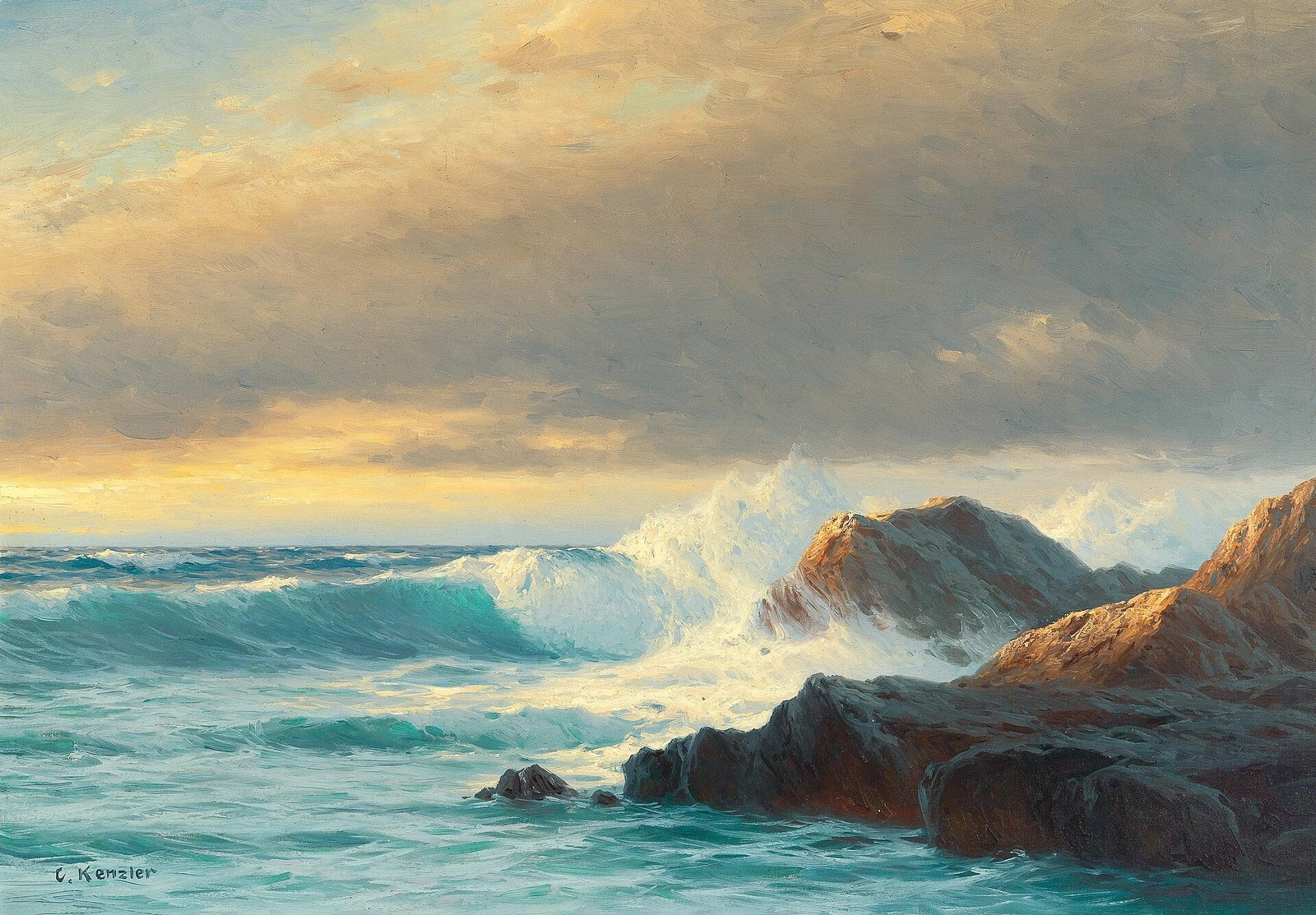
Almost as if the timing was arranged precisely for the end of their conversation, they both hasten up the steps to the deck, whereby they are immediately pelted by heavy and cold drops of rain slanting down like a sheet from a densely clouded sky. Not only are they greeted by rain, however, and the wind that carries it through the air, but also by a flurry of activity even more intense and feverish than they witnessed when the ship’s crew was preparing for the coming storm. The waves are tumultuous, but to their immediate estimation not dangerously so, at least not enough to threaten sinking the ship. Seeing the captain Hældáris draws near to him with Relmaríndë at his side and calls his name, “Olándir, what causes this ruckus? Is something amiss?”
Turning his body in mid-movement, as if to answer Hældáris while not easing the momentum of his own activity, Olándir shouts back over the noise of the wind and the rain, “Something is amiss indeed. And it is not the storm.”
“Not the storm?” Relmaríndë voices for them both. “What then do you mean?”
It is as if the bottom drops out of their hearts whenever they hear the captain’s response, “There is something in the water. Something very large. It is making passes beneath us.”
“How long has this been happening?” Hældáris asks when he finds his voice again after the first shock of fear and surprise.
“Only just now has it begun,” Olándir says, and then he adds, “Listen, I can’t stand here chatting while my men need me. If it is some kind of aggressive beast, we need to prepare the weapons immediately.” And without allowing them any time for further words, he turns and moves away.
Immediately Hældáris and Relmaríndë share a purposeful glance and the former says, “What are we to do?”
“Do? I don’t know that there is anything we can do,” replies Relmaríndë, the expression that crosses her face one that Hældáris has only occasionally seen before, a countenance of profound anxiety and grief. And this, even more than her words, startles and alarms him. For as sensitive, kindhearted, and gentle as she has always been from the first day he met her, he has also sensed in her an incredible strength of mind and heart, and even of body, which is unlike that of ordinary mortals. But here she has found her match, and more than her match.
“W-we must try,” he says, trying to force some measure of calmness and courage into his voice, though he feels none in his heart. Grasping about in his mind for some course of action, he continues, “I shall gather the men together and tell them to take their weapons. This beast shall not have us without a fight.”
Her mind clearly occupied with other thought, Relmaríndë nods absentmindedly and watches Hældáris from where she stands as he disappears into the body of the ship once again.
“It is as I feared,” she says to herself under her breath, but follows it immediately with, “Oë Eldaru ya tua Illiandir, hygas en venas a noän, en daras elandra ya ren tua, aïn haifa ohomë nu ti.”
With this entreaty she walks to the edge of the deck and, holding tight to the railing, directs her gaze downward into the waves, seeking to plunge to their depths and to see the threat that assails them. And it does not take long, but a few moments, before she sees it: a long and dark bulk slithering through the water no more than twenty yards beneath the ship. Yet even so, she feels it before she sees it, and the feeling is so intense that it almost pushes her to her knees. Her legs buckle so violently that she remains standing only because of the railing to which she clings.
A mysterious presence seeks entry into her mind, invading her senses and her consciousness as if to throw open the doors of her freedom and to ravage her interior. It takes all of her self-presence to resist it, and the struggle is so intense that she loses consciousness of everything else around her—of everything but the struggle of two interlocking minds and wills, hers and that of whatever force moves the mykkëvéngr and gives it life. In all that follows she is unconscious of her surroundings and knows only this clash of beings, this invisible strife of spirit and spirit, of light and dark.
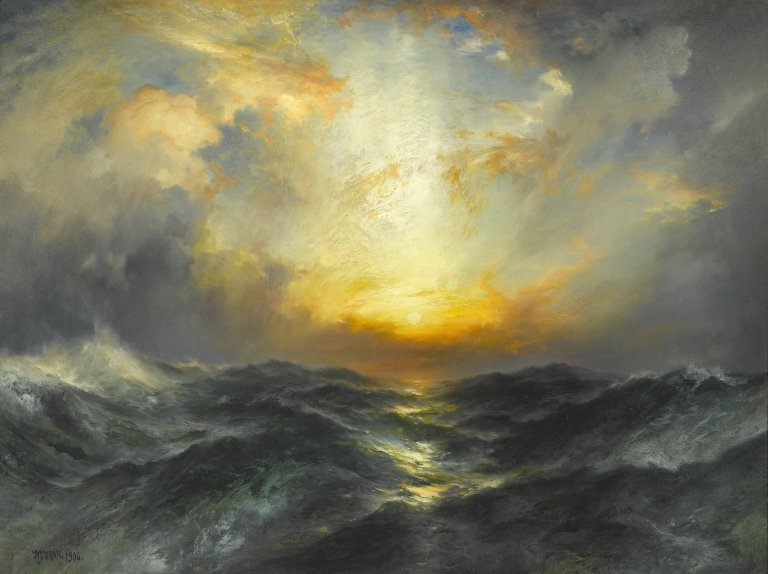
Hældáris, returning now to the deck of the ship with the men under his command following shortly behind, see her and makes a move to draw near to her. At that moment, though, another shout is heard and all eyes turn to the west, where the face of the setting sun shows through a cleft in the parting clouds, its light glittering brilliant across the cresting waves and through the falling rain, even as it descends from twilight into darkness. And they see it, the thing toward which the shout directed the attention and the hope of all: land! A mass of land lies before them on the very horizon of sight silhouetted against the last fading light of the sun and thus unmistakable.
“Keep your harpoons and lances trained on our foe,” cries Olándir in command, “but set your hearts toward land. We have yet a sliver of hope!” With these words the captain, in a burst of energy and speed, goes below deck to engage the remainder of his men in the near fruitless task of using oars to row through the stormy waters toward the shore that awaits them. Thankfully the storm is not any stronger than it is, and the waves and the wind are pushing them already in a northwesterly direction, so they shall not be fighting the swell of the ocean directly. But there is still little or no hope that they shall attain land if the creature threatening them launches its attack.
Hældáris comes to Relmaríndë’s side and speaks to her, but noticing that she is unresponsive—enraptured in some mysterious interior battle or dialogue, and unresponsive to his words and his touch—he grasps her arm to steady and protect her. Aeyósha too comes to her side, and, after looking deeply at her and then at Hældáris, he turns his gaze to the water. Then comes an intense moment of expectation in which the very air itself seems to hold its breath, and all of those upon the ship feel as if a wicked hand reaches out to grasp their throats and to strangle them. And as soon as the moment comes, it passes, and the air is broken by the bellowing cry of Aeyósha, “Here comes the beast!” Only a second or two later the sound of his voice is dwarfed by the roaring of swelling waters and the deafening crash of wood as the mykkëvéngr, its scaly serpentine backside, jagged fins splayed out along its length as they break the surface of the waves, rams against the ship.
Wood shivers and splinters and the ship rocks so violently that many men lose their footing and fall hard against the deck, arms flailing wildly for some means to steady themselves and rise to their feet again. But the ship holds.
Aeyósha lets out another bellowing roar, this time not a communicator of words but only an expression of frustration and of fear. And then, turning back, he sprints to the other side of the ship and casts his gaze into the waves. “If it comes back for another, I think we shall not survive.”
Captain Olándir reappears on the deck and says, to no one in particular, though all his men attend to his voice, “The hull has been damaged, but only slightly. With any luck we can withstand even a few more blows, though the ship will be taking water.”
“I fear it shall be much worse than that,” retorts Aeyósha, turning to face the captain.
“What do you mean? What do you know of seafaring?” asks Olándir.
“Of seafaring I know nothing. But of the behavior of animals I know much, of animals hunting and consuming their prey.” Aeyósha’s eyes lock with those of Hældáris, who for a moment turns his gaze away from Relmaríndë—still captured in her inner struggle—to look at his friend. Then Aeyósha looks directly and intently at Olándir. “This beast is toying with us, captain. I’ve seen it so many times before. It—”
But his words are interrupted whenever the mykkëvéngr rams the ship again from the opposite side of the hull with equal force. When the men have steadied themselves again, Olándir says, “How could it do more damage than it has? It seems the ship yet holds against its strength. Does it not ram us with all its might already?”
“Have you seen it up close, captain?” Hældáris asks, turning to face him even as he keeps a hand tight on Relmaríndë’s arm.
“No, I was—never mind. We do not have time to talk,” Olándir says, and turns away, considering the conversation concluded. “Prepare for another hit!”
“But you don’t understand!” cries Hældáris, voicing what is in Aeyósha’s mind as well. “The serpent has fins like blades upon its back. We have not seen the worst of it yet.”
“Oh, by all the gods above and below!” the captain curses, spitting, though this has little effect as his spittle is caught up in the wind and the rain. “Prepare to struggle for your lives, men!”
And then it comes. The serpent’s long body snakes up above the cresting waves and for an instant the eyes of all are fixed upon it in terror, and then it slams against the ship with full force, the fins of its back slicing into the hull like the blades of a jagged-edged saw against old wood. The ship shakes violently and a terrible crack sounds through the air as it splits in twain. The force of the hit and the splitting of the ship throws most of the men off balance and many, even trying to hold on to the guardrail or rigging or mast, plummet into the water. Only a few manage to remain where they are. And even for those who withstand the chaos and the movement, little can be done. For where they stand soon changes, as the parts of the boat twist and turn in the crashing of the waves, undulating up and down and thrashing about wildly, threatening to overturn entirely and plunge them headfirst into the waves.
And even then the mykkëvéngr is not done, and it returns again, sawing through one of the remaining halves of the ship. After this Hældáris sees little more, as the force of the hit dislodges Relmaríndë so violently that she nearly catapults over the railing and would fall straight into the sea had Hældáris not such a firm grasp upon her arm. But even this is to no avail, and the movement of the ship as it splits asunder is too much for him to keep a grip both on her and on the handrail. He releases his handhold on the ship in order not to lose his hold upon his wife, and they both together plunge into the water of the ocean.
What happens after this is difficult to express in words for the sheer terror of it and for the amount of things that occur in such a short span of time. Hældáris lays his arm tight around Relmaríndë’s waist and tries to hold her limp body close to his own while with his legs and his free arm he attempts, though vainly, to remain above the water. With every new wave his head is thrust under and he takes a mouthful of water, salty and cold. The sun has all but set now and everything descends rapidly into darkness, but Hældáris knows some of what is happening around him simply by the sound: the mykkëvéngr continues to ram the ship until it is in what must be splinters, and the shouts of men echo all about him in the water, cries of fear and of pain, but also cries of friendship even in the face of death as men cling to one another and seek to aid their companions in grasping broken pieces of wood and directing them toward the land that looms as a black shape in the distance. And over all this, the whistling of the wind and the swelling of the waves continue.
Among the din the shouts of Aeyósha are heard, encouraging the men in a loud voice. Hældáris too wants to encourage these men who have been entrusted to his leadership and his care, but he is unable, both because all of his effort is spent in trying to breathe against the onset of the waves and to keep himself and his wife above the water, and also because in this moment there is nothing he could find within himself to say. His heart is broken and his mind is spent, and he is staring into a black pit of bottomless evil, opening wide maliciously and laughing in mirthless delight as it devours him and all those around him.
Suddenly he feels a firm grip around his chest, heaving him up from the water—and Relmaríndë in his arms—and his side strikes against something hard. Wood. The grip releases him. He realizes that he has been lifted up onto a sliver of the hull that, though he cannot tell its size, seems wide enough to hold almost his entire body above the water, with only his lower legs dangling still in the chaotic water. “Now stay there, and hold tight both to her and to the raft, if you can.” It is Aeyósha’s voice. How did he get so near? And how did he see his friend in the darkness and the chaos?
But there is no time to answer these questions. He feels it in his heart and his mind before he feels it in the water: the serpent passes directly beneath him, and there is a bulging of the water, almost a boiling, as it passes; and even as chaos engulfs him Hældáris finds himself for a moment looking up at a narrow break in the clouds above him, through which a handful of stars glisten. And then the wood beneath him splits and the water drags him downward into its voracious depths. In the vehemence of this movement the wind is knocked out of him and for a moment consciousness slips away. As quickly as this happens, however, he wrenches himself back into the waking world, only to find that Relmaríndë has slipped from his grasp.
“No! No! No!” he cries in panic, batting the water wildly with his hands in an effort to find her, to grasp her before it is too late. But instead a wave catches him full on and thrusts him deeper under the water, disorienting him entirely. His body twists and rolls uncontrollably, and indecision takes him. With half of his mind and his body he reaches out for his wife, still searching for her in the muffled underwater tomb, hoping against hope to lay hold of her, and with the other half he tries to orient himself and to propel himself back up toward the surface. In effect he is rendered immobile, and he feels the life begin to slip from his limbs, as much in shock as in despair, as much in loss of air as in the pain that splits through his body. And he sinks into darkness.