Albrýndaer. Vælírian Years 1146-1147 (2nd T.A. 989-990)
One unavoidable part of growing up in a prison, even as unusual a prison as this, was the fact of criminals. For not all who were cast into the subterranean dungeons were condemned only for political motives; there were also many who were doers of evil in its many manifestations: murderers, thieves, brigands, and the like. And one such criminal stepped into Albrýndaer’s life when he was still small and vulnerable—budding, it is true, into life, but too weak to defend himself—and caused what is one of the deepest and worst of traumas: the ravaging of the heart through the violation of the body. Like a despoiling bear neither gentle nor loving, this man, Méldor by name, an acquaintance and even friend of his family, caused a damage to the eleven year old boy’s already malnourished and frail body—and to his sensitive heart—that would leave scars forever.
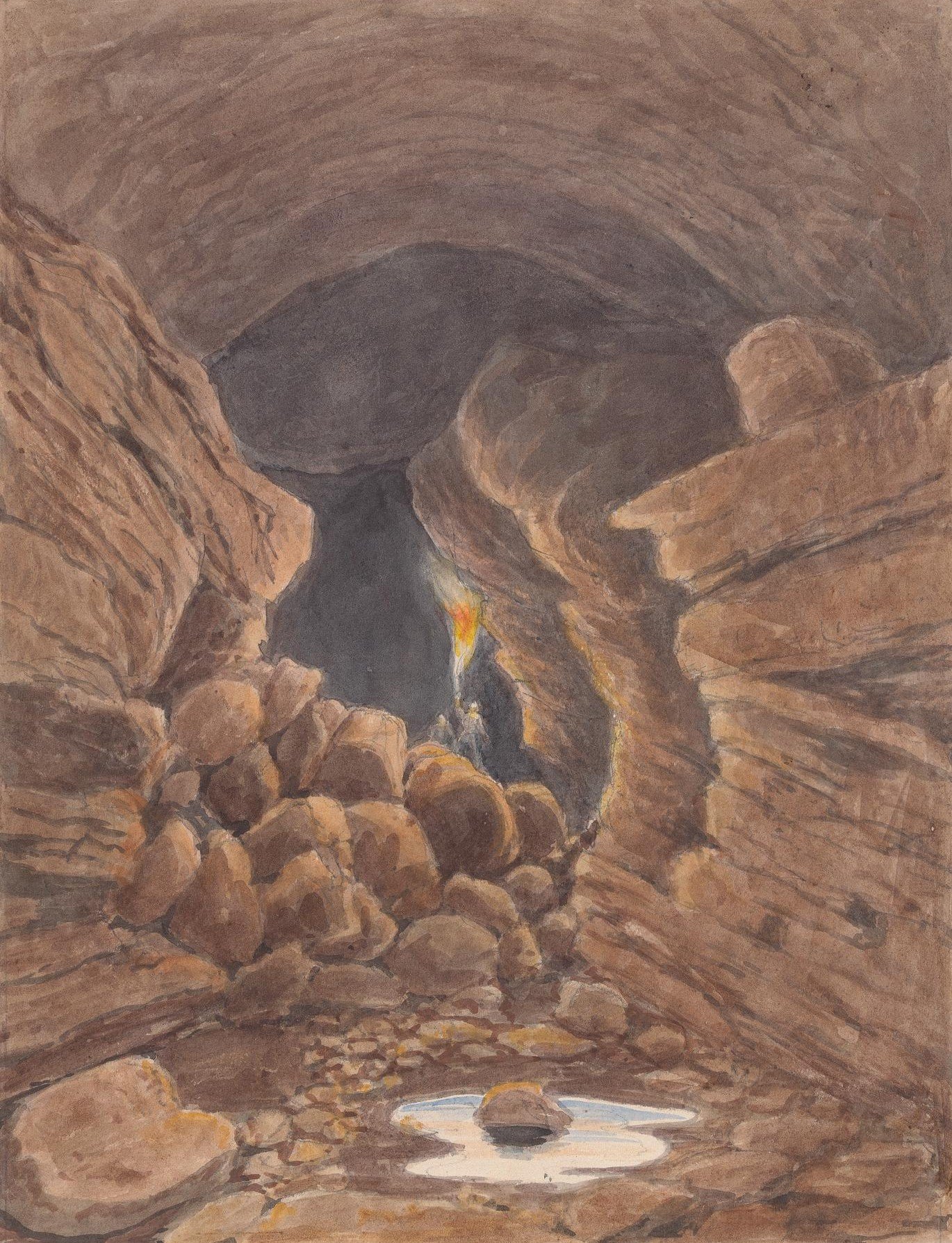
And what followed upon this experience, though intended to bring healing and security, in fact brought yet further scars. After this happened to him, Albrýndaer, confused and conflicted, fled from the inhabited area of the caves, unable to bring himself to return yet to his family, or to speak with any others whom he might come across. In the dim light of the glowing veins of ore, he passed into the narrow tunnels that branched off from the main cavern, paying far too little attention to his location and almost none to recalling the path so as to find his way back again. In this moment it seemed to him almost preferable, after all, to disappear from the sight of all, to take refuge in some small crevice of stone and to make a safe nest for himself. And this he did, if only for a moment, when exhaustion began to overtake him.
He curled up in a small alcove at the end of a narrow passage, clear water dripping slowly at intervals into a pool not far away. Letting down his hair and drawing his cloak tight about him, he tried to slip from consciousness into sleep. But instead his body only let loose its pent up tension and began to shake uncontrollably as if in fever, both cold and hot, burning with chill and sweating with icy perspiration. And in his mind, before his inner eye where the impressions of sight and feeling remain even after their objects have passed away, he relived again and again the moments of his desecration. The face of the man, and his voice, and his rough touch, came again and again in waves, unwanted yet inescapable. And try as he might to move beyond them to some meaningful thought, to some escape, he found all avenues closed and the same horrific experience approaching him from all angles.
Wrenching himself from his fetal position, he threw himself forward onto the stone floor of the passage and plunged his face into the cold water of the pool. He bathed his face and his arms over and over again, and then his whole body, as if the touch of water on flesh could somehow reach deep within and purify also the shame and confusion, the regret and loss, that he felt deep within himself. But instead he found only physical illness, due to the combination of his anguish of heart and his cold dampness of body. When at last he woke from the sleepless oblivion that eventually overtook him and left him lying numb upon the hard stone, he shook truly from head to foot with terrible chills, and his body ached with severe fever.
How long he remained in this place and in this position, the shadow of death hanging over him, he did not know. And little was his mind present enough even to ask such a question. Only a thin thread of self-presence remained, the inner core of consciousness, the sanctuary of the “I” that abides even when all else seems plunged into nothingness through sickness, intense suffering, or affliction of spirit. And all of these he bore simultaneously in this time, and they bore down upon him until one thought alone remained with him, one impulse, stretching out as if a child trying to emerge from the womb or a plant to break through hardened soil. This thought was that the Love that had held him from his earliest days, from the very origin of his life before he even left the sanctuary of his mother’s body, stood always in opposition to a lovelessness, an evil, so deep and so terrifying that its sight and experience could bring nothing but horror. And if Love had held him always, there existed also something that sought to sever him from this love; and if security had touched him and even pervaded him before, so insecurity now crept up on him—no, more, it violently rent its way into his very self, as if a poison injected into the flesh there to pollute all, until sick and unfit either to receive love or to give it.
This was Albrýndaer’s first taste of true horror and loss, the taste of a world severed from the Love that gives all things meaning. And with the slightest thread of his remaining consciousness, he hated such a world, and feared it. Yet even more, his inmost heart reached out, with a sinuous aspiration so frail and so subtle that it was hardly more than a thin thread of web in the darkness or a single hair of the head fallen to the ground unseen: his heart reached out for the Love that in that moment seemed so far away, the sole lifeline to save him from drowning in the murky waters of death and despair.
He was found like this days later, though he knew it not. Consciousness only returned to him whenever voices penetrated into his mind as the person carrying him in their arms drew near to the encampment again. With eyes fluttering open, he beheld an unrecognizable bearded face directly above him, and others farther away, blurred as if seen from deep underwater. And then all thought and awareness slipped from him again.
Only when his raging fever calmed, through the ministrations of his parents and a member of the community who was skilled in the arts of medicine, did he open his eyes again. And he found himself lying now on his back on his own pallet and in his own dwelling, many layers of cloth thrown over his body to keep him warm.
Eventually his father drew near and bent over him, his face lined with worry, but also with anger. At first, Albrýndaer assumed that the anger hidden in Daeran’s expression was directed toward his son, but soon it became apparent that the reality was otherwise. “How do you feel now, my son?” he asked.
“H-how long has it been?”
“Since you were found? It has been close to two days,” said his father, “though you were missing for just as long.”
“I am sorry,” Albrýndaer said in a whisper.
“Why do you apologize?”
“I am sorry for endangering myself and leaving the camp.”
“Please do not concern yourself with that, my son.” Then, placing a hand upon his child’s forehead to feel for fever, though perhaps this was but an excuse for a gesture of tenderness and compassion, he repeated his original question, “How are you feeling now?”
“Better, I think,” replied Albrýndaer, “though I remember little of these last days.”
“Yes, of course…though it is clear you are getting better. Otherwise we would not be able to hold this converse at all.” Then a shadow crossed Daeran’s countenance, and he closed his eyes for a moment, as if to shake away phantoms from his eyes or to summon up some clarity and courage from deep within. “I do want to speak with you, however, about what led you into the tunnels. What could have driven you to do something so rash?”
“I-it was nothing, Aba,” answered Albrýndaer, finding himself torn between the desire to share the pain and shame of his abuse with his father and a deep-seated inability to bring himself to do so.
But to his surprise, Daeran said, “It was not nothing, Bryn,” using the nickname that only his parents and Ílya used to refer to him, and, at that, only in moments of special intimacy or poignant speech. “We know that something serious happened to you. We had to care for you, after all, in your illness, and we inspected your body.” And then, after a moment’s hesitation, “Someone did something terrible to you. This much is certain, and if you are not willing to share this fact with us voluntarily, then I must insist upon bringing it up.”
In response, Albrýndaer simply burst into tears, tears of embarrassment and tears of relief, knowing now that his secret was known before he had time himself to hide it or attempt to forget it. In response to these tears, Daeran leaned forward and wrapped his son in his embrace, holding him silently for a long time until the his tears were spent, and his sobs had given way again to silence, and the shaking of his body to stillness.
Leaning back and looking deeply into Albrýndaer’s eyes, his father said to him, “I would like to know who it is that did this to you. You understand that, do you not? Great ills could follow upon keeping this a secret.”
Unable to speak at first, Albrýndaer but nodded silently, wiping the lingering tears from his cheeks and drawing his knees up to his chest. But then, as if to break the strangle hold that was soon to grip him and steal his voice entirely, he spoke the truth to his father and told him the identity of his abuser. A flash of emotion crossed Daeran’s face upon hearing his son’s words, but it swiftly hid itself again. The latter understood only the manifestation of anger and disappointment, and a deep sense of betrayal, that a man whom he had considered a friend had done something so horrific. But the rest remained beyond Albrýndaer’s grasp, and even as he looked up at his father, intense exhaustion again overtook him, and he collapsed back into his bed. Seeing this, Daeran drew the covers again over him and, with a gentle whisper, said, “Rest now, my son. And worry no more about anything.”
And whether he wished to do anything else or not, Albrýndaer could not but follow his father’s words, and a deep, albeit dark and troubled sleep took him.
When he woke again his mother, Milly, was present, and their eyes met for a long moment whenever he sat up and turned to her. It was not difficult for him to see that she had been weeping, and had only shortly before left tears behind, as her eyes were still red and swollen. Forcing a smile, she said, “Let us get you something to eat. You feel well enough to eat, do you not?” He nodded to this and watched her silently as she busied herself preparing him a meal. “Since you were unconscious for so long, we had to get water into you one way or another, but it was impossible to do the same with food. You must be beyond famished.”
“I suppose so,” he replied, “though I really have not had time even to notice that.”
“Well, regardless of whether you feel your hunger or not, you need nourishment, otherwise another kind of illness will overtake you.”
“I could eat, and I suppose that is what matters.”
“In that you are right,” Milly said, sitting down before him and handing him a platter of food, which he began slowly to eat. “Your fever has been gone for over a day, and even your restless sleep gained some measure of repose at the end. I knew that you would return to us—return to normal—soon.” Something about the pronunciation of this last word, “normal,” sounded to Albrýndaer’s ears strained. In fact, the lighthearted manner that his mother was now presenting appeared to him contrived, and he wondered what bothered her so. Yet even if it was only the grief and sorrow of knowing what pain had been inflicted upon her son, this was more than enough.
“Where is Aba?” Albrýndaer asked when he had finished eating.
Lowering her eyes, Milly replied softly, “He is out. But worry not. He shall be back quite soon, I am sure.”
“Perhaps I should rise and try to walk some. I could perhaps seek to find him,” said Albrýndaer. “I imagine he would be glad to see me up and about.”
“I…no, I do not think that is best,” retorted Milly hastily, and the intensity in her voice was far beyond what simple concern for the health of her son would merit. This Albrýndaer could not doubt.
“Why not? I am feeling quite well enough for that,” he pressed. “It might do me good.”
“No, you really should not. Please stay inside for now, and rest. I will tell you when it is good to leave our dwelling.”
“Leave our dwelling—”
“I mean to press yourself too hard,” his mother corrected herself, before he could say any more. “We do not want you slipping back into sickness, do we?”
Just as Albrýndaer was about to open his mouth again, another voice sounded from behind his mother, and a moment later the figure of his father appeared in the small cavern, the thick leather flap of the makeshift door—like that of a tent—shutting behind him.
“It is good to see you up, my son,” Daeran said. “How feel you now?”
“I am full well again, I think.”
“Good, good. I am glad to hear that. I have something else to show you, which might help your peace of mind and body still further.”
“And what is that?” asked Albrýndaer.
“Why do you not come with me, and I shall show you?”
When Albrýndaer made a motion to rise, his mother caught him with a firm hand upon the shoulder, resisting him. But her face was turned not to him but to his father. “Daeran, what are you thinking?” she exclaimed, tension strong in her voice. “Did we not discuss this?”
“We did, but I have not changed my mind.”
“It would not be helpful for him.”
“And why not?” Daeran said. “He needs to know the way that the world works, and to understand that we are all on his side.”
“But this is wholly unnecessary.”
“I think not. I think it more necessary than anything. We cannot shelter him forever. Look, after all, at the world in which he is growing up, and the suffering to which he is subjected to day after day.”
Seeing the heat of argument rise between his parents, Albrýndaer shrugged off his mother’s hand and rose to his feet. Both of them turned to him, surprised at his quickness and his resolve. “It does not matter,” he said with hardly a thought. “Let me see what Abawishes to show me. I am old enough to handle it now, and I would regret not seeing it, now that I know his intentions.”
“But you would not, son, you would not,” sighed his mother, but even so her eyes revealed that she recognized her defeat. If she were a woman of stronger will, she would have resisted still further, but her spirit now was broken through the events of the previous days, and through the years that she had been imprisoned far from all the light and beauty of the life that she once knew.
Wrapping an arm around his son’s shoulders, Daeran led Albrýndaer out of their dwelling and through the scattered tents of the encampment to what he knew to be the “town center,” if this encampment could be called a town. Like others of its kind, scattered throughout the massive cavern that was the dwelling of all the subterranean “prisoners” of the Empire, it was smaller than the usual village above ground, with a form of governance and authority more like that of a family than an institution, just enough to keep chaos at bay and to facilitate cooperation between the different members of this unnatural and forced community.
When they came to the center of the encampment, Daeran stopped walking, and Albrýndaer stopped with him, though at first he did not understand why. In the half-light of the cavern it was difficult to see anything clearly at a distance, but as he peered forward in the direction that his father gestured, Albrýndaer discerned a sight which immediately made him regret so hastily dismissing his mother’s warnings. In the very heart of the encampment’s center, erected out of wood and cloth, was a gibbet a good ten feet tall, and the figure of the man for whom it was made still hung upon it, the rope tight around his neck and his legs dangling freely at an odd angle, showing that his neck had been broken when the support under him had been pulled away. The vision seared itself into Albrýndaer’s mind and imagination like a brand of fire pressed against the flesh. But in after years what would haunt his dreams as much, or more, than the vision, was the eerie sound of the rope creaking in a slow rhythm under the weight of its victim: a man who had surely done great evil and had desecrated the innocence of a young and helpless boy, but who had now been made a grotesque spectacle of death in the name of justice.
Overcome by this vision, Albrýndaer was saturated with a feeling of disgust, not only at what he saw, but at his father for bringing him here, and at his mother for allowing it—and at himself for witnessing it—even as his heart burned at the memory of his abuse at the hands of the man who was now suspended as a corpse before his eyes. Little then did he hear his father’s words, “You understand, do you not, Bryn? This was necessary. It was impossible for us to leave this man unpunished and free, for he could harm others besides yourself, were he not to attempt to hurt you again as well. This was done to protect you. In a climate such as this, there truly is no other choice, if any semblance of safety and of justice is to remain among us.”
† † †
In the months and years following upon these events, the tenor of Albrýndaer’s life changed drastically. How could it be otherwise, after his own person had been violated so profoundly and so directly, and, in the response given to this, the very security and understanding that he had always felt from his father and mother from his earliest days was all but shattered? Had they manifested true empathy and compassion, focusing on sheltering and caring for him rather than on punishing his abuser, and involving him in the trauma of witnessing his death, perhaps things would have been different. Perhaps he would have been able to speak with them of the immeasurable pain of heart that he bore within himself after the abuse he suffered. But instead he found himself slipping away from them more and more, closing off from them both his heart and his life; and if he shared himself and his aspirations with them before, he did so no longer. All their inquiries into his well-being were met with resistance or evasion. They continued to play a large role in his education, but the most intimate and secret core of his person was now closed off to them entirely; and even if Albrýndaer wished to open it to them—and a small part of him did—he found himself incapable of doing so. For a fundamental distrust had taken root in his heart following upon that terrible and traumatic week, a distrust that would mark him for years to come. It was a distrust not only in his mother and father, but also toward others as well, as if his disposition, which before inclined spontaneously to thinking the best of other persons and assuming the good in their intentions and the wisdom of their actions, inclined now instead to thinking the worst, or at least remaining always on guard for the hurt that he assumed would unavoidably come were he to allow himself again to trust in another.
And much of the marvel and beauty of reality, of its wonder and its sparkle, was faded in his eyes, and a heavy shadow fell over all things. But this shadow fell especially upon his own heart and his own body, and of all the places where the pain of his loss were felt, it was in his relation to himself that he felt it most keenly. The scars of hurt, the scars of confusion and shame and fear, cut so deeply into him that he did not know if they would ever heal, or if their healing was possible. And though he continued to believe in the Love that held him always, a Love wholly good and wholly beautiful, a seed of insecurity and doubt was nonetheless implanted deep within him. A part of him now felt a world far contrary to the one that he had known before—the world held always in the security of Love—a world, rather, of profound isolation and insecurity. Which one was the true world? Could they both be true, or had the new depths of evil and darkness that he discovered revealed the falsity, the naivetë, of the world of love in which he had once believed?
His heart thus bore a profound awareness, and a profound question. If this world had truly been born from the heart of an eternal Love, what had happened to turn it into the world that he now knew, a world marred by evil and teetering on the brink of the abyss, an abyss of loss, insecurity, and ultimate aloneness? In his own life, the answer was evident, all too evident: it was the evil that he himself had encountered. But this was no answer to the true question his heart asked, for behind the direct ills that afflicted him, behind the human failure and malice that resonated in his own heart and flesh, he felt a vast ocean of evil. In every human heart—in his very own heart—this evil dwelt, a tendency broken and obscure, opposed to the light, and often kindling into actions which hurt the lives of the living and shattered relationships. An evil both personal and cosmic: this is what he felt, an evil that lived inside every person as some heritage of the past, some trait that all bore as part of their inheritance in this world, and yet also an evil that fell upon all of them from without, like a heavy shadow weighing upon them and seeking to resist and oppose their ascent to the light, seeking to oppose their movement beyond the evil that lived within them and toward the Love that called them. But even in this struggle, in this fight against evil both within and without, love and light also drew them, fought for them, and protected them, also both within and without. For in the confrontation with evil, an innate aspiration to beauty, to goodness, to truth—to love—also lived within every single human heart. And the world still sang its mysterious song, a song marred by evil and discord, yes, but giving hints of a harmony still.
In light of this, despite all the loss that Albrýndaer suffered during this painful time, there was one person with whom he continued to feel safe: with Ílya Myrica. She was like a lamp in a dark place for him, a lamp that, as frail as it may be, and as humble its radiance, continued to flicker and to burn, giving both light and warmth. They continued to spend a great deal of time together, and doing much the same things, though the tenor of their relationship changed—in many ways immediately and in other ways only gradually. Ílya knew the weight that Albrýndaer now bore, and was considerate of it, though she never pressed him to talk about it, and he never brought it up himself.
† † †
If in earlier years Albrýndaer had feared that he was in danger of thinking too much and acting too little—and even more of getting caught in a cycle of fruitless pensiveness—this fear only found actual grounds in later years. As a child it was not a true danger, for his thought was always born of wonder and stirred on by desire, by curiosity, and by hope. So even when he thought, he thought in the beauty of the real and toward it, and all the movements of his mind and heart found their origin and their end in a contact with the world that approached him from the outside, and which ever enfolded him. But after his heart was shattered in that fateful time at the cusp of adolescence, when the child begins to lean toward the future man, then the tenor of his thought indeed began to radically change.
As it sadly happens so often for societies that grow old and decrepit in their “enlightenment,” forgetting the foundations that have given them birth, and the truths that have fostered them to life, so it can also happen in the life of the individual man. He ceases to think in wonder and begins to think in doubt; he ceases to live his life from the wellspring of desire, and instead begins, out of fear, to attempt to safeguard himself against death. Having tasted the death that is loss of innocence and the bitter poison of evil, Albrýndaer witnessed the destruction of the wonder that was once the foundation of his very life and the atmosphere of his existence. And thus his thoughts became, rather than adventures of the heart, burdensome preoccupations from which he felt incapable of freeing himself.
For years, it is true, he continued to play, at least in the little games that he and Ílya devised. And these were in a manner a refuge and a consolation to him. But even such play, such a little sanctuary of wonder, was to dissolve and give way more and more as he moved beyond childhood and into full adolescence and from adolescence into adulthood. And indeed he became a man, both physically and mentally, at a very young age.
† † †
Already years before this period Albrýndaer had already begun to take on responsibilities within the community, life being what it was in the underground, marked by perennial lack of resources and hardships of all kinds. At first he engaged in simple work fitting to his age, gathering mushrooms or dimlight rushes from moist areas of the cave, one for people’s nourishment and the other to be used as wicks for candles and lamps. These sources of light, too, he helped to make at times, though this was usually something that each individual or family did for itself: soaking the fibers of the wick in melted fat of the underground animals and setting them aside to cool and to harden, and then delivering these lights to those who were too ill or elderly to easily make them for themselves.
Later on, whenever his age passed from single digits into double, there was an attempt to teach him to tan and treat leather. But the job was difficult for him, because the odor of the fluid used for tanning bothered him a great deal. Deciding that his nose was simply too sensitive for this kind of work, after only a month it was decided that he would apprentice in other crafts. And so he settled with the crafting of pottery and other clayware—usually understood to be a woman’s work rather than a man’s—and this at first embarrassed him a great deal. Already he was keenly aware of his weakness and frailty, and this begot in him a hypersensitivity to any way that he might be a failure in the tasks expected of a young man his age (though he had no other reference points) or a burden on others.
Milly tried her best to console him and encourage him that, though man and woman were indeed different and excelled in different areas of life—each having unique gifts and capacities—there were many areas where their capacities coincided, and they were more alike than different. For whether a person be a man or a woman, they are above all a human being, a unique individual, even if this humanity is always lived, in both the flesh and the spirit, either as masculine or feminine. “You may be doing what many see to be ‘a woman’s work,’ but I do not see any reason why it makes you less of a man. And indeed I think you do it almost as well as any woman I have ever known.” And this, in fact, was the truth, for Albrýndaer was particularly adept at working and shaping with his hands. All knew, though no one voiced it to him directly, that this was due both to his gentleness of spirit and to his thoughtfulness of mind, such that he was never even tempted to rush through his work, but coaxed it into being with a sense of almost timeless attention. Such an attitude annoyed certain people, of course, but beyond its intrinsic goodness, it also certainly helped to bring good pottery into existence.
When he wasn’t working at making pots and other such things, Albrýndaer was often sent to gather either the mushrooms and rushes of his old work, or to collect clay from the deposits deep in the cracks along the tunnels or in the beds of the many silent pools buried in the depths of the underground caverns. This work, however, was never done alone, because, as has already been said, going into the tunnels alone was dangerous.
Such was his life during these years, one of ever increasing work and of ever decreasing play, and while he did not resent the growing responsibilities entrusted to him—indeed he was grateful to take his place within the community and to be of benefit to others—he did lament the fact that the last fragments of wonder and of play were slipping from his grasp as surely as water through one’s fingers.
Indeed, as the months and years passed, the sense of security that as a child he had known—a security that remained even in the unusual atmosphere of his birth and growth—slowly slipped away until nothing remained for him but a profound sense of loss, and then finally, in his ordinary consciousness, hardly more than a numb emptiness.
† † †
And having withheld his inmost heart from his dearest friend, Ílya, he also began to feel estranged from her. She made numerous subtle attempts to draw near to him and to find access to his thoughts and feelings, but more and more he shrugged her off with some word or other, or simply changed the topic of conversation entirely. And so she sought instead simply to be with him, to be a friend to his hurting heart, even if she could only circle around the outside and was not allowed access into the inner sanctuary. But this hurt her profoundly. Not only did she care deeply for Albrýndaer and ache in her own heart of hearts for his well-being—and thus feel deep pain and sorrow that she could neither be with him in this place nor help him to heal. She also had come to love him with a love perhaps deeper and wider than could be expected of a young woman her age.
Much like Albrýndaer himself, the circumstances of her life had been a catalyst of growth and maturation unparalleled, and by the age of sixteen she both looked and acted like a woman five or more years her senior. Thus was expressed once again what can almost be stated as a law of human existence: that the human heart matures and grows, both in thought and in action, both in wisdom and in love, more through poverty and trial than through comfort and ease.
And she had poverty and trial in abundance, perhaps even more than most in the underground dwelling. And though she had a deeply sensitive heart, this suffering and lack never seemed to embitter her but only to make her more compassionate and understanding of the pains and struggles of others. This, too, is a mysterious reality present at the heart of human existence: that suffering may either break a person or it may be a space where he finds himself anew precisely in the movement of love by which he learns to live in the mutual belonging of all persons to one another. As with every process of transformation, even that by which clay is turned into pottery or a a strand of rush into fire and light or any other raw material into a work of art, so it is with the greatest transformation of all: that of the heart and the life of the human person. Indeed, as with every process of transformation, there exists a certain risk, a certain peril, in the movement by which the gift hidden in something is set free and its deepest potentialities are fulfilled. For this occurs in part by the crucible of flame, by the breaking and reshaping, by the changing from one form of life into another, which crosses over a great unknown, even if deep underneath it all there is a continuity that abides in the heart’s conviction and pursuit of the beauty and the love that touch and invite it.
And Ílya, for all her joy and cheerfulness—and these were authentic and true—experienced also profound loneliness and sadness. Not only did her relationship with Albrýndaer—her one true friend—come to a stand-still or even begin to weaken and to dissolve with the passage of time. She also suffered a deep lack of love and care from her father, and indeed violence, for he was not a sensitive man and in the best moments was distant and cold, while in the worst moments he lashed out at her in violent anger.
The abuse that she suffered at the hands of her father, though not sexual in nature, nonetheless sensitized her heart even more deeply to compassion with the pain of Albrýndaer. But since he refused to open himself to her and to allow her into his place of pain, instead locking it tight so that no one could draw near, perhaps even so that he himself thought of it no longer, her compassion became as a fire burning up her own heart. And though it found expression in the silent laments and prayers of her inmost being, joined together with her own most personal pain—and thus catalyzed her healing and maturation yet more deeply—it also began to close her off from relying on others for understanding or love. And in this, sadly, she became more like Albrýndaer with the passing of years. Since he refused to be more like her and to open himself to compassion, she eventually sunk into a similar state of despair—not a despair of life or of goodness like that of her friend, for she remained integrally whole, deeply sensitive and with a thread of undying hope—but despair of ever finding another human heart who really cared enough to enter into the adventure of love and mutual understanding.
The degree of the breakdown in their relationship was illustrated keenly one day when Ílya was seventeen and Albrýndaer was fourteen. For once, and quite unexpectedly, he had turned to her and said, “Ílya Myrica, sometimes I worry for you.”
“You worry for me? What reason have you to worry?” She raised her eyebrows in asking this, as if standing accused and trying to defend herself playfully, though under this expression Albrýndaer read something more serious, even sad. Long had she desired him to ask this question, but now it came so unexpectedly, and after so many disappointments, that she did not know how to respond. And even if she had wanted to respond positively, her heart resisted itself.
“I do not mean that you yourself give me cause to worry,” he clarified. “No, how could I ever worry about you in that respect? I mean rather that I worry because of your father.”
“What about my father?”
“Does he not treat you poorly?”
“In what manner?” she retorted. “What makes you think such a thing?”
“I have heard the way that he treats you and even at times seen the bruises,” said Albrýndaer. “Does he hit you often?”
“No,” she lied. “It is a rare occurrence, and nothing you should worry about.” Saying this, she was dismayed at the tone in her own voice, and wished that she could speak again to correct it. But instead she remained silent and waited for Albrýndaer’s response.
“I am sorry. I can see that you do not wish to talk about it. And so I will not press,” Albrýndaer said. “But above all I want to say: I am sorry that you must suffer this. I am a coward for not trying to help you more, aren’t I?”
“This isn’t about you,” she responded, again dismayed at herself for speaking so—half consoled at his expression of compassion and care and half angry at him for waiting this long.
“No…it is not. It is about you, Ílya. Please, if you ever feel able to talk about it, or if you desire to lean on me for any reason, do not hesitate.”
“I-I…” she begins, but is unable to say what she truly feels. And so she settles with, “Thank you, Albrýndaer. Thank you.”
† † †
During his fourteenth year Albrýndaer’s father began to teach him how to hunt. Few professions were possible within the limitations imposed by the underground prison—though there were plenty of tasks, as we have seen—and thus one’s first hunt had become a kind of “initiation” into manhood. But before a hunt was considered safe, one must train. For this was not a matter of felling a deer at fifty or a hundred yards with a longbow, but rather a matter of directly attacking creatures far more vicious armed with little more than a sling or a stone knife. And Albrýndaer was taught in the use of both. The sling was but a simple leather strap with a wider section in the middle to hold a rock for flinging at one’s prey. And it took the young man much longer than he expected to be able to throw the rock in a way that was both accurate and forceful enough to do any damage to its target. It seemed for him always to get caught in the sling when he released it or to go flying off in an unwanted direction. On the other hand, the knife felt easier, if also more fearful. It was hardly more than an extension of the hand, and this was both its strength and its weakness. Eight inches of shaped stone sharpened to an edge and a point, with a handle of wrapped leather: this was all that stood between him and the beasts that he would be required to confront and to fell for his own sustenance and the sustenance of the community.
Bats would not be dangerous to him, but they were notoriously hard to catch either with rock or with blade. The same was often true of rats and other vermin, though these were preferable for their safety, though little meat they gave. It was the more dangerous beasts who yielded more nourishment, and whose hides could also be used for garments, tents, and tools. Wraithclaws were much desired, though they were terribly aggressive, and were often to be found in packs. Luckily they only hunted the smaller vermin as their prey; but if one were threatened they would all band together to defend themselves against their attacker. Creatures that were best described as a mix between a wolf and a bear, with fur of the darkest black and claws that shone ghastly white in even the dimmest light—hence their name—the wraithclaws stayed far from the camps of the prisoners. And yet they were surprisingly easy to locate, if not to kill, for they were noisy creatures, communicating in throaty cackles.
A wraithclaw was, in fact, Albrýndaer’s first kill, though this was entirely unintentional. He and Daeran set out from the encampment, each with weapons for the hunt—though his father intended to use his own only if they fell into danger—and passed some way into the tunnels. They lit no lantern or candle and trusted rather to their own hearing and sense of space, and for a meager amount of sight to the glowing ore veins that were almost never absent from the caverns and tunnels of the underground prison, though varying greatly in quantity from one place to another.
They looked and listened for rats or other small creatures, but before any of this they encountered the sound of a wraithclaw near at hand. As they drew nearer they discerned its shape dimly visible as it bent over the ground, snuffling and digging, though they could not see precisely what it was doing.
“Now this is an unexpected opportunity,” Daeran said in a whisper to his son. “Rarely do we find one so occupied. It should not be difficult to come a few steps closer and to knock it unconscious with the sling. Then you know what to do.”
Albrýndaer nodded and swallowed hard, trying to calm the violent beating of his heart, which now pounded so loudly in his ears that he could hardly hear anything else. But he took the steps and then placed the rock within the sling, preparing to swing it. And his legs began to shake so badly that he struggled to remain standing, not so much at fear of what the creature might do to him as to what he intended to do to it. And this he did indeed do. The first shot from the sling misses the head of the beast and instead pelted it on the shoulder, rousing its attention and its ire. The second throw, however, directed at the wraithclaw as it charged toward Albrýndaer, struck it straight between the eyes and, combined with its own momentum, sent it careening into the rocky ground.
After hardly a moment’s pause, Albrýndaer, spurred on by his training, leaped upon it with his knife bared and plunged the blade deep into its skull through one of the eyes—the best way to avoid ruining either fur or meat or any other bits of the creature of which the people of the encampment would make use. And then, overcome by the visceral brutality of what he had done, he turned away and choked, trying to keep down the bile rising in his throat.
Seeing this, his father placed a comforting hand upon his shoulder and waited for the retching to stop, and then said, “You did it on your very first try. I have to say: I do not know if I have ever been so scared in my entire life. I suppose that is what being a father does to you. But you took it down and dispatched it before it did any harm.”
“You were scared?” Albrýndaer asks, not fully understanding his father’s words as his imagination still replays the kill before his mind’s eye.
“Aye, that I was. For you, my boy,” Daeran explains. “I would hate for any harm to come to you.”