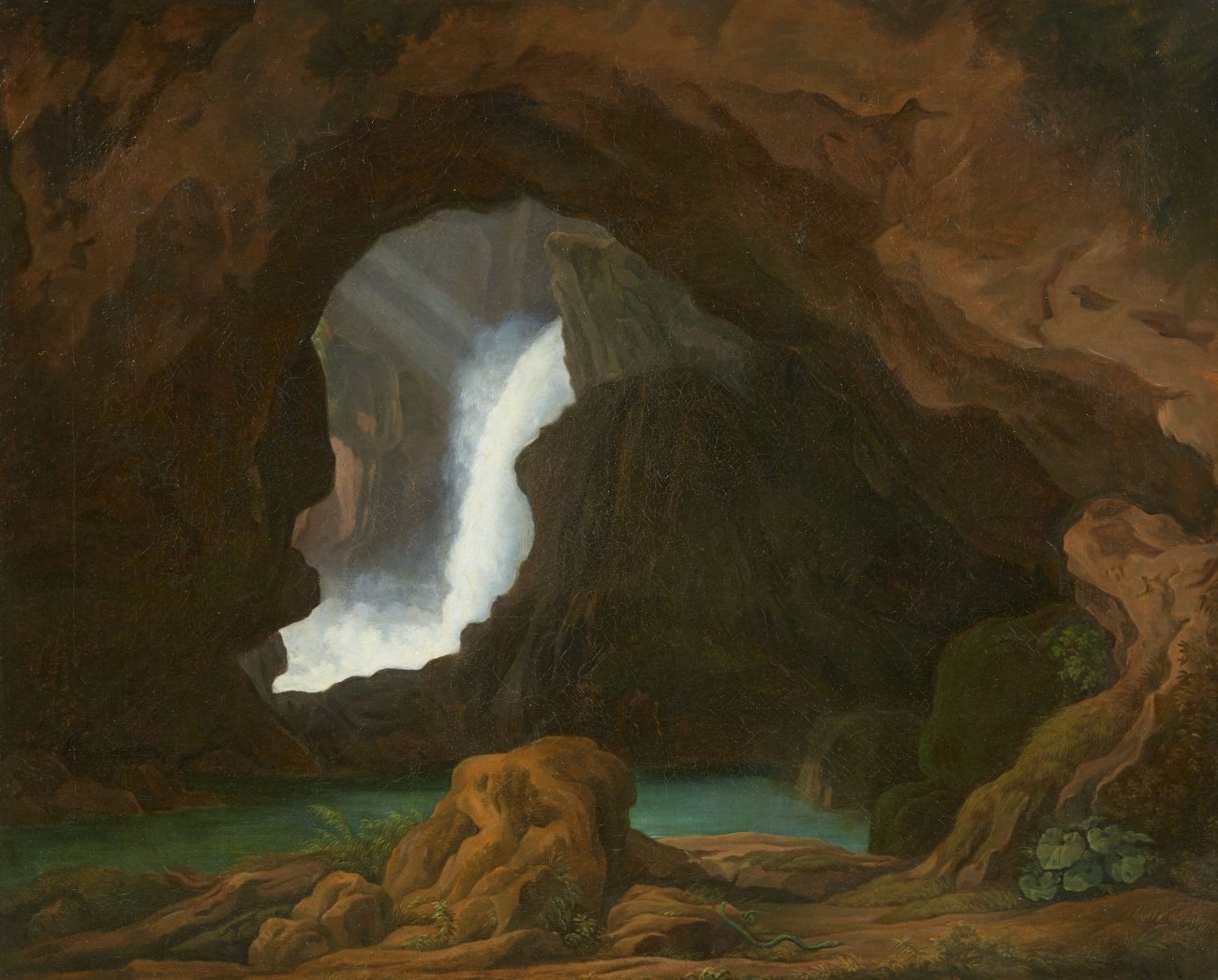
Albrýndaer. Vælírian Years 1147-1150 (2nd T.A. 990-993)
The taste of death during his first hunt was difficult to stomach, and especially the act of killing. For Albrýndaer had a deep and abiding sense of the preciousness, indeed the sanctity, of life—of all things that lived and breathed, acted and grew, brought forth young and died. He knew, of course, that a man or woman is far different than the irrational creatures who lived beneath the earth or even upon it, and he saw this difference played out in countless ways in his daily life, even in the makeshift society built in the caverns far from the light of the sun. For even if man and beast both live in a cave, one paints pictures upon the walls and one does not, one carves figurines with which to play and one does not, one writes and speaks and shares in formulated language, expressing thought and volition, and one does not. Indeed the man himself can choose to spare his prey in pity, whereas the beast can do nothing but what it has been designed to do, and this is its gift and its nature, and what is precious about it. For to each creature there is a gift and a purpose, and yet in the human person, raised up in intelligence and in will, in the spirit that breaks beyond the boundaries of the material and temporal world, there is a “gathering together” of all that exists in lower creatures and its elevation in something more than itself.
And so Albrýndaer lived, and in all his living he tried to respect the world that he encountered, even as he received plants and animals entrusted into his dominion for his nourishment and the nourishment of those he loved. And so too he worked, learning even more as he grew of the many parts that went into human life and how much care it required, even for such simple things as the mending of clothes or the preparation of a single meal or the regulation of healthy relations between the diverse encampments sharing space and resources in the vast cavern of stone. But encountering the fragility of life, balanced as it were on a precipice and ever striving to stay aloft, he also began to feel viscerally, in his very heart and bones, the fear of death. For if he had once been confident and serene in the enfolding embrace of Love, this confidence had now been taken from him, even as he could not stop searching for it. But in its place he felt only absence, and fear filled the void.
Work and responsibility were a refuge for him during this time, providing a stability that he could not discover within himself, and idleness would have been destructive, as it is for every man. For if he could not occupy himself meaningfully in moments of repose, of gratuitousness, as he had once done even in the activity of the mind and of the heart, then it was good that he had external activity to occupy him. It mattered not whether it was pottery or cooking or hunting or repairs of clothing and tents, or any other work, in all of it there was a meaning, for in all of it he touched with his hands, with his very flesh, the mystery of the real. Indeed, even though he could gratuitously play no longer, there were rare moments when he felt the same contact with meaning, with purpose, and with beauty in work that he had once known in play. He came to experience, even at a time of intense darkness and suffering, the truth that for the mature heart work and play at their root are one. And this was new for him, and new in a way that he desperately needed; for while he could summon no sense of motivation within him to devote himself to playful activity as he was used, his daily responsiveness to the demands of work put him in a situation where life could be lived once again, and thus hope could be found.
And in the daily responsibilities of life—sometimes irksome and oftentimes difficult—he found the hard shell that had been growing up around his heart softened a little, and at least for these moments (would that they could be always!) he looked out beyond himself, beyond his own personal struggles and doubts, and to the people for whom he worked, and to the life that he shared with him in co-responsibility for the existence that was theirs. And so labor became for him like a book to be read each day, telling a story to which he knew neither the full narrative nor the conclusion, but which was compelling nonetheless—or precisely thus, for he was held in the midst of it. Indeed, labor became a space where he found again some semblance of the contact with creative Love that he had once known, and though he no longer communed in the depths of his heart with such Love—which he perceived to have, as it were, abandoned him—he nonetheless knew at times that it was there, encircling him in his very activity, and that his own creativity and work were a participation in it. Yet he also knew that without this reality of communion with Love—he knew not what to call it—even his work was constrained and could not truly take flight. Yes, what of the reality deeper than work, which not only illumined and guided work, but also surpassed it? This, in pain and despair, he had long tried to forget, even if the aspiration for it continually came forth again where he least wanted and expected it, and sought expression.
† † †
And so Albrýndaer found a glimmer of life abiding still even in the death that he had come to taste. He grew thus in strength of body, but especially in depth and breadth of mind, and despite the darkness that weighed upon him, he matured as a person and became both more compassionate and more understanding; disillusioned, yes, but also increasingly clear-sighted. The daily activities of life provided him stability, and his growing care for his people—even exiled prisoners as they were—gave him a sense of purpose and of belonging. Or rather his awareness of belonging stirred him to responsibility and to care.
Shortly after his sixteenth birthday, during the last days of the year 1149 (his birthday was the 16th of Ventéras), Albrýndaer at last spoke with Ílya of the topic that for years now they had both known and yet avoided. And once it was brought into the open, the passage of years did not matter, for the pain and all the anguish of Albrýndaer returned to him as if new; yet so too, it did not matter for the mutual trust between them, and once they began to speak, it was as if they had always been speaking.
“What is justice, Ílya?” Albrýndaer asks as they sit together in the dim light, facing one another.
“You would know the answer better than I,” she replies.
“But I would like to hear what you have to say.”
With a knowing gaze, she inquires, “Why do you ask this question?”
“Surely you know.”
“I do,” she says, “though I am surprised. I have waited so long that I began to wonder if you would ever broach the subject. It is the image that still haunts you. It is the injustice of the justice that was effected before your very eyes. A man hangs upon a gibbet in a public place, and is ridiculed by all: is this justice? I think not.”
He nods in response to her words, but explains, “But I do not know if it truly was injustice. Surely he received what he deserved, and his punishment was ordained to the protection of our community. He was a…was a danger. And he could have easily hurt others besides myself. I have thought long on this, and I see more and more clearly the wisdom of Aba’swords. He recognizes that a society without punishment is also a society without law. And without rule of law, what is there? Freedom for the wicked and danger for the weak.”
“You believe your father’s words, then, that there was no other way?”
“I…I think I do.”
“But? Something bothers you about this?”
“Yes. Even though I see its necessity, something does not sit well with me, nonetheless.”
“The fact that his death was paraded before your eyes as if witnessing it would bring you satisfaction? As if the man deserved not only punishment but humiliation, torture, and death?” Ílya asks.
“Both of those,” he replies, though loath to pronounce the word. “As I think about it, I realize that all of us in this world deserve far more punishment than we receive, even the innocent of us. Or rather…that’s not exactly what I mean. What I mean is that none of us deserve all the goodness, love, and beauty that we do receive, and on a daily basis. Every day beneficence is extended to us beyond our merits. Could this not have been extended, even if in small measure, toward Méldas?” On saying the name of his abuser, Albrýndaer lowers his head almost as if to hide his face. He is surprised that he voiced it, but also knows that he must, in order to bring the other great pain in his heart into the open, that Ílya may see and receive it. And if not now, perhaps he shall never find the courage again. “But within all of these questions of justice, something else disturbs me as well.”
“Do you perhaps feel betrayed?”
“By Méldas?” It does not get easier the second time.
“That is beyond question, and I grieve greatly at the betrayal.”
“Yes,” sighs Albrýndaer, but he cannot look at Ílya, knowing that her gaze is compassionate and yet piercing. He is not prepared to go into that place…not yet. Let them go there slowly, step by step. “But you mean by someone else as well?”
“Yes. By whom do you think?”
Albrýndaer thinks on this for a few moments before answering. “My father, and even my mother. I feel betrayed by them, as if they ought to have protected me and yet they did not. I understand that the…the abuse that I suffered was beyond their knowledge and control. But they could have saved me from receiving wound upon wound in what followed.”
“And in that sense of betrayal, you feel alone and isolated?” asks Ílya, reaching out and placing a hand for a moment upon Albrýndaer’s knee, though he does not respond to this touch.
“Yes. Alone might be the best word,” he answers quietly. “But it is not just an ordinary aloneness. It is not just loneliness as the lack of another person’s presence. For even in that, there can be found a beauty—a beauty to solitude, to aloneness, in which the longing and hope of the heart can expand, reaching out to something greater. I once believed in that greater reality, and perhaps I still do, though it is now beyond my reach, and seems to hold me and care for me no more. I once was so confident that it was woven into our every thought and burned in our every desire. I once believed that in solitude too there was communion, for the fabric of all things was woven of Love, and without it nothing at all could exist. This I felt, even before I could give voice to it in speech. But now. Now I know not either what I feel or believe, and only the pain of what I have lost and what I cannot seem to find again.”
“I have felt this Love as you,” affirms Ílya, “and I cling to it still. But even in that, I could not speak of it as you do even while in the depths of your pain. Perhaps all persons feel so at the beginning, before this knowledge, this intuition, is lost in the darkness that falls upon every life. And how I wish, Albrýndaer, that I could give this certainty back to you again.”
“This darkness, this loss, this is precisely the pain of which I speak,” says Albrýndaer, unconsciously looking up and meeting Ílya’s eyes in the amazement that he is so deeply understood by her. “How can there be any darkness if there is such light? And yet if there is such darkness—as I feel and know in both heart and flesh—then how can there be true light? Is the light perhaps just an illusion? Have I dreamed it all along? Ah, you see…the pain is like a poison. But it is a poison because of the evil, the sheer malice, that is tasted underneath it and within it. How could such evil exist, such terrible violence? And how could those who are ‘good’ inflict violence in response, as if this would somehow restore the order that the first evil had disturbed?”
“You have an unusual way, Albrýndaer Hríndas, of speaking about the suffering of your heart,” remarks Ílya, her voice filled with gentleness. “Never have I met anyone who is so filled with a sense of the real, of the very weight of being, that he complains of his own trauma by speaking spontaneously of the cosmic battle between light and darkness.” She pauses and smiles lovingly and gently upon him before continuing. “And I love this about you. I love this thirst that burns within you, this deep sense of the world of which you are a part. And thus I have grieved intensely at its loss these last years. I felt in the past that you were going to leave me behind in the impetus of your wonder and your longing. But now I just want you to be yourself again, to rediscover the beautiful child that was lost, even though now he shall be a man.” She pauses and they remain for a long moment looking into one another’s eyes. At last, when they both become uncomfortably aware of the intimacy of their reciprocal gaze, she continues, “I also want you to acknowledge—I want you to acknowledge, Bryn, that your pain hurts because it was inflicted upon you, and not only because it reveals that something is wrong with the universe. Perhaps only in this way can you begin to discover what was lost. They both go together, after all, the particular and the universal, your own heart and the heart of all the world.”
“I…I do acknowledge this. Though perhaps there is truth in what you say, and I do belittle my own pain,” he whispers, nodding his head. “Nonetheless, if I speak in this way, it is not to detract from my own person, but to try…to try however weakly to express the very depth of my pain and loss, and to trace it back to its source.”
“Yes, acknowledge it you might,” she replies, “but I wish that you would share it with me. I wish that you would allow me to be with you in the pain, as in the thoughts and struggles, aspirations and longings of your heart, as you once did. For as much as you might see in your mind, in your thought, it is not enough. You must also let your heart simply relax and grieve. Finding answers for yourself will not bring full healing where you need it the most. For there are certain things that only tears can heal. Or rather certain things that only tears held securely by tenderness. For if the answer is truly Love, then there is no way to receive it but in love.”
For a long moment their eyes interlace in a deep reciprocal gaze, now without even a lingering since of discomfort, for all false self-consciousness has fallen away, and much is said that needs no words. They are, indeed, hardly aware of looking so deeply upon one another, swept up as they are in the space that such reciprocal beholding, such mutual holding, creates between them. And in an instant Albrýndaer feels that this space between them, this bond that unites them in shared gazes, can be nothing other than a participation in the same Love that has always upheld all things, and that bound him to his parents at the beginning of his life. If they, his mother and father, have failed him, Ílya is still here, loving and secure. And even were she to fail him too—perish the thought—the Love that lives within her and beyond her would continue forever.
But in such love, there is space for pain. Indeed, in such love, ineffably, darkness and evil itself are held—foreign to love, yes, and opposed to it, but borne in long-suffering compassion. And this compassion touches Albrýndaer’s heart now, even if only for the briefest instant, and tears well up in his eyes. These are the tears that for four years now have been unable to come forth and find expression. Seeing this, Ílya does not hesitate. She reaches forward and draws Albrýndaer into her embrace. He buries his face against her shoulder and, in the safety that her presence provides, he lets his tears at last flow freely, and his grief find expression in mourning.
† † †
The depth of a person’s life, and its true breadth, is not judged on the number and variety of their experiences, but on the profundity with which these experiences are plumbed, grasped, and explored, and the degree to which they beget in both heart and life the goodness for which the human person has been made. A heart spilled out on the surface of many experiences can find itself spoiled, numbed to the depth hiding within every moment, having many things and yet possessing little understanding of the significance of anything. On the other hand, as was the case with Albrýndaer, a heart bereft of so many experiences can yet be led precisely thus to plunge to the very heart of the experiences that it does have, and to the core of existence itself, asking the questions that lie at the foundation of life, and whose answers are the wellspring not only of right thinking but of good action, and thus of happiness and flourishing.
The trials and little beauties of his existence proved precisely thus for Albrýndaer: vessels of the discovery of realms of depth not visible to the eyes, though revealed in all that is visible. And Ílya above all was a vessel in this manner, not only due to the ways in which she invited him to play and to wonder, to let his pensive heart also incline itself outward in incarnate action; but she was such for him above all simply because of who she was in herself. In her Albrýndaer discovered in the deepest way the marvel of what it means to be a person, and he felt in the most profound way that he had yet known the cry of the heart: “It is good that you exist!” He knew then, from the heart of his experience, what was true affirming and assent to the goodness of another person’s being. And in addition to this, he also came to experience for the first time the mysterious longing to plunge into the reality of another individual, to explore all the facets of their being and their experience, even to the very sharing of the inmost thoughts and feelings of the hidden heart. In other words, in this twofold experience—of affirmation and of longing for communion—he experienced gripping his heart the grace that can only go by the name of love, a love that, because it is grace, demands of the heart of man everything, indeed asks of him more than he is himself natively capable of giving.
Of course he had loved his mother and his father and the others in the settlement whom he knew; and he loved all the impersonal realities that he encountered as well, from stone to light to water to air; but this was something that became a seed of all future growth, to be rivaled in its importance for his development only by his deep innate sense of the eternal Love that held all things, and his relationship with this Love, which had now been so grievously fractured. In fact, in his darkest place, it was the love of Ílya which remained his sole lifeline, the only thing that seemed to him to still be—despite everything—safe and secure. And gradually, through his deepening relationship with Ílya, his eyes were opened in a particular way to the horizons of love, and its limits—or rather its limitlessness, in the promise of totality and eternity that it bears within itself, reaching out beyond the limitations inherent in the frailty of a broken world toward a world where love brings forth the joy of communion without ending or surfeit, without danger of estrangement or the pain of loss.
But, sadly, there was much yet to happen before this awareness would grow into full maturity in Albrýndaer’s heart once again, and much loss still even of the very love that he trusted. For while the experience of being loved and received by Ílya proved to be deeply healing for Albrýndaer in the wellsprings of his heart from which thought, desire, and choice flow, it was neither universal nor complete. Even in the very area where the remedy had been applied, he bore the same scars, the same doubts and fears, the same inner resistance and self-protection that he did before, even if these were weakened. In fact, in the time following in the wake of their intimate conversation, Ílya experienced yet another profound hurt, realizing to her grief and sorrow that Albrýndaer spoke no more of the matters upon his heart than he did before. Nonetheless she had in her naivetë hoped for more, even for an immediate and complete healing. Thus she came to taste deeply for the first time a lesson that would remain with her always: that the human heart, no matter how much love it receives, and how radiant the truth communicated to it, heals only gradually and with much pain.
However, despite all of this, and to her consolation, Albrýndaer appeared less sorrowful in his daily life, and in her presence he was admittedly less sullen and silent; something had changed and she was glad for this. But there was more as well. For she rejoiced, though she felt somewhat ashamed for it, that his tenderness toward her had been renewed, indeed that it grew in the way appropriate for a young man entering into adulthood. He began to express his love for her, reservedly, yes, but truly. Reflecting upon her own response to his love, Ílya recognized the shame as unreal—as born of fear—and she knew that the desire to be loved was neither selfish nor unhealthy as long as it remained rooted in authentic truth and goodness. She thus began to receive from him the love that she had long desired, and in this love found the courage to express her own love as well. And this reciprocity wove their hearts together more deeply than they had been before. The closeness of childhood thus gave way to the closeness of youth and even began to show the first blossoms of the intimacy of maturity.
† † †
As the fruit of his labor and responsibility, and in the subtle shift in his heart through his openness to Ílya and the growing communion between them, Albrýndaer found a new stability within himself. He began to taste the seeds of new life taking root within his heart, and some even beginning to germinate. However, this process was disrupted in only a few short years, and his life, along with the lives of all those in the caverns of the earth, radically changed. When he was eighteen years of age something was awakened in the heart of the earth which would change the fates of many and bring immeasurable suffering. Or perhaps this “something” had always been there, awake and vigilant and waiting only for the right moment to appear.
It all began when a hunter from a nearby encampment returned alone even though he had set out with a party of four. And the story he brought with him was terrifying even for being so difficult to believe. But his solitude gave strong evidence to the truth of his words, as did the wounds he bore: deep claw marks upon his chest and shoulder. Even as the man was being tended and his wounds treated, his story began to spread through the encampment like fire through a dry wood, and within a matter of days to other encampments as well. He had seen, so his account went, a host of creatures unlike anything he or any man had ever seen before—beasts born out of the very shadows and wreathed in darkness as in cloaks, though bulging forth from this spectral mass were bodies with flesh not unlike that of earthly creatures, not unlike the flesh of men, though blackened and desiccated as that of a living corpse. And their eyes pierced through the darkness not like a light, even an eerie light, glowing with the spark of life, but as a devouring darkness that seemed to eat up one’s very soul, as whirlpools dragging a person down into the abyss. These creatures—and there were countless numbers of them—had slain with ease his three companions and he himself had barely escaped, fleeing blindly through the tunnels in fear for his own life and in a half-conscious desire—persisting even in a mind shackled by terror—to bring warning to his people.
And now the man, whose name was Hádra, seemed to live elsewhere than in the world of flesh, his encounter with the creatures of darkness having shattered the sanity of his mind. Only many years later, in other circumstances and by the abiding tenderness of his wife who stayed always by his side, would the light of life in his own eyes be rekindled and his mind return, scarred, yes, but found anew, to live beyond the terror that had once broken him. But that is another story, one of sanity rediscovered even in its very loss, and in the only way that it truly can be found anew: by the abiding presence of another whose love, steady and patient, enters even into the darkness of the sufferer and brings, in this place, both understanding and light.
Albrýndaer heard the news three days after its first announcement. The words he heard were not directed to him, but to his father, and he he overheard them clearly when they were spoken. And he listened intently to the ensuing conversation.
“Man-like creatures clothed in darkness, you say?” Daeran said upon hearing the news. “How do we know that there is truth behind these words? What if the man, overcome by fright, imagined what he saw, or distorted it? What if it was nothing but a pack of wraithclaws or even some unknown beast we have yet to encounter?”
But even as he said these words, Albrýndaer knew that he shared the same thoughts and the same hesitations as did all in the prison, all, that is, who had any knowledge of the history and legend of the people. And if Albrýndaer, born in the darkness himself, knew the tales, then surely the others did as well. Beasts like the walking corpses of men clothed in darkness with eyes as blackest night: these were the words with which the feared and fabled ötûnr were described in accounts of the old days. Thus, though many spoke words of doubt and caution not unlike those voiced by Daeran, in their hearts they feared.
And the fear was well-founded, as within a matter of days the first encounter gave way to others. And these encounters happened not now in the depths of the tunnels wherein a few men came across creatures lurking in the darkness, but rather in the violent assault of the ötûnr on any who left the confines of the encampments to hunt, to gather, or to work. Thus it became known that a great power had indeed been awakened or stirred to wrath, and that this power watched with keen and malicious eye the dwellings of the people who made their living in their earth-bound prison.
It was not long before most had caught at least a passing glimpse of these fell beasts, and felt the horror that their very proximity stirred in the human heart—or rather the horror which threatened to suffocate and snuff out even the tiniest threads of human hope, happiness, or freedom, assailing the heart internally with even greater violence than any external oppression. And the ötûnr appeared not in the likeness of dead men alone; no, they took also other forms, of beasts of bizarre shape and unnatural size, or of a combination of beasts both natural and fantastical, both large and small.
Experienced hunters were thus stationed at the outskirts of every encampment, taking turns keeping vigilant watch at all times. And yet watch alone these did not remain, for they often sparked into real combat by the appearance of the ötûnr, an appearance that was clearly ordained to bring harm to the settlements of the humans, though what reason for such action these beasts could have, no one knew. For they came at various and unpredictable times and in numbers ranging from a handful to close to thirty, and when the latter occurred, there was little hope for survival not only for those keeping watch and guarding the encampment, but for all the people making their living within it. Soon the survivors from ravaged encampments were seeking refuge in others; or entire encampments, fearing a similar fate for themselves, joined together with their neighbors and consolidated their lives and their protection, building around their tents and workshops and supplies walls of stone and rawhide with but a single gate carefully watched by men with slings.
But slings proved to be all but useless against these beasts, and it soon became apparent that the only way to slay them such that they were truly felled and did not immediately rise again was to pierce their heart or to remove their head. And even then it was necessary to destroy their bodies by burning, otherwise in a matter of days their very flesh would begin to reform itself or be refashioned by whatever mysterious and hidden power gave them life. And creating fire in such abundance was difficult in the underground cavern, for there was a complete lack of wood, and what little grass or vegetation there was the communities relied upon already either for nourishment or for lighting their homes and encampments. They had to rely, therefore, upon the bodies of the creatures themselves and whatever flammable oils and fats they collected from hunting. Yet this too proved to be a serious problem, for if a siege on the surface world proved to be a trial for the citizens under siege, not only because of the warfare involved but because of the famine and hunger within, so it proved to be even more grievously so here.
Albrýndaer’s encampment was soon flooded with immigrants from a nearby settlement who sought to join forces and to create a bastion of defense against the encroaching darkness. And this they did. However, none of the measures taken were able to prevent tragedy. Within a matter of weeks Albrýndaer had witnessed more of death and destruction than he ever imagined he would. And all of this was compounded because he received every injury as if it were his own, and every betrayal of life as a question shouting to the silent heavens demanding an answer. Hunters were sent out to gather what food and resources they could to sustain the settlements even at risk to their own live, and often few returned, and those who did return were wounded in body and shattered in heart, with deep scars upon their flesh or missing limbs, and hollow gazes in their eyes.
After three months the encampment in which Albrýndaer dwelt—though it was surely much the same everywhere else—was on the brink of starvation. The violence of the ötûnr made it impossible to acquire the necessary nutrition, and the infirm or elderly began to die of malnutrition and accompanying illnesses. Albrýndaer’s mother herself took to bed and was unable to rise, and he spent as much of his time as he could spare sitting by her bedside and nursing her, though nothing did he have to ease her pain, relieve her fever, or satisfy her consuming hunger. And even as he sat, he felt himself wasting away along with her.
The one moment of light and consolation during this time, as feeble as it felt to Albrýndaer, was when Milly spoke to him one early morning after a restless night tossing in her bed and crying out in delirious dreams. “My dear son,” she whispered to him in a hoarse voice, “I feel that I have failed you in every way that a mother can fail her child.”
“Hush, mother. Do not speak, and especially not of such things,” he replied without thought, and more hotly than he intended.
“No,” she retorted, raising a frail hand as if to forestall any further intervention or resistance. “Allow me to say what I wish to say.” And seeing him nod despite himself, she continued, “I have failed to protect you from those who would harm you, and even in the face of your hurt I failed to shelter you, to let you know that you were seen. In my cowardice and my fear, I left you to be hurt, even against my own better judgment. And now there is nothing I can do to give you the one thing in which my hope could still reside: a future life in which you can grow to be a man, a man good and true, and can find a way to leave this place…to find the world beyond the darkness where light still shines.”
After she had fallen silent, Albrýndaer looked at her for a moment and met her eyes, but he could not sustain her gaze and soon lowered his own. Nonetheless she spoke no more, and awaited only any answer that he might wish to give. At long last he was able to say this, and no more, “It is not your fault, Aïma. I hold nothing against you, so please, be at peace in this regard, and rest.”
Hearing these words she seemed satisfied, though her heart was not wholly consoled and the lines of sadness and lament continued to mark her face, lament at the unavoidable fate that awaited her son, as it awaited all people condemned to suffering and death in this underground prison.
† † †
To Albrýndaer’s relief the threat of death from illness passed from his mother, and Milly was able again to rise from her bed. But this did nothing to remove the danger—even the certainty—of death from starvation or from violence that awaited her, as it awaited him and all persons in the underground prison. And he felt powerless at the thought, indeed infuriated at the realization that spared as she was from the illness that had struck her down she was still condemned to death in a way perhaps even more gruesome. Was there not anything that he could do? How could a world so deeply held by love be so totally abandoned and left to destruction? These two questions persisted so long and so deeply in his mind that they blended together as one, and he felt two conflicting convictions which he could not reconcile: he felt that all this destruction was his fault, that if only he were stronger he could somehow prevent it, and yet he also felt a profound anger and disappointment, indeed a rage, toward the One whom he had once thought to be enduring Love sustaining and protecting all things. Even if he had tasted the rediscovery of this love for a moment in his growing communion with Ílya, in the beautiful security and intimacy between them, it seemed to him now nothing but a shadow in comparison with the evil and death he faced on a daily basis. The shame and powerlessness therefore grew to the point of overflowing, and were he capable he would have acted out rashly even for the mere purpose of doing something rather than nothing, of failing an attempt rather than attempting nothing at all.
Yet he knew nothing that he could do, and he cast his eyes about desperately for some escape, for some answer, while none came. And then it happened: the last drop that would break the dam and send its waters bursting forth into folly. Ílya was taken away from him. Without any forewarning or explanation, her father departed from the village, bringing his daughter with him. Albrýndaer would not have known until later, when he intended to meet with her again for the few moments they could still spare to be alone together, except that he witnessed them in the very act of departing. He walked through the encampment to bring back to his home what little water he could from the nearby well, a pool with reservoirs deep in the stone which nonetheless was running dry as if to deliberately mock their pain and to compound their sorrow. And as he walked he looked up and caught sight of Ílya, her arm firmly held in that of her father. They were moving at a swift pace toward the edge of the encampment, and by the look on her face Albrýndaer immediately understood what was happening, though he knew neither the reason for their departure nor their destination.
Setting down the vessel of water he sprinted toward them, crying out her name and waving his arms. But such a display was not necessary, for in some way unknown to him she already recognized his presence and felt it, and turned her eyes upon him, eyes filled with sorrow and longing. “I go, Albrýndaer,” she said simply. “I go to a place where we may hope to find more safety and security, and perhaps more hope of life than here. He gives me no choice.”
“Then I shall accompany you,” cried Albrýndaer without hesitation.
“No, no…” she answered, tears springing to her eyes. “You must stay with your family. Only depart from this place if they also come with you.”
“But I cannot just say goodbye, Ílya,” he said. “I cannot just let you depart like this.”
Yet her eyes said farewell, and he knew it. At this moment her father, who until now had deliberately been ignoring the young man—for whom he had no appreciation but only distrust, if he took any thought for him at all—turned back to look at Albrýndaer, his eyes flashing. “You cannot come with us even if you would,” he said. “It is my intention to save our lives at whatever cost, and a little brat like you shall have no part in endangering or interfering with my plan. Get away and run back to your aïma and youraba. She is right there; run home now and leave us to our own affairs. Two mouths to feed is already more than enough.”
Overcome with fury and disgust, Albrýndaer instead ran forward and sought to pull Ílya from her father’s arms, crying out to her in the effort to convince her to stay, “Please, I shall do all I can to protect you myself. Do not go, I beg you. If you want to depart, we can do so together, you and I, and my family too.”
But she only looked at him with eyes overflowing with tenderness and with sorrow, and whispered, “Farewell, Albrýndaer. I am sorry.” Wiping tears from her eyes with her free hand she then reached out, despite herself, and laid a hand on Albrýndaer’s cheek. Then she said, “Go now, before he hurts you.”
It was too late, for her father, infuriated by this delay and even more by the display of affection, struck Albrýndaer so firmly in the face that he sprawled backward onto the ground and all but lost consciousness in the flurry of pain and vertigo that overtook him. By the time his eyes were able to focus once again he saw that Ílya was being dragged away beyond reach, looking back at him and saying silently what they both understood to be their final farewell. There was no hope of a future reunion—not in circumstances such as these. And so he did the only thing that he could do: he reciprocated her gaze and said farewell too, adding in that silent voice of the eyes the simple words that he hoped she understood: I love you.