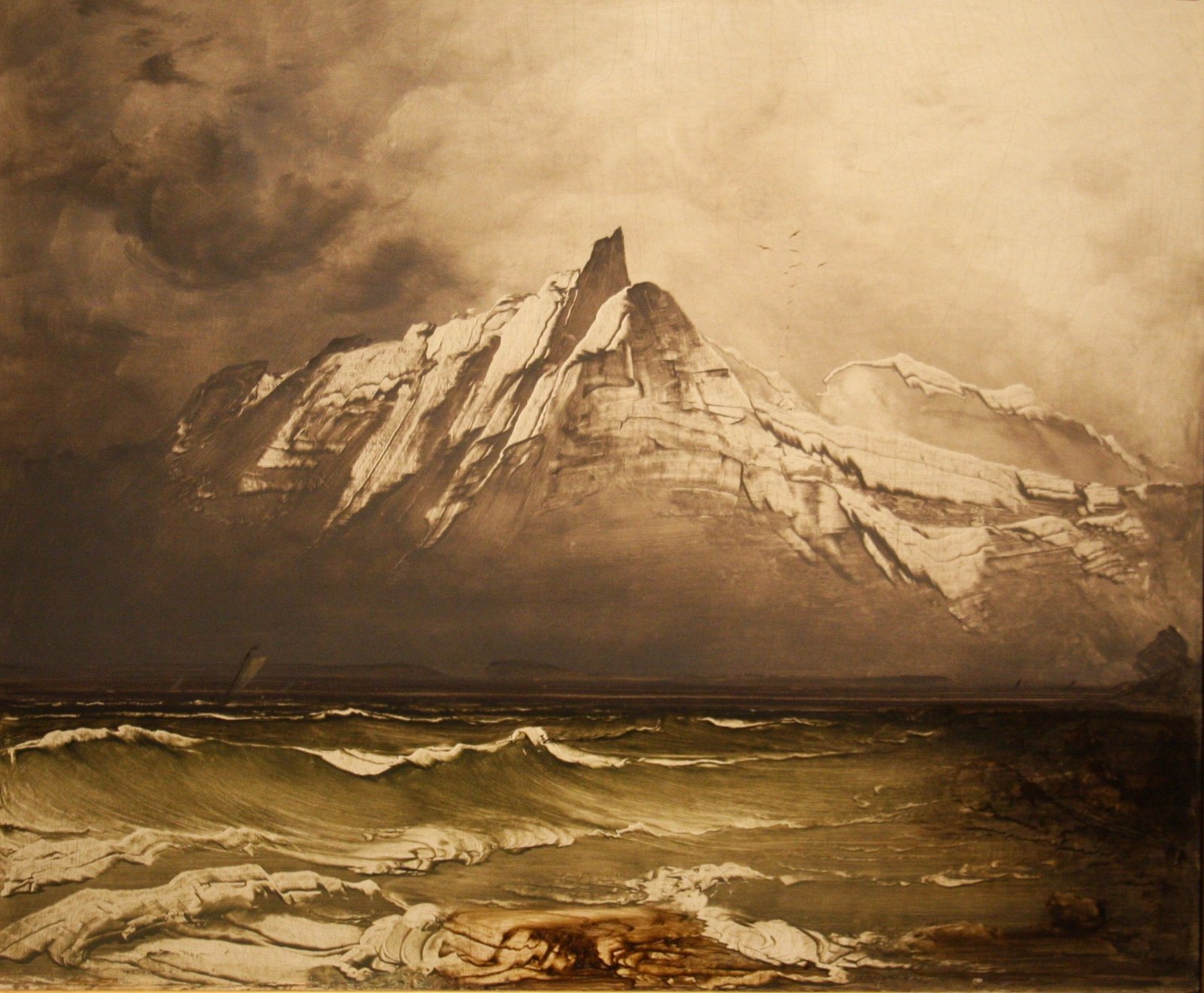
Albrýndaer. Vælírian Year 1150
Stirred to reflection by the pain that he witnesses, by the combat and slaughter that are now happening all around him, and by the loss of the person most precious to him in the world, Albrýndaer’s thoughts turn inward once again. He also sees cropping up like shoots from the soil tendencies that cannot be called by any name but rebellious. In their desperate situation and in the fear that oppresses them, many hearts turn to anger against the Empire that forced them into this place, and in this anger foment the thoughts of violent rebellion and revolt. But no matter how strong these feelings may become, or how focused these thoughts, how could they ever find expression? How could persons, however great their number, instigate a rebellion when they are held captive in the depths of the earth? Regardless of this impossibility, Albrýndaer is disturbed by what he witnesses, and even as he does not understand either the depth or importance of these movements, they unsettle and frighten him. And so he speaks with his father about the origins of their people, about the people of Vælíria, and about the birth and growth of the Empire. Perhaps, he thinks, in knowing more about these origins, he may also be able to discern more clearly some answers to the questions upon his heart.
“Aba, what has motivated the Empire to become what it is today?” Albrýndaer asks when they have a moment together in the silence following dinner, while his mother rests in the other part of their shelter.
“What causes you to ask such a question? Is there anything in particular upon your mind and heart that stirs this?” his father replies. “You have no direct experience of life in the world above, and thus are devoid of all direct contact with the political structure or manner of existence in the Empire. So what draws you to pose this question to me? Is it simply the desire to learn?”
“It is that, I suppose. I do desire to learn. But also…I also want to know what is responsible for giving me the life that I do have. After all, as you say, you have the Empire to thank for your exile and imprisonment, and thus I too owe it the same.”
“I suppose you are right to want to know,” sighs Daeran. “And, after all, much of our knowledge in this life is indebted to what we have heard from others. Even I have little direct experience of the politics of the Empire, and most of my knowledge comes from books I have read or conversations I have shared with others more knowledgeable than I. But even then, the Empire saw my knowledge, indirect as it was, as real enough to be threatening. And it certainly was real for me and your mother when they arrested us and cast us into this prison.”
“You were truly imprisoned for your knowledge?” Albrýndaer asks.
“I was imprisoned for my convictions, though these were born of knowledge and the discernment that it allows.”
“And what were these convictions of which you speak?”
“Well, in order for you to understand that, you must first understand the state of the Empire in which I lived. And thus, the answer to your question.” And so Daeran begins, “What is important for someone your age to understand is that, without the ability to govern himself, a man cannot be truly free. Even if another makes laws to which he is bound, laws that he himself has not either made or chosen, he must be free in adhering to these laws, and for this to be the case they must have arisen from an atmosphere of communal discernment, and be themselves expressions of what is good for each and all, insofar as such things can be expressed in law. But whenever the law instead becomes a tool in the hands of the powerful, something that is used in order to manipulate and control lesser men, then a grievous ill has occurred, and one that must be rejected and resisted.”
“A man must govern himself in order to be free, and cannot act merely from external compulsion,” Albrýndaer reflects. “Yes, I understand this. There is obedience and docility to the wisdom of others, and of a community, but even such obedience must be free and mature. Otherwise we forfeit something intrinsic to us—as you said, our freedom, but also truth. Without truth we cannot be free, but without freedom we cannot find and adhere to the truth.”
“You speak with understanding beyond your years, my son,” remarks Daeran. “In fact I am surprised, and touched, by your quick and deep response.”
“Yet you spoke of an abuse of law,” Albrýndaer continues, his mind latching onto the thread of a thought and wishing to follow it through to its conclusion. “How can we know that this is happening? Cannot law sometimes seem unfitting in a given circumstance and yet still be true and just?”
A slight smile plays upon his father’s lips. “A very perceptive question, Bryn. It is true that the law, being as it were general and abstract, can never fit perfectly to every situation, and this is why, in addition to being itself just and true, it must also be applied justly, and with discernment. Of course, certain acts, since they are evil neither by mere circumstance nor mere legislation, but by their very nature, are always to be rejected as incompatible with both the common and the individual good—”
“Like the murder of innocents,” interjects the son.
“Precisely,” says Daeran, “like the murder of innocents. Protection of the innocent is the foundation stone on which every society stands or falls. But other things of similar nature there are as well. These things are always to be abhorred and resisted, and law rightly condemns them. And yet there are other things that are more variable, in which it is not strict good and evil, right and wrong, which marks out the way for human action, but wisdom and discretion, the spirit of true discernment. And here the law should not be too strict.”
“How so?”
“What do you think?”
After a moment’s pensive silence, Albrýndaer says, “Either in condemning things that are acceptable even if not universally mandated, or which are rare, or in mandating things that are not truly obligatory for all?”
“Again, you are exactly right. Whenever a society condemns what is good or demands as obligatory what is not truly required of all—and especially if it demands what is evil—then that society is sick and destined to destroy itself.”
“But how does this happen? And how does it relate to the Empire?”
Now it is Daeran’s turn to take a moment for thought before at last replying, “It happens in a number of ways, I imagine. I suppose any man who does evil for long enough must seek to justify his evil by making the whole world agree with him—in other words, he must make his own blindness a law by which all abide. And thus he will be excused or even lauded for his wrongdoing. Or, if he has the station and the power, he may simply seek to control other men and to bend them to his own ends. And for this purpose he uses the law, and his right to exact obedience and to inflict punishment, as a tool.”
“And thus we are in this prison?”
“Yes, and thus we are in this prison, condemned not because we committed acts against the just rule of law, but because we held opinions contrary to those which the Emperor thought fit to allow.”
“What opinions did you hold?”
“Simply put, that the people of Vælíria deserve a just society not under the rule of a single Emperor, but rather in a form of governance that respects and listens to the voice of the people and fosters their good.”
“I see how that could be unwelcome for such a man as you have described. But how can he get away with imprisoning people simply for thinking things that are unwelcome to him?”
Rubbing his forehead absentmindedly, Daeran sighs. “Now that is a more difficult question to answer.”
“Then I have two others, if I may,” proffers Albrýndaer enthusiastically.
“You are just full of questions, are you not? Please, go ahead, my child.”
“First, what are the unjust rules that the Emperor asked people to follow? And second, where did it all start?”
Daeran laughs softly to himself, not answering immediately. He is astonished by his son’s depth of thought and feeling, and he realizes in this moment how much he has taken Albrýndaer for granted, how little he has cherished and esteemed, and therefore fostered, what lives so vibrantly in his offspring. “How late we often are to recognize the depth of what is right before our eyes,” he mutters under his breath.
“What did you say, Aba?”
“Oh, it was nothing,” says Daeran more loudly, turning again to look at Albrýndaer. “I do not wish to enumerate the ills of the Empire in which I was born and in which I spent the majority of my life—at least not until you are older, though I admit you seem mature enough already to handle all that I would tell you, or most. I will say only this: for many generations the rulers of our land have been occupied in an all-consuming lust for expansion, the expansion of Imperial rule over all other nations of the world, and the imposition of the Emperor’s power over even the most insignificant aspects of life, insofar as they may be ordered to his own benefit. Thus it was in the mandating of cultic worship, in exorbitant taxation, in harsh punishment inflicted upon minor crimes. These are but a few examples. But my confreres and I,” the father continues, a thoughtfulness in his eyes as he allows his mind to carry him back to earlier days of his life, “we did not only react against injustice. We dreamed of a better world, of a new world.”
“Was it always like this?” asks Albrýndaer. “I mean, was it like this your entire life?”
“Oh yes, things became this way long before I was born. For hundreds of years the Emperors have followed a consistent course. A century ago they conquered and subjugated our ancestral land of Telmérion, from which our own people came over a thousand years past. And we have also waged an exhausting and relentless war in the lands of Tel-Velfána, far, far to the east, in which our sons and brothers and fathers alike are being slaughtered like cattle in the name of Imperial expansion. This is to say nothing of the iron hand at home, which you, my son, have experienced first hand from before your very birth.”
“The Empire cannot be all evil, though, can it? Surely there must be some good.”
“Aye, I suppose there is somewhere, but it is little and insignificant, worth hardly a thought or a mention. What we ought to focus on now is dismantling the corrupt structure in its entirety so that something new may be born in its place.”
These words, as justified as they appear on the surface, startle Albrýndaer, and for a moment he is at a loss for words. Instead of asking the question that he first of all desires to ask, he instead says, “How many years ago lived the first Emperor, and how did he rise to power?”
“It was four-hundred years ago, in the year 748 since the arrival of the first refugees in the land of Vælíria and the birth of our nation as a people distinct from that of Telmérion. As to how he rose to power, much unfortunately has been shrouded in the mists of history or obscured by those who write history to suit their own agenda. Yet even in the face of this, I believe much can be recovered that was lost, and much lives among the common people that no propaganda or false history can erase.”
“I believe that too,” remarks Albrýndaer thoughtlessly, and his father again smiles.
“You believe that too, do you? Well, good.” And then he continues with his answer. “Suffice it to say that the Emperor established a new state only through much bloodshed and the use of a superior military force, though political negotiation and the exchange of wealth also had a role to play in it. I suspect that many were all too willing to acquiesce to the new world he wanted to create because they hoped to benefit from it, or to find themselves in his good graces if they cooperated.”
“You think he was wrong to use these means to attain an end that he thought worth pursuing?” asks Albrýndaer, hoping that his father does not recognize that the question is intended to reveal more information about the one to whom it is asked than it might about the Emperor or any historical events of the past.
“To use these means?” Daeran says. “Aye, I do think he was wrong. Or mostly. Sometimes grave means must be used to combat a grave evil. Sometimes one can only fight evil with evil, or, at least, violence with violence. If the Emperor so many centuries ago fought to destroy what was good, to shackle freedom, and if his successors have done the same, then lovers of freedom must fight back to regain what has been taken from us. And if they are truly necessary, any means are acceptable in attaining this goal that is so greatly desired.”
“I see,” says Albrýndaer quietly, unable to muster anything else, seeing the clear contradiction between his father’s earlier words and his later answers. There is a moment of dense silence between father and son before Albrýndaer is able to pose a final question, “The last thing I have to ask, at least at present, is this: What did Vælíria look like…before? Before all of these events took place, and the Empire became what it has been these last four-hundred years?”
“Another fine question,” replies Daeran, “and I would answer it at length were it not that our conversation has already greatly fatigued me, and I wish not to overburden your mind. And we both must rest if we are to have energy to work tomorrow.”
“Then another time?”
“Aye, another time. And your question also makes me think of a book that I believe resides in this very settlement, one on which you have yet to lay your eyes. I will inquire tomorrow with its owner and see whether or not he is willing to allow you to read it.”
† † †
When a week later Albrýndaer at last receives the book, a thin leather-bound copy hardly larger than his hand, he finds a solitary spot in the corner of the encampment, lit by the light of the glowing ore veins just above his head. Running his hand gently over the cover, which is weathered with decades, perhaps centuries, of age, he reads upon its face the word: Benaíon. And underneath, the inscription: and accompanying material. It seems that the original text is old, even ancient (and perhaps fragmentary), and in this volume has been supplemented with commentary from another author. This intrigues Albrýndaer, and yet he has no context to make sense of it, and so he simply opens the book and begins to read:
Concerning the origins of humankind upon the earth, be they the people of Telmérion or any of the other many peoples who in the course of time would settle land for themselves and spread across the rich and variegated world from the center-point of humanity’s creation, we owe our knowledge to the people whose memory is far longer than our own. Though veiled from mortal sight their wisdom endures, and the long-abiding remembrance, and still among us endure some of their writings. Particularly cherished is the account of the earliest origins, the Arechaíon, penned by a hand far older than our own and by a spirit superior in every respect. Think not that it is through pride that we have called our lesser account the Benaíon, for it is not intended as a comparison with the sober majesty and beauteous depth of the original. It indicates, rather, that our account seeks to pick up in some, albeit far inadequate manner, where the former has come to its conclusion, leaving the threads of man’s history frayed and as yet unresolved in their great weaving, as they are until this very day. Finding in that account the fabric of humanity still greatly condensed in space but internally torn asunder by strife and division, we seek to follow these threads forward through time, as they progress both in good and in ill. And the account here given can only be partial, and indeed leaves many of the most important affairs in silence—especially the humble life of each man and each woman and the love that is shared between them in the bonds that always unite hearts, and the love too that unites them with the Author of their existence and the custodians, the Anaíon, who enfold them and care for them in his name. Here instead only the broad strokes of history are portrayed before our gaze, seeking to offer to our minds the general shapes both of societies and of their lands, so that all further knowledge, be it broad or particular, may find its home in what is already known.
Before years were accounted and the 1st Age had yet begun, emerging from the mists of timeless beginnings beyond thought or memory, in which are many generations of life, begetting, and birth, humankind began to spread across the face of the earth both near and far. However long this uncounted history, and however much has been forgotten by all but the hidden custodians of our past, this history is nonetheless still our own, and we bear its memory impressed upon ourselves beyond consciousness and thought. For from it we emerge and in its current we continue to live, as it carries us forward to ages yet to come. In this earliest beginning of all beginnings, as we know from the Arechaíon, life began for the human race from man and woman, two who reflected one another according to a marvelous design, and who together gave birth to others. Thus from two came many. Such was the origin and growth of the human race upon the earth, from man and woman to a family, and from a family to clans, and from clans to many nations.
But so too, from unity came division and from harmony disharmony. For if our race was once a family, and if indeed a family it remains, it is a divided family, a family at war with itself. From the unity that once existed in the sacred woods in which dwelt the primordial light, now inaccessible to all but the Silióni, there came a division of men upon the face of the earth. Peoples arose with their own customs and ways of life, their own structure and manner, and indeed and indeed many spread even to lands far across the sea. But our account is concerned with the development of the peoples of Telmérion itself, in which over the generations clans arose in greater number, setting themselves apart from others on the basis of blood relation or divergent ideals. And though it is indubitably true that authentic and abiding unity among men can persist only on the basis of the reality that unites them, of their shared conviction in the one truth that binds all men and in binding them liberates them, it is also the case that when this truth dims in the hearts of men, and mere wishes or opinions replace truth, then they become divided from one another and concord is replaced by strife.
Thus the three original clans, the Galrídi, Erulári, and Hyréli, gradually became many, as later generations colonized new lands and marked out boundaries for themselves. Nonetheless, among many of these peoples and clans there continued to exist a degree of harmony and cooperation, and not all was division and strife. For distinction and multiplicity itself, too, can be an expression of the super-abundant unity of reality and of reality’s Creator. Trade and mutual cooperation many times not only existed but flourished, as certain clans excelled in one area of expertise—be it fishing or woodworking, hunting or stonework—while other clans flourished in other areas, and they were happy to share with one another the fruits of their life and labor.
The Rhovánni, descended originally from a branch of the Hyréli, traveled to the south and the east, and they became in large part farmers and fishermen, establishing small villages, or fændi, in the steppe and the plains that spread from the central mountains of Telmérion, and villages too along the coast. The greatest of these were the two settlements of Rhóvas and Ristfænd, founded, each, by one of the two brothers who, with the blessing of their father, Herald, set out from their homes to create settlements that would carry the family legacy to future generations. Gûdric founded Rhóvas while his brother Elric founded Ristfænd, and there existed between the two settlements a friendly rivalry. Situated nearer to the coast, Ristfænd flourished primarily in the activity of fishing, which provided sustenance for those who found their living within the walls of the village or in the surrounding woodland plain. But this also served as an object of trade with settlements to the north and the east. In particular, the village of Rhóvas established commerce with Ristfænd, giving in exchange for fish the grains and vegetables that flourished in the arable lands and farms dotting the hillsides upon which Rhóvas was established. Of course, Ristfænd itself was not wholly bereft of agriculture, since this art is in a profound way the foundation of every economy and society, the living of man and woman upon the bounty of the earth. So too, in the more densely wooded region around Ristfænd, much growth occurred in the development of architectural and artistic skill in the working of woods, whereas in Rhóvas stonework became the preference, considering the rocky crags and stony hillocks that punctuate that landscape.
In addition to the villages where people gathered together in communities of mutual support and protection, there were also many homesteads scattered across the face of Telmérion, usually independent in their daily life and subsistence though subject to both the protection and the laws of the clan in whose territory they made their home. It was only indeed in the early centuries of the 1st Age that many of these homesteads, with the development of Telméric society, became the locus point of territories ruled by a dæmas, a custodian, who for his part pledged fealty to the hæras of the clan and supported him both by tithe and by willing aid in battle. As for those who pledged their fealty to the dæmas and worked the land over which he was the custodian—the ûrendi—they too were in the most part appreciated and respected—for if anything endured in the history of Telmérion when so many other values were attacked or called into question, it was the sacred beauty of the humble and hidden, who even more than lords and rulers prove to be the foundation of society and history and the safeguards of its health and wholeness.
While such people received the produce of the land they worked insofar as necessary to support their own families, they were required to give the rest into the custodianship of the dæmas or those commissioned by him, who distributed it to those families who found themselves in greater need or who were devoted, whether by special talent or by request of the dæmas (or even of the hæras himself) to unique tasks—tasks such as smith-work, woodcutting, or cattle ranching. There were a few cases even of someone being supported in pursuit of scholarship and the arts, though this latter was usually pursued only in the larger towns or cities, where such a life was more easily maintained and also found support from like-minded fellows.
Such developments in the structure of society as have been explained above were not exclusive to the lands of the Rhovánni, but indeed occurred with but a few exceptions in all the different clans of Telmérion, though their structures and manner had different coloration and nuance depending upon the given clan. To the north of the lands of the Rhovánni, east of the Teldren Mountains unto the sea, grew the clan of the Erulári, who remained more than any other people unified both in vision and in government. Though smaller in number than any of the other clans, never developing any of their settlements (until the later days of the high kings) beyond small villages, they of all the people of the diaspora most held remembrance of Eldáru in their hearts. They, too, held the Silióni closest in affection, for from a single womb indeed had the founders of both peoples sprung in years long past—before the blessing and consecration of the Silióni people and their setting apart.
Yet if the development of the clans thus far treated until this moment has appeared peaceful and harmonious, this is an exception, the prerogative of the Erulári and the Rhovánni alone. For while the concord between the Erulári and the Rhovánni was indeed a haven of peace for many generations, in all the other regions of Telmérion, both north and west, conflict was the rule, a conflict often accompanied by bloodshed and war. Before speaking of the conflicts of these clans, however, it is first necessary to situate their geographical locations and their unique contours.
The Galrídi and other branches of the Hyréli, far different from the Rhovánni in integrity and intent, populated the remaining lands of Telmérion over a period of many centuries. The people of the Galrídi split in twain not long after the rending of the earth and the veiling of the sacred woods. Some of them repented of the evil that their people had inflicted, and of the blood- and power-lust of Gálrid their leader. And yet others withheld such repentance and continued on the path of malice marked out by their fathers. From the beginning this conflict expressed itself in bloodshed, and would have threatened the very existence of the Galrídi people were it not that the first group—the Germûndi—refused to wage a war of attrition bringing death and instead withdrew to the far north. They sought in hiding and in refuge to safeguard their future, a future in which the evils of the past could be forgotten, or at least righteousness could be recaptured where wickedness had once flourished. Many years later members of this clan explored the far northwest of the continent and founded the clan of the Bruï, which in time, because of its shelter and remove from the war and conflict of the other clans, and its high level of craftsmanship, artistic work, and seafaring trade, would become the richest and most populous of the clans.
The other group of the Galrídi traveled rather to the west and the south, and became over time the two clans of Mineäs and Onælándis, the latter to the south of the lowest stretch of the Teldren range and the former to the north of it. And with bitter strife they struggled for coexistence, or perhaps more often than not fought for dominance, against the remaining Hyréli clans. These clans of the Hyréli, settled in two places, again divided among themselves though without the animosity that clove the Galrídi asunder. The Winfréyi settled in the center of Telmérion, in a wide swathe of land cradled between the great Teldren range on the east and the south and the lesser branch of the Finistra range on the west. This came in later ages to be called the Valley of Eréssa, reaching from the ocean to the north to the insurmountable cradle of the mountains in the south, abutting upon the lands of the Erulári and the hidden forest of the Silióni. The other branch of the Hyréli were the Oromardë, who settled far in the southwest, along the forked peninsula that looked out over the vastness of the sea, with islands appearing just at the limit of sight on clear days when the sun shone bright and the fogs rolled back. The people of the Oromardë, however, were in later centuries either integrated into the people of the Onælándi or returned to the clan of their ancestors in the Winfréyi, and the clan itself ceased to exist. And thus were formed, as would endure for many centuries, the seven clans of Telmérion: the Erulári (later known as the Galapteäni), the Rhovánni, the Winfréyi, the Germûndi, the Onælándi, the Mineäsi, and the Bruï.
† † †
In the midst of the First Age a great threat arose that was not of man, but greater than man, and it wrought more evil and suffering than all the wars and machinations of humankind that went before it. The great lieutenants of the fallen Anaía Igrándsil, whose names were Belheróth and Midrôchus, were sent out to the land of Telmérion not long after the parting of the earth worked by the hand of Eldáru, and while they sought to work evil from the beginning, only in the first age did the full extend of their wicked action become manifest. Infuriated by the intervention of the One, they sought to work ill where he had brought goodness, and to stir aflame in the hearts of men the wickedness that already lay within them through their prior infidelity. However, into the forest of the Velási they were not allowed access, and so there they could not bring direct material harm. But elsewhere their reach was longer, and thus there they focused their malice. And they were patient and long-suffering in evildoing, so great was their malintent and hate, a fire that burned and was never quenched, that the full horror of their plan was not manifest for uncounted centuries, until the ages before ages had passed away and, with the consolidation of Telmérion as a single people, time began to be accounted in ages, and centuries, and decades.
Belheróth took to himself pleasing guise as that of a man, old and wise, a weathered traveler, and he found welcome among the people of the Bruï, becoming in time a counselor to the hæras and a sharer in his secret thoughts. Midrôchus rather preferred to stir fear in the hearts of his enemies, whether through open malice or through the terrors of the night and the night’s mæres. He sought for himself a domain that he could call his own and from which he could execute his plans. In order to do this he slew many of the people of the southern mountains and burned their settlements, razing both nature and artifice to the earth, and then erected in their place a great forge, the aïnónnun, the bowels of which reached deep in the earth, though in appearance it seemed no more than a castle or fortress of blackest stone.
And yet open violence stirred open resistance, and the peoples of the nearby clans of the Rhovánni and the Onælándi gathered what force they could muster, men at arms and archers and riders on horseback, to lay seige to the stronghold of Midrôchus. A great battle drenched the mountain valleys with blood—shed by both man and beast, as at this time the creatures fashioned of shadow and darkness first took form and flesh, creatures in our own times called the eötenga, the beasts of crippling terror. But vain was the warfare of men against such creatures, as even when they were slain their dread lord, Midrôchus, but gave them flesh again and sent them forth to fight. In coming years containment of the threat alone was possible for the children of men, and defenses against the horrors of darkness, until one would come, blessed by the divines, who could purge them from the earth and thereby limit the power-lust of Midrôchus. The tales of such deeds of both evil and valor are recounted elsewhere, for example in the long account of the anointing and kingship of the one called the “king of light,” the “scarred king,” Séra Gal’áptes. Here all that needs to be said in their regard is that these ill events and wicked deeds played an important role not only in the fracturing of the land of Telmérion but also in instigating what would become the great departure of men across the ocean to the west. If in the ages before ages many had departed from the lands known as Telmérion, whether north or east, south or west, never before until this time had they departed in such great number, and with such necessity. For in the year 844 of the first age, according to the accounting of the Telméric calendar, men first landed upon the shores of what would come in ages hence to be known as the land of Vælíria. At that time it was a vast and uncharted wilderness, home to many creatures, many unfamiliar and unimagined, with a climate more varied than that to which its new settlers were accustomed. The land was more expansive than the rugged, sea-cradled island of the Telmérins, and so while both had in their bounds verdant grasslands, towering peaks, craggy ravines, and expansive forests, the newfound land brought much greater variety to the eyes of its beholders, and the climate ranged from mild and temperate wooded plains and moors, and even marshy wetlands, near the coasts, to frigid taiga and tundra among the knees of the mountains, and mountains themselves so high and cold as to prove impassable.
It took, of course, many centuries for the land to be explored and settled, and even now, more than a millennium later, secrets still lie hidden beyond the mountains to the west, which no man has yet successfully scaled. A symbol of mystery surrounded in an aura of unknowing, the Cohéloth Mountains stand even to this day as a sign that as great as man’s exploits and adventures may be, the greatest adventure lies beyond the realm of his sight, in the “far west” where a fabled land lies, known only to imagination. How this fable was born is no longer remembered, but remembered it is. However, as the centuries passed, another fable was also born, one of unexpected provenance and import and yet expressing much the same impulse as that signified by the impassable mountains in the west. This was the fable of the sea and of the “far east,” not now a place of untouchable mystery, an unknown future yet to be discovered, but of a past shrouded in the mists of time and yet remembered fondly in the deep hidden heart of the people of Vælíria, if not in thought at least in feeling and sentiment. For thence they had come in ages past, and in the hearts of many lived a hidden train of thought or a secret feeling that in that place lay answers that had since been left behind and long forgotten.
But such feelings grew only like a seed requiring much time and experience in order to mature and bear fruit, a time of both forgetting and remembering—forgetting the evils that had beset the people who came across the ocean from the east, and yet remembering, however vaguely, the beauty of the gift of life that in that eastern land was their origin and their foundation. At its earliest beginning the land of Vælíria was a colonial frontier, though those who came to it from the east came not so much as explorers or as conquest seekers but rather as exiles, many penitent and lost, but all bitter and scarred by the conflicts from which they fled. For even more disastrous in its consequences than the conflicts of man against man was the conflict with the powers of darkness that in these years weighed upon the people of Telmérion to crush and eradicate them. After the first manifestation of the eötenga, it was their horrific activity that led many of those inhabiting the land to seek new life in fleeing across the unknown seas to another land that would be free of the threats that here weighed upon them.
And so it was that travelers came into the west. This new land, as has been said, even with a vast ocean separating it from the continent of Telmérion, was not far unlike the latter in its landscape and in its climate, though the differences are enough to be noteworthy. And both were much changed from the earliest days of the world, since the breaking of the first pledge and the betrayal of the primal gift, when the Illûstra was rent from the tree that was its sanctuary. Or so we believe, for the land that would become Vælíria was unknown in these earliest beginnings. Yet after that grievous day the course of history was altered forever, and deeply marred, and the very stars in the heavens above were changed and appeared to man strange. The universal embrace of warmth, in which even the cool of morn, eve, and night was not a bitter threat to the well-being of man but a caress upon his skin, gave way instead to bitter cold and unpredictable storms. So too the beasts that were his companions began to manifest animosity toward him and toward other creatures of the earth. As when a linchpin that acts as a cohesive center is removed and the whole network comes undone, the same was it when the gift of the light entrusted to man and woman—the center of the universe—was betrayed, and the stone became bereft of light, and the tree no longer held the radiance of the One suspended in its embrace.
Before the birth of the Empire the land of Vælíria was populated with small city-states or clan-lands called nomári, or nomain the singular, each ruled by one who stood in dynastic succession based for the most part upon familial blood relation, though there were some exceptions in the case of power and position seized by violence or political machination. These rulers, known as the harési, held sway over what was usually thirty to fifty leagues of land delineated in prior centuries from that of other nomári by the decisions or upheavals that shaped the political geography of the continent.
Such a governmental and economic structure was highly subsidiary, and most power lay in practice not in the hands of the harés of the city-state as in the hands of the lords, or the dómës, who from house or manor kept custodianship—in mutual benefit—over smaller sectors of land usually of a few thousand acres. It was they who were responsible for the protection and care of the lower and yet most populous class of this budding society, named the ûrandi, who would in turn work the land owned by the dómaand give to him a tribute or tax while also receiving their living off of this land.
While in theory such a living for the ûrandi was fair and unforced, and they were free both to live in the land as well as to leave the land and seek a living elsewhere, in practice such changes were often impracticable. After all, there were few places within the boundaries of Vælíria in which any other life than the one the ûrandi already had was easily attainable, were it not to seek employ as a mercenary, soldier, or tradesman, or to make an even harder living in the lands still uncharted on the slopes of mountains or deep in unexplored forests. But such is the nature of human freedom, which is never unbounded and arbitrary liberty, but rather responsiveness to the gift of life found within the true confines of reality, in which a path is marked out for both individual and mutual benefit and flourishing. Such authentic freedom, as a general rule, was recognized as a true and valid right proper to these people, and accepted as of utmost importance, and they were well allowed both to stand up against any abuse of power as well as to flee from it or to seek a more right expression of it elsewhere. All with extensive experience of life, however, know how difficult the pursuit of authentic freedom in a broken world can prove in practice; but such remained in most places the ideal.
All were held by the rule of law, which exists in the service of humanity and its flourishing—being but the expression of what is true, good, and just—and thus it was to truth itself, in law and beyond it, that bound society together. Whenever this system expressed itself authentically, therefore, the relation between dóma and ûrandi was one of mutual responsibility and care, and a sense of reciprocity reigned that, as long as fairness prevailed, neither would think of betraying. And if on the contrary a dóma abused his power in any way, he could be held accountable to the one from whom he had his own benefits, and to whom he was responsible, namely the king or harés of the city-state in whose boundaries his lands lay (and to the norándas who ruled with him), and indeed to his own ûrandi themselves, on whose cooperation he was bound to rely for the fruitfulness and stability of his rule. The harés, for his part, as the prime custodian of a given clan or state, was expected to exercise his power by necessity in dialogue and cooperation with the dómës and the other norándas, who lived in the towns or cities surrounding the castle or citadel, the central governing and protecting structure at the heart of the city-state, wherein were housed and trained both the central military and the scholarly institutions (though each dóma also had his own army for the protection of his lands and the exercising of his own legitimate authority and custodianship). For example, were it the desire of a harés to change a law in his given domain, he would find it necessary to consult and receive the unanimous or majority approval (depending on the given state) of his elected council of norándas, who for their part were intended to be representatives both of the dómës in the outlying lands and of the ûrandi whom they supported.
In this light, fealty given from one man to another was always understood to be reciprocal in nature, and loyalty was given from the lower classes to the higher only insofar as the latter also held faith to the true essence of the just society, a fidelity both to the bonds that united persons and to the law that called them together to a common standard, a standard inscribed in the very nature of reality itself and facilitating the good of all. This being so, anyone in this system, even the lowest, had the right and duty to oppose someone who arrogated to himself power or acted against the law, and to seek to bring about again in its proper place the rightful rule of law. This understanding of the freedom of all men in obedience to the truth, this understanding of liberty in law, was one of the first things to be dismantled with the corruption of power. This heritage common to the peoples of both Vælíria and Telmérion was thus set for destruction when men sought for a centralized power in the hands of a few, or indeed in the hands of a single person, taking to himself power that claimed to be absolute.
Before its degradation this way of organizing society proved basically humane, rooted as it was in the familial and communal duties of reciprocal care and responsibility that arose at the beginnings of our civilization. And insofar as it maintained this familial spirit in its official procedures, even if not in the full consciousness of its participants, it remained a just ordering, and served justice for all who were held within the orbit of this political order. But as the history of all human society illustrates, no political structure alone, however many protections it may have, is enough to safeguard by itself true justice for all persons. And even deeper than the communal and familial nature of the legal structure was the cosmic, or one might say metaphysical, in which all persons, whatever be their roles and duties in society, were custodians of the law which was not primarily a written or customary code of conduct as the very nature of reality itself rightly understood and lived. In this respect, too, it is possible to recognize the profound truth that lies at the heart of authentic wisdom: that express law alone is not enough for the preservation of justice and the flourishing of humanity upon the earth; what is needed even more than mere law is love and compassion, and what is needed more than mere justice is pity and mercy. And the deepest freedom emerges not from outside of man but from within him, by the truth of his own inner being set free by beauty, goodness, and truth.
Here it becomes apparent that no human society, however well ordered, can usher in a complete or permanent state of well-being, and that man’s happiness upon the earth lies beyond what the state itself can offer, indeed beyond what can be found within the confines of the world itself, since man has been born from, and is destined for, a happiness beyond the world. This does not mean, of course, that the pursuit of a just and noble society is a false goal, nor that it is a fading dream; no, it is a valid and necessary pursuit, both because of the societal nature of man who is born into a communion of persons and ordered to this communion for his very flourishing, and also because the nature of man is marred and broken, because the human community is broken, and needs to be guided and educated toward its true fulfillment and toward the good of all, the great and the small, the strong and the weak alike.