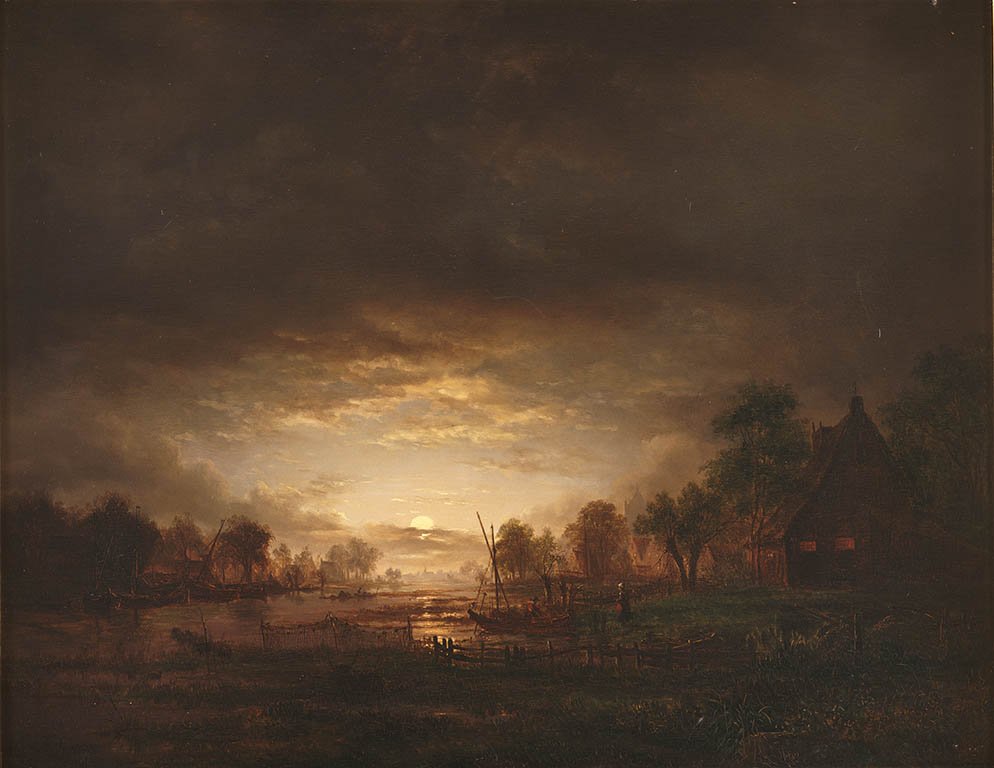
When they depart from their camp among the ruins of the old tower the next morning, all the men of the company are surprised, albeit relieved, that there was not so much as a hint or a rumor of a stringa during the previous night. Perhaps indeed they have given up the chase. So too during the day the landscape begins to change from moorland to marshland, as the dry expanse gradually descends under their feet closer to sea level, and the soil becomes damp and thickly laden in mosses, lichen, and prickly shrubbery of all kinds. Shallow pools stand in the lowest places, clear and cool, reflecting the light of the day with placid face and depths unmoving, collected from the rainwater that falls upon the lands. When the traveling companions draw near to one pool larger than the rest, mostly hidden among tall grasses and reeds, they startle a herd of reindeer, at least twenty in number, which bound out of their enclosure and prance across the field to the south. When the creatures have gone a certain distance, however, they stop and turn back, watching the men in curiosity and caution, their bodies perfectly still and umoving and their gaze turning neither left nor right as if they were captured in paint and canvas or etched in stone. Only after the men have moved on do these stragglers bound after their companions and join the rest of the herd.
“Our supplies are running rather low,” remarks Astër, “and they would make good eating.”
“Perhaps,” says Édvin, “but I would prefer we not waste time on that. Even if you were able to fell one with ease, it would take a good few hours to clean and dress it for preservation. We have come to the river valley that marks the boundary of the Vollrænd and a village should not be far, as long as we have not strayed too far to the north or the south.”
“What village is that?” asks Aeyósha.
“It is called Stûrkas, a quaint and welcoming place, often visited by the caravans passing between east and west, though of permanent residents it can count no more than eighty or a hundred persons in all.”
“We should have no trouble purchasing further provisions there, as well as finding lodging for a night,” continues Égill. “Who knows? Perhaps even this very night.”
And so it is, as the land descends steeply for a league or two before revealing to their eyes a wide valley dense with trees and vegetation with the crystalline line of a river at its heart, glistening in the sun as it weaves its way from south to north before emptying, beyond sight, into the sea. Far on the limit of sight to the west they can make out the rise of the land once again, the end of the river valley and the start of the Vollrænd properly speaking. Before descending fully into the valley, however, they spend a quarter of an hour getting their bearings, as some days back they lost the main road on which travelers would come from Ûlfaeng to the west, something not difficult to do, as in the moorlands the earth is so overgrown with grasses and so littered with stone that only a proper road, cobbled and paved, would survive the wear and tear of time and the seasons. Once they know more or less where they are, the brothers direct them to travel another half an hour to the north, where they find a well-trodden, wheel-marked path weaving its way down into the valley below. As they descend trees rise up to envelop them and soon they find themselves cradled in woodland once again. A breeze from the north begins to blow, rustling among the branches and leaves that are dense overhead, blocking much of the direct light of the sun and allowing it to fall only in speckles and splotches here and there among the undergrowth. In the bowels of the woods it is chilly even in midafternoon, and traveling is slow since the road is heavily rutted from a recent heavy rain, its damp soil clinging to the wheels of the wains and the boots of the travelers. The beasts of burden mewl as if in complaint before, in response to another arrhythmic song and prosaic poem by Égill, they accept their lot patiently and return silently to their toil.
Laughing softly to himself as he rides on the carriage beside Égill, Hældáris takes the lyre again in his hands and, plucking a few strings, sings a song that emerges in the very moment in which he gives it voice:
Hurry, our helpers, hasten on your way
for hay awaits you at the end of day.
Haul your burden, heave and pull, untiring;
you have gone most of the way, aspiring.
A little more and you may fill your gut
in some sheltered cabin, barn, shed, or hut,
and sleep like rocks ‘til your next escapade
with hopefully a lighter cavalcade,
a trip a bit smoother, a bit more fine,
since you won’t be carrying me and mine.
“You had better watch out,” Égill says playfully when the song has ceased. “Too much poetry and music and a man takes flight, unable to keep his feet firmly fixed on the ground. Then we won’t be needing a caravan at all. And too much eloquence and this poor tradesman will begin to doubt the goodness of his own little songs.”
“I could never replace your songs,” says Hældáris, placing a hand on Égill’s shoulder. “Your creatures know your voice unlike any other, and there is nothing I would do to change that. The song was for you, not for them.”
“That, Hældáris, I well understood. Even though I have given it no voice in word or in expression, you have sensed my fear and anxiety, and you have soothed it as well as any man can. I fear what awaits us in days to come.”
“We shall do whatever we can to protect you and your brother. Such is the agreement we made, and we intend to keep it.”
“I just hope that any threat we face will not be beyond you and yours.”
“As do I.”
† † †
As they near the river the trees recede, hewn back to make way for farm and pastureland, and the evening sun casts its last blazing light directly in their faces as it dips below the horizon, soon to bid farewell for the night and to allow the land to plunge into nocturnal darkness. “At this rate we will come to the village just as complete darkness falls,” says Égill to Hældáris who, to give the donkey a bit of a rest, now walks beside the carriage. “There are a few inns in Stûrkas, a great number for a place so small. Often villages of this size have no more than a taberna with a single room, or even simply stables where, if the proprietor is generous, men as well as animals are allowed to stay. But here we may even have the privilege of private rooms—not, of course, that it matters much after so many days on the road, sleeping around a campfire together.”
“How far have we progressed toward your final destination on this journey?” Hældáris asks, his knowledge of the geography of Væliria somewhat lacking.
“Turholm? We are about half way. However, our paths may diverge a little before that, if no reason arises for you to accompany us to the city itself, for the road splits and we must take the southern branch. Your destination, on the other hand, lies to the northwest.”
“I suppose we shall decide when making such a choice becomes necessary.”
In truth they come to Stûrkas before complete darkness has fallen, and this is fortunate as they are able to get a sense of the village’s appearance and layout before retiring for the night. The village, when they approach it, appears not unlike many similar settlements in the land of Telmérion, with small houses of wood or stone with thatched roofs nestled closely together, and even a longhouse in which the village’s reeve must live and conduct his affairs. On the other hand, Stûrkas is quite different in that it is built on both sides of the river, its two sides connected with three lumber-planked bridges, protected from flooding in part by a large weir fifty or so yards upstream. And even from here they can see, a bit beyond the weir, a fishgarth spanning the distance of the river, the current of water bubbling over and around its wooden poles and netting. A few fishermen are at work preparing to haul in the final catch of the day before returning home for the evening.
A large taberna-and-inn, again similar in appearance to those one would find in a larger town or city in Telmérion, greets them shortly after they step among the houses of the village, its sign that of a blue stag on a white background. Outside the building a stocky man with a full beard of hair graying from brown to white greets them, “A caravan coming from the east, are you? Looking for a meal and lodging for the night? We can provide both, and stable for your animals and a guard for your carriages and their goods.”
“Jóharr, it is good to see you again,” says Édvin, stepping down from his wain and extending an arm to grasp that of the man.
“Ah, Édvin, Égill. I did not notice that it was you. How long has it been? Three years?”
“More or less,” says Édvin. “We have not had cause to travel this far north for some time.”
“Better than taking advantage of the business of our competitors,” says Jóharr. “So you will be staying for the night?”
“If you have room for the two of us and the five guardsmen who accompany us,” Égill says, also stepping down from his cart and greeting him.
“Aye, we do. The roads have been troubled of late, with an increase in bandit activity. There have also been other, more groundless, rumors. And affairs to the west have been increasing in seriousness as well. What with the spreading conflict, trade has been disrupted and the price of goods has nigh doubled. All that is to say,” concludes Jóharr with a crooked smile, “that there have not been as many caravans as we are accustomed to receive, and we should have no problem giving room for all of you. How do two rooms sound, divvied up however you deem appropriate?”
“That will be just fine,” replies Édvin. “Payment before as usual?”
“It is our policy.”
While Édvin settles the financial affairs with Jóharr, Égill and the caravan guards lead the donkeys and their wains to a wide alleyway behind the inn, where an armed guard stands watch over stables deep enough for both animals and carriage to be sheltered for the night. Untying the beasts and allowing them to nibble at the hay strewn about, Égill begins to remove from the wains a few boxes containing the most personal or precious items, which even with the armed guard he does not feel comfortable leaving out-of-doors. The five other travelers gather from among their own personal belongings what they might need for the night, and then all together return to the main street. Édvin has already made his way inside, and Jóharr gestures them after him, wishing them a pleasant evening and a restful stay.
By now darkness has cloaked the land and they are cheered by the cozy warmth and light of the room that greets them as they enter the building, a wide atrium with a blazing hearth and chairs and tables strewn about. Along the walls also are cushions on which recline a few travelers, poorer or more frugal folk who cannot afford or do not wish for a more private room and are content to sleep in the main room. Of course, even for its lack of privacy it shall be warmer and perhaps therefore more comfortable than the private chambers, since it alone shall have heat throughout the night. In this respect at least, the practices and customs of the Vælírians are almost exactly the same as those of the Telmérins, even if in so many other areas they diverge. The rowdy and boisterous laughter coming from the far end of the room, where a group of men sits around a table drinking and playing a game of chance, reminds them of some of these differences.
“After the last few days,” remarks Égill, “I could use a bit of lightness and laughter.”
“We all could,” replies Aeyósha with a smile. “The darker it is the more important it is to be light.”
Égill raises his eyebrows and says, “You Telmérins sure do seem to enjoy double meanings and plays-on-words.”
This exchange is cut short by Hældáris who unintentionally interrupts, saying, “What instrument is that?” He gestures across the room to where a woman sits near the hearth with a stringed instrument upon her lap, which she does not pluck but bow, changing the tone by pressing the fingers of her other hand to the strings at different intervals. “That looks as though it would be quite difficult.”
“You have never seen a bowed instrument before?” asks Édvin, approaching the men from another part of the room, where he has been in conversation with someone whom they take to be the wife or sister of Jóharr.
“We have bowed instruments in Telmérion,” replies Hældáris, “just not like that. The sound is beautiful: more rich, full, and subtle than I have yet heard from its like.”
“It is a gjalláfen,” explains Édvin. “Perhaps once we have settled in you may have an opportunity to speak with the performer and ask her about it. She might even let you give it a try.”
“I have never played a bowed instrument before, so I imagine the patrons would not at all appreciate my ‘giving it a try.’ You pluck a string and it makes a sound, but bowing is completely different. This much I know, and I would not want to punctuate the evening with squeaks and squawks.”
Since it is not yet time to retire for the night, the men share a table and order some food and drink, speaking softly of their journey so far and of their plans for its remaining length. Îsáric and the two brothers are the first to push back their chairs from the table and to bid the others farewell for the night. Dágra and Astër follow shortly afterward, leaving Hældáris and Aeyósha alone.
“You seem to be doing better,” says Aeyósha. “I have seen you smiling more and even expressing again your native humor.”
“I suppose I have,” replies Hældáris, “though I cannot say why this is the case. For my grief has hardly lessened, and whenever I call my wife to mind, the pain is like a knife. And I still feel exhausted without cease, as if all my vigor is drained by the constant sorrow that I bear within me. Nonetheless, what you say is true. It has happened entirely unexpected and unbidden. Perhaps it is true that joy truly comes to us only when we are not looking for it.”
“Maybe so. But it brings consolation to my heart to witness the change in you, however subtle it may be.”
“Thank you, my friend, for caring for me, and for walking with me on this journey.”
“I made that choice whenever I decided to depart from Telmérion at your side,” Aeyósha says, “and yet the choice was made for me even more deeply when I survived with you when all else were lost. This mysterious circumstance I see as both a gift and a call, as an undeserved grace and as a task entrusted to me.”
“And this consoles my heart,” Hældáris affirms. “Though do not overburden yourself. You have long been a friend to me. Allow me to be one also to you.”
After this both men sink for a while into thoughtful silence. In fact, they realize that the room has now grown quiet and still as the musician has ceased her playing and the conversations of the other guests are dying down to a final hush or stopping altogether. But a few moments later Jóharr approaches them and says softly, “It is nearly the fourteenth hour. That is our curfew in order to allow those who wish to sleep in the main room to do so. If you wish to remain awake I would ask you to do so in your private rooms.”
“Thank you, Jóharr,” says Hældáris. “We will go to our room. And I imagine we are both more fatigued from our journey than we realize, and a bed shall be enough to help us recognize it.”
“Then may you have a restful night.”
Aeyósha and Hældáris share a room with Dágra while the other four travelers share the adjacent room. Their room-mate is already asleep when they enter, so they prepare for rest and retire in the darkness without another word. Even after he has laid down, however, Hældáris does not slip quickly into slumber. Indeed, even when he hears his friend’s breath slow and deepen, he remains awake, lying on his back with his eyes open, though they behold little more than shadows in the dim moonlight that filters in through the window above his head.
He thinks about Aeyósha’s words and he sees that they are indeed perceptive, revealing once again the tender attunement and watchful eyes and heart of his long-time friend and companion. For though he has not ceased to hurt at the loss of Relmaríndë, nor to bear the unsolvable anxieties and persistent struggles of these previous weeks, Hældáris’ heart has begun to find some measure of rest and peace in surrender and in hope. Perhaps peace and joy indeed come unbidden and unexpected, born not of grasping but of acceptance. With this thought he feels sleep begin to overtake him.
† † †
He is awakened to a painful pressure against his chest and a firm hand placed upon his mouth. Opening his eyes he sees in the dim moonlight the shape of a figure leaning over him, its face close to his own though indistinguishable. Only when a mouth opens and fang-like teeth give hint of their presence does Hældáris, still groggy with sleep, understand. Squirming his body in the attempt to get free and groaning to get the attention of his companions, he watches helplessly as the stringa inclines its head to bite him. With a surge of energy he is able to free his right arm, and with it he swings hard, placing a blow against the side of the stringa’s head and shifting their weight off of himself enough for him to rise to a sitting position. At this moment a cloud moves from before the moon and pale light shines full into the room; in its luminescence he makes out more clearly the form of a man, his flesh sallow as if hanging too loosely over muscle and bone, giving him a skeletal appearance, and in his face eyes that glow subtly with a sickly hue. He is wrapped in a black cloak that enshrouds him from neck to feet, with a hood that until moments ago was pulled up but has now fallen back as he was forced off Hældáris’ body.
“Help!” Hældáris cries once he has regained breath and voice, even as he shifts his body away from the stringa and tries to rise to his feet. Hands are extended toward his throat and the stringa leaps upon him with surprising agility; and both together tumble from the bed onto the floor. A vicious contest of strength ensues as the man, apparently furious from his failed attempt to drain his victim unawares, wrestles like a wild animal, and Hældáris, finally awakening again to his full bodily strength, fends him off. But even so, the hands find their way around his neck and he feels the breath being squeezed from his body.
“Who is it?” cries a voice. It belongs to Dágra. “What is happening?”
Hældáris tries to speak but only a gurgling sound emerges, even as the stringa goes still, as if trying to mask his presence until his victim is dead. But the effort to combine stealth with strength opens up a weakness in the stringa’s strategy, and Hældáris takes advantage of this, shifting his hips until one of his legs becomes free enough to ram into the man’s body, pushing him away. This is just enough to force the stringa’s hands to loosen their hold on Hældáris for a single moment, a moment just long enough for him to breathlessly cry, “Stringa!”
This is all that his companion needs. Even in the dark Dágra is able to act, and only an instant passes before there is the sound of a blade entering flesh, and the stringa cries out in pain. Then he slumps limply upon Hældáris, who gently rolls him aside onto the floor and pushes himself into a sitting position. A hand is extended to him in the dim moonlight and Dágra pulls him to his feet.
“Well, that was a close call,” says the latter. “I am glad that I sleep always with a blade at my side. Wait, you were not bitten, were you?”
“No, I think not,” replies Hældáris, inhaling deeply to catch his breath.
“My brothers, what is it that I missed?” The voice of Aeyósha emerges from his side of the room, and they hear his shuffling as he rises from bed. A moment later there is a flash of light and then a steady radiance as he ignites an oil lamp, holding it aloft.
“The hunt is over,” says Hældáris, “but only just in time.”
“You slew the stringa?” Aeyósha asks.
“That was Dágra’s doing.”
“Then you have done what I wish I could have done: protected my dearest friend. Thank you.”
“Let us move the body,” says Dágra. “I do not wish to return to sleep with a corpse in our room.”
“It must be in the heart of the night,” says Hældáris. “I do not wish to disturb the other guests. Shall we try to pass him through the window?”
“That is clearly how he entered.”
“I did not expect,” Aeyósha observes with a sigh, “that we would be attacked indoors after so many nights in the open.”
“I suspect that was precisely his plan, to attack when we were divided.”
Pushing open the window pane, which swings sideways on silent hinges, Hældáris climbs through the window and turns back, as Aeyósha and Dágra lift the body and prepare to pass it through.
“Wait!” calls Aeyósha. “Do you hear him breathing still?”
At this moment many things happen so quickly that Hældáris has hardly time to climb again through the window before they have run their course. The stringa twists his body so violently in the hands of the two men that they drop him to the floor, and before either of them can react he rises again to his feet and leaps upon Dágra, knocking him from his feet and onto the nearest bed. There is a cry from Dágra and then an angry roar from Aeyósha, who lays hold of the stringa from behind and, with great strength, wrenches him from his victim and throws him across the room until he hits the opposite wall. Taking in his hands the lightbringer from where it leans against the foot of Hældáris’ bed, he bares its blade and advances on the man, while Hældáris leans over Dágra. Lifting him again to his feet they turn together to Aeyósha and the stringa, to see this now through to the end.
“For my sister I shall slay each one of you,” comes a voice of cold malice and age-old hate, hoarse and yet as sharp as a blade’s edge. “I would have been content with the light-bearing one, but now you leave me no choice.”
“How are you not slain?” asks Dágra, holding his neck as blood trickles through his fingers. Hældáris notices this with grief and horror, though the moment does not allow him to remark upon it. For the stringa leaps again from where he crouches against the wall, and were Aeyósha not such a skilled warrior, and were he not also able to channel the light, the man would have had yet another victim. But the blade of the king’s sword buries itself deeply in the man’s torso, and as it emerges on the other side it glows faintly with bluish light.
“No… You are not the one. How?” Collapsing to his knees with the sword still embedded in him, the stringa cries out in fury and anguish. “Sister! Flee while you can!” And with this the life leaves him for the last time, and his undead existence, prolonged so long beyond natural human span, comes to an end. The sallow flesh of his face, pulled taut over bones far too old, immediately begins to sag before the eyes of the three men, as if upon being slain he ages decades in but a few moments and returns to the domain of mortal flesh, his body passing into the repose of death, and his spirit at last released into the journey beyond.
“He spoke of his sister,” says Aeyósha, and without a moment’s hesitation he climbs through the open window with the sword in his hand. Hældáris on the other hand turns to Dágra and helps him to sit upon the bed. Taking the lantern in his hands he holds it up and inspects the mercenary’s neck.
“He bit you,” he observes sadly, stating the obvious but with serious implication, not knowing what other words would be appropriate.
“He bit not to drain me of life in order to fuel his own, but simply to poison me,” says Dágra, his voice surprisingly calm, though it trembles ever so slightly. “He got his revenge, though I am glad we were able to stop him before the end.”
“Is there no way to stymie the spread of the poison or to stop its effects?”
“Y-you have already been told the answer to that question. At least as far as our knowledge goes, it is impossible.”
“But that does not mean we cannot try. How long do you have before you succumb?”
“But a few hours… If I am lucky, a day.” Even as he speaks it is clear that Dágra is being overwhelmed by the toxin inside of him, and his body slumps as if he is too weak to hold it up. Hældáris gently helps him lie down on the bed—Dágra’s own—and then gently squeezes the area around the marks of the stringa’s bite in the vain hope of expelling some of the toxin. Nothing comes but dark red blood, its metallic scent strong in the room, mingling with the bitter, unnatural scent of the blood of the stringa that pools on the floor beside them.
“You saved my life, Dágra,” Hældáris remarks, “and at the cost of your own.”
“Hush. I am glad that I was able to do something for you before we parted ways. Y-you cling to that…light…won’t you?” His eyes flutter and close and his head lulls to the side, and then, as if mustering himself, he continues, “I wish we could have spoken more and shared many beautiful conversations. But perhaps…”
“Yes,” says Hældáris, finishing for him even as he loses consciousness, “in the next life.”
† † †
Aeyósha returns a quarter of an hour later, not through the window but through the door, and their companions are with him, and Jóharr as well. “I searched for her but I could not find her,” he says. “I do not know if what he said in his parting words was simply a gesture of brotherly devotion or if he expected her to hear his voice and to flee. When daylight comes we can inspect the surroundings for any clues. Until then, I suppose we can clean up this mess.”
“And I will inform the guardsmen at first light,” says Jóharr.
“There is something more pressing and more grievous at this moment,” interjects Hældáris, as none of the others have noticed the state of Dágra.
Astër steps forward, startled, “Dágra? What happened to you?” Kneeling at the bedside he places a hand upon his companion’s brow. “He was bitten… I see it now.”
“Yes. I am sorry.”
“Then there is nothing we can do. His flesh already grows cold and the life leaves him.”
Dágra’s traveling companions remain in vigil at his bedside through the rest of the night until, as the first rays of dawn shine in through the window, dancing in warm hues upon the opposite wall, he passes from this world.
He and his killer are laid out in an empty room in a nearby house as preparations are made to inter or dispose of their mortal remains. Some suggest burning the body of the stringa and burying Dágra here in the village. Others suggest burning both of the bodies, one as a purgation and one as an honorable effigy. At last the decision is made by Astër. “He has a wife and a son in his hometown of Elûric. I wish to send his remains back to them to be mourned and buried where they belong. Let us burn his corpse and collect the ashes. As for the monster, do with it whatever you wish. I care not.”
“You have a family, Dágra, who even now awaits your return,” Hældáris says under his breath, addressing the deceased man. “How I wish I could have come to know you more deeply before you were taken away.” And then, turning to speak to Astër, he asks, “How far away is his home? I would visit his family with my condolences if I could.”
“I fear it will not be an acceptable detour for your journey, which in your mind is so pressing. It is quite in the opposite direction. But worry not, I shall deliver the condolences myself.”
“Very well then. But at least allow me to send a letter with you.”
“As you wish.”
As for the body of the stringa—a man long bound to powers of darkness who dies nameless among strangers—it is burned and buried in an unmarked grave. Hældáris and Aeyósha stand over the grave for some moments after the unceremonious burial, wishing that they knew the man’s name and could speak it in their silent prayers that he would find mercy and new life after his countless years of living death.
And then it is done, and fatigue descends upon them with a vengeance after the intense events of the previous night and morning. As they walk back toward the inn-and-taberna, a man in a heavy mail hauberk and helmet, with a sword at his waist, hails them. “Greetings,” he says, “My name is Réllic. I am the captain of the guard.” And after they have introduced themselves, he continues, “I may have some leads as to the ‘sister’ of whom the creature spoke, if it is in your interest to pursue her. There are two things that may be of assistance to you, and in fact of assistance to us, if you agree to my proposal. First, we did indeed find a set of tracks leading away from the window of your room, though we stopped following them a few hundred meters into the woodland to the east, though it seems they lead further still. Thus I would suppose that ‘she’ was here during the attack, as we thought, and that she fled at the bidding of her brother. Second, considering the direction of the footprints and our prior knowledge of these creatures, we have a suspicion that they in fact have a lair somewhere nearby, and that it would be possible to track her to it.”
“What makes you think that?” asks Aeyósha. “We were first set upon by their hounds some days back, further to the east. Surely they would not canvass such an expanse, would they?”
“In fact they would,” explains Réllic. “It is the manner of stringr to hunt in many locations, as they become hated and hunted themselves in all places where they make their presence known. I expect that they have numerous lairs. If you make haste, you may yet find her before she departs from this one, and bring an end to this affair once and for all.”
“You said that we may be of assistance to you,” remarks Hældáris. “Is that what you meant?”
“Aye. We have suffered stringr attacks for many years past, and have never been able to do more than limit them by preventative measures. It seems even those were not enough last night. I am sorry about your companion, but we are relieved that a stringa has been slain, and would hope to see the same for the other as well. Or if you wish not to slay it, at least capture it and allow us to bring it to justice. This may bring some measure of peace and security to our village. Will you do it?”
“Can you not spare any of your own men at arms to accomplish this task?” asks Aeyósha.
“I fear we have not the power to bring down a creature such as this. We have tried before and failed, and none of my men wish to relive such an experience,” Réllic says, and though he speaks tersely and as if with reluctance, it is clear that he will not change his mind on this matter. “Were you to bind her and bring her to us, however, we could handle the rest. Until then, I shall redouble the guard on the village, awaiting your return, as we fear an attack in retribution, either from her or from her kin. And it goes without saying that a handsome reward shall be yours upon your successful return.”
“It is an unpleasant business,” says Hældáris, “but also necessary, that those who harm the innocent must be stopped.” He shares a glance with Aeyósha. “Though we regret the lack of assistance, we are willing to aid you nonetheless. We shall seek this stringa and judge for ourselves, are we granted to find her, what ought to be done.”